Fish Stress Index Calculator
Estimate overall catch and release stress from water quality, fight intensity, air exposure, handling style, salinity change, and the flow available for recovery.
🎯Catch and handling presets
⚙Stress inputs
Stress estimate
Calculation breakdown
📊Species and stress grid
Trout / Salmon
Walleye / Perch
Bass / Sunfish
Catfish / Carp
Pike / Muskie
Redfish / Snook
Tarpon / Permit
Striper / Bluefish
📋Reference tables
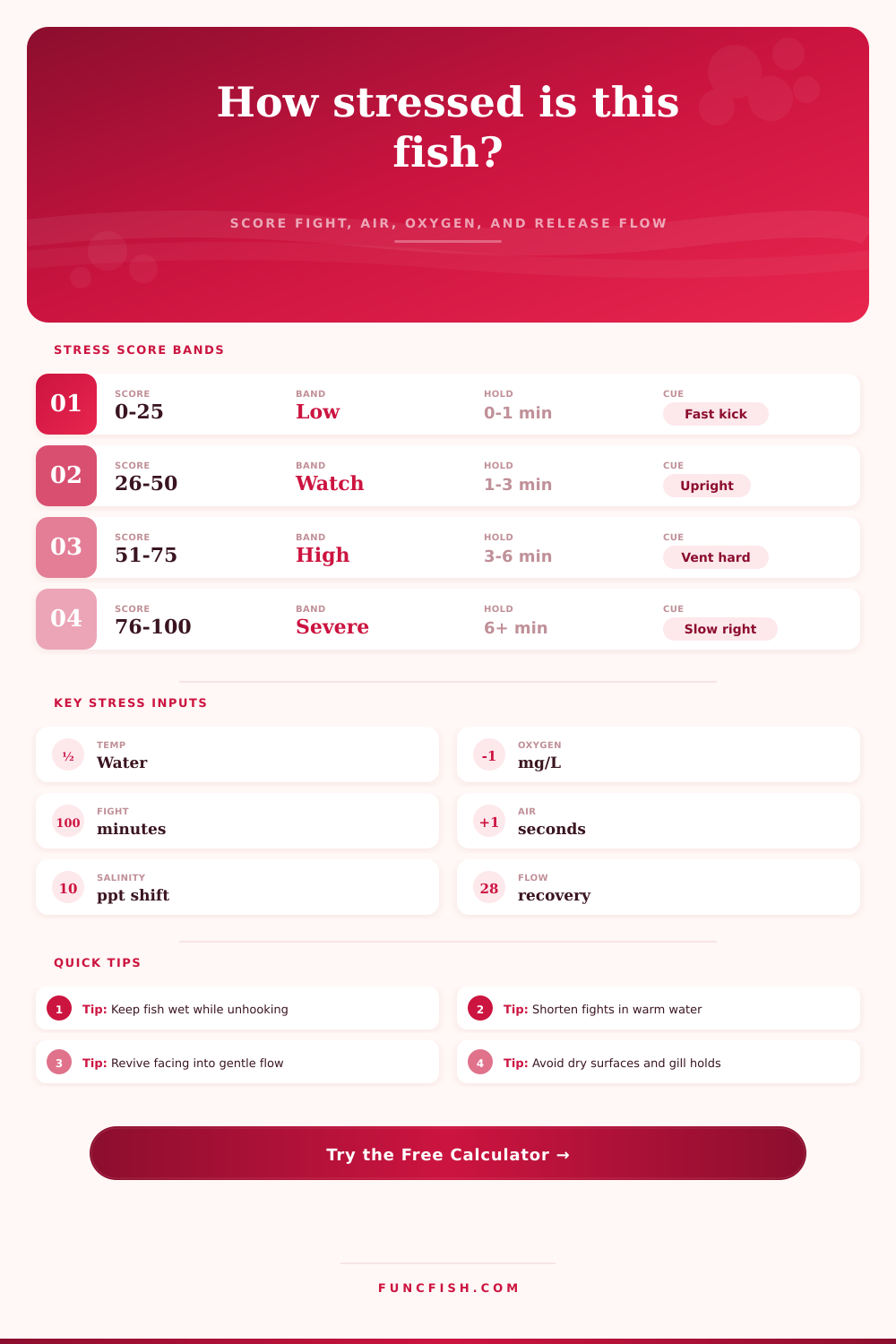
| Stress band | Score range | Release cue | Recovery action |
|---|---|---|---|
| Low | 0-25 | Firm kick, upright | Short hold or direct release |
| Watch | 26-50 | Breathing fast | Hold until steady balance |
| High | 51-75 | Slow righting | Nose-first support in flow |
| Severe | 76-100 | Weak movement | Extended recovery and careful judgment |
| Water condition | Low stress | Moderate stress | High stress trigger |
|---|---|---|---|
| Coldwater fish temp | 46-62°F | 63-68°F | Above 68°F |
| Warmwater fish temp | 60-82°F | 83-88°F | Above 88°F |
| Dissolved oxygen | Above target | 1-2 mg/L low | Near critical value |
| Salinity shift | Within tolerance | Half tolerance | Above tolerance |
| Fight and air exposure | Lower load | Watch zone | Heavy load |
|---|---|---|---|
| Small resident fish | Under 1 min | 1-3 min | Over 3 min |
| Large freshwater fish | Under 3 min | 3-7 min | Over 7 min |
| Strong saltwater fish | Under 5 min | 5-12 min | Over 12 min |
| Air exposure | Under limit | Limit to 2x | Above 2x limit |
| Handling or flow | Multiplier | Stress effect | Best use |
|---|---|---|---|
| In-water unhooking | 0.75 | Reduces handling load | Fragile or warm-water catches |
| Wet rubber net | 0.90 | Protects slime coat | Photo and quick measurement |
| Deck or bank contact | 1.55 | Raises abrasion load | Avoid when release matters |
| Steady recovery flow | 0.82 | Improves oxygen exchange | Nose-first revival |
💡Release checks
Tip: If temperature or oxygen is the main driver, shorten the next fight and keep the fish submerged during hook removal.
Tip: If handling or air exposure is the main driver, prepare pliers, measuring board, camera, and release path before lifting the fish.
From the instant it breaches the water’s surface until it hits your hand, it’s under your care, and the clock starts ticking on its life. It’s not just about landing catch; it’s about what happens in those next 90 seconds.
Stress is a measurable physiological load… Not a feeling. Anglers mistake what they “feel” for stress when in fact it’s result of accumulated loads from handling, fight time, oxygen level and temperature. This tool measure that load. It translates invisible variables into something you can act on.
How to Keep Fish Alive After Catching Them
But probably most perilous of all is water temperature. Seventy degrees is often on the limit of coldwater species like trout. They burns through oxygen reserves quickly. Their metabolism also increase. If there’s not much dissolved oxygen… As is common in warm, stagnant water, it goes downhill quick. That’s why those environmental factor are weighted so heavily by the calculator; that’s the baseline of how tolerant to stress a fish is. Perfect technique doesn’t matter. If water is too warm and low in oxygen when you hook into the fish, it’s game over for them.
There’s also big variable of fight time and that doesn’t always mean minutes on the clock. Five minutes in cold water with a catfish won’t hurt him much. Five minutes in warm water with trout will be deadly. So this tool takes into account how tolerant each fish is to fighting. How does their physiology differ from a bass vs. Pike vs. Striper? Presets come in handy here too as they provide starting point for typical situations. No need to guess the numbers, the model figure out the coefficients for you.
Oxygen is not always understood. When an angler lifts a fish out to remove a hook or take a photo they don’t realize what they’re doing. Time in air removes its protective slime coat every second. Air exposure collapses gill tissue and causes it to stick together, it will decrease oxygen exchange effectiveness. For saltwater species such as tarpon, which are particularly prone to drying out, the calculator severely penalizes time in the air. A matter of seconds changes a low stress band to a high stress band. Just check out quick change of bands in the reference tables. Low stress becomes watch status, then high, then severe. It happens fast.
How you handle it is just as important than how it fights. Mucus comes off on dry hands immediately. A wet rubber net or wet hands retain the slime coat. Unhooking them in water is best for the fish’s survival. Minimize physical handling while keeping it in its element. The lower score is given for in-water methods with the tool. Dragging the fish on a hot boat deck increase stress by raising the stress multiplier. Now you’re not only adding thermal shock but also abrasions too. The results breakdown shows which of these component drive the score. If your primary driver is handling, adjust your method. Barbless hooks will allow faster release. Submerge the fish.
Finally, there is recovery flow. Oxygen rich water moving over the gill of a stressed fish are vital. If you are holding a fish in a net in slack water you are not helping it recover. That lets the fish exhaust itself. Hold the fish with its nose facing into steady current. This allows water to flow over gills naturaly to help it recover. The calculator consider how much recovery time is required when estimating hold time. More recovery time is needed if the score is high. If the score is low a quick release is fine.
So it’s not about not fishing; it’s about fishing smarter. Knowing those factors allows you to make better on-the-water decisions. In warm water, maybe you’ll shorten your fight. When oxygen is low, maybe you won’t snap a photo. Maybe when removing hooks, you’ll keep the fish wet. Those little tweaks accumulate. They’re what decide if that fish lives or dies slowly. This calculator gives you the information, then it’s your skill that executes. Both working together keep that fish alive. And that is all that matters.