Fish Thermal Stress Index Calculator
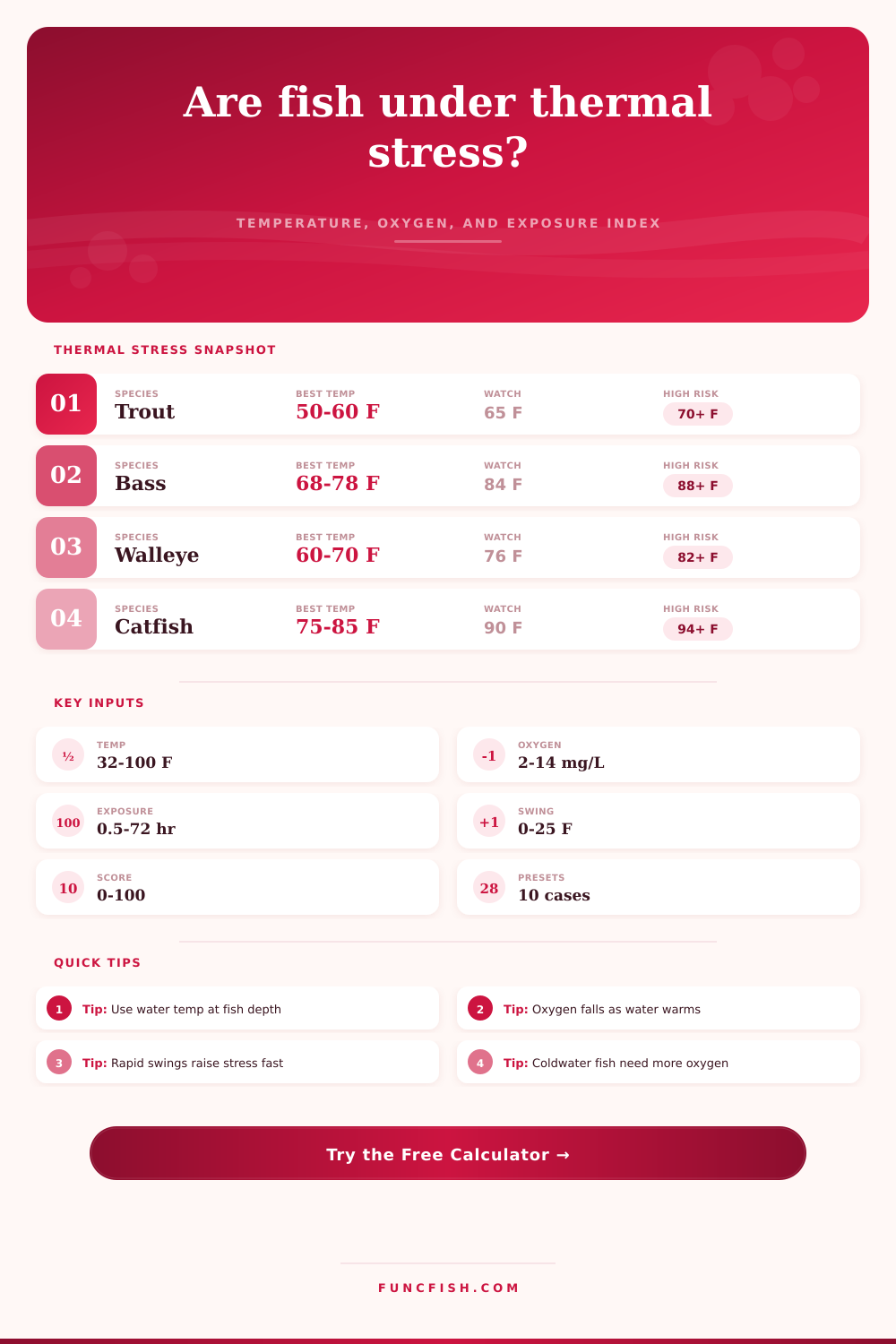
Estimate a 0 to 100 thermal stress index from species tolerance, water temperature, dissolved oxygen, exposure duration, and recent temperature change.
📌Thermal stress presets
⚙Thermal stress inputs
Thermal stress index results
Formula breakdown
🐟Species comparison grid
Coldwater
Coolwater
Warmwater
Tropical
📊Reference tables
| Species group | Preferred range | Watch zone | High stress zone | Thermal style |
|---|---|---|---|---|
| Rainbow / brown trout | 50 to 60°F / 10.0 to 15.6°C | 61 to 65°F / 16.1 to 18.3°C | 66°F+ / 18.9°C+ | Coldwater, oxygen sensitive |
| Salmon / steelhead | 48 to 58°F / 8.9 to 14.4°C | 59 to 64°F / 15.0 to 17.8°C | 65°F+ / 18.3°C+ | Coldwater migratory |
| Walleye / sauger | 60 to 70°F / 15.6 to 21.1°C | 71 to 76°F / 21.7 to 24.4°C | 77°F+ / 25.0°C+ | Coolwater, moderate oxygen need |
| Bass | 68 to 78°F / 20.0 to 25.6°C | 79 to 84°F / 26.1 to 28.9°C | 85°F+ / 29.4°C+ | Warmwater, broad tolerance |
| Channel catfish | 75 to 85°F / 23.9 to 29.4°C | 86 to 90°F / 30.0 to 32.2°C | 91°F+ / 32.8°C+ | Warmwater, tolerant but oxygen limited |
| Tilapia | 78 to 86°F / 25.6 to 30.0°C | 70 to 77 or 87 to 91°F | Below 64 or above 94°F | Tropical, cold sensitive |
| FTSI score | Band | Meaning | Fishing / holding read | Priority |
|---|---|---|---|---|
| 0 to 20 | Low | Inside normal thermal window | Routine observation is usually enough | Normal |
| 21 to 40 | Watch | One stress factor is starting to matter | Shorten handling and watch oxygen | Moderate |
| 41 to 60 | Elevated | Thermal or oxygen load is material | Reduce hold time and avoid extra stress | High |
| 61 to 80 | Severe | Multiple stress factors are stacked | Cooling, flow, shade, or release urgency rises | Very high |
| 81 to 100 | Critical | Near edge of practical tolerance | Immediate corrective action is warranted | Immediate |
| Dissolved oxygen | Coldwater read | Coolwater read | Warmwater read | Stress effect |
|---|---|---|---|---|
| 8.0 mg/L plus | Strong buffer | Strong buffer | Excellent | Little oxygen penalty |
| 6.0 to 7.9 mg/L | Acceptable to watch | Good | Good | Small penalty for coldwater fish |
| 4.0 to 5.9 mg/L | Stressful | Watch closely | Usable but narrowing | Moderate penalty |
| 2.5 to 3.9 mg/L | High risk | High risk | Stressful | Large penalty |
| Below 2.5 mg/L | Critical | Critical | Critical | Index climbs sharply |
| Comparison factor | Low stress example | Higher stress example | Why it matters | Index role |
|---|---|---|---|---|
| Temperature gap | Inside preferred range | Near upper or lower edge | Metabolism and respiration shift quickly | Main thermal score |
| Acclimation gap | 2°F / 1.1°C change | 10°F / 5.6°C change | Rapid change limits adjustment time | Acute-change score |
| Exposure duration | Less than 1 hour | All afternoon or overnight | Stress load accumulates over time | Duration multiplier |
| Handling load | Undisturbed fish | Crowded livewell or transport | Activity and confinement raise oxygen demand | Handling add-on |
| Oxygen margin | Above species target | Below minimum comfort level | Warm stress gets worse when oxygen drops | Oxygen penalty |
💡Calculator notes
Temperature tip: Use a probe reading from the actual holding depth when possible. Surface water can be several degrees warmer than the zone fish are using.
Oxygen tip: Treat the oxygen result as a buffer check. A warm but oxygen-rich system may score lower than a slightly cooler system with poor aeration.
It’s an afternoon in July. You’re standing on bank of a shallow cove. Your livewell hums with bass, which slap surface as you look on. The air is sticky and heavy. You dip your probe into water and read eighty-two degrees. Eighty-two degrees. Sounds fine, right? Bass is warmwater fish after all. But you have three hours ahead of you trying to keep these fish alive. Oxygen depletes and that sun bake the bank. That’s when instinct breaks down and data prevails.
Plug numbers into calculator above and let it do the math. Let it turn your vague unease into a specific stress index. Decide if you should release now, or hold ’em awhile longer.
Why Fish Get Stressed
Temperature isn’t always sole variable when it comes to thermal stress. There are other factors. A combination of variables work against fish physiology. Warmer water carries less oxygen. People often overlook this fact until it’s too late.
Fish may have been swimming along happily at sixty-degree water temperatures because that water was loaded with oxygen. Then you increases that water to seventy-degrees. You take out almost half of the oxygen-carrying capacity of that water. Now throw some handling stress on top of them and you’ve created a perfect storm. Their energy use spike from handling stress, which increase their oxygen demand. The fish is not dying because the water is hot. The fish is dying because it’s suffocating in water that used to support it.
For that reason, dissolved oxygen input is important. On paper, five milligrams per liter seems fine for most other species. But let’s say you’re holding a trophy bass. Conditions are now different than before. The fish has been crowded, netted, and held for four hours. In this situation, five milligrams doesn’t give their gills much to work with at all. The tool accounts for this by also penalizing low oxygen readings, especially for species that prefer cooler water. Warm water + low oxygen = trouble. And you don’t have to be a chemist to get it. Just measure it.
Another silent killer is temperature swing. Water heated by shallow banks in the morning sun can drop rapidly as clouds roll in or wind mixes cooler deep water up to surface. Wind brings cooler deeper water to the top, or clouds move in and cool things off. A ten-degree change in one day shocks a fish used to a steady environment. Its body cannot adjust enzyme production fast enough to compensate. This sharp change put a shock load on a fish that compounds over time. The calculator will look at the difference between current temp and the acclimation temp. It will also make sure a sudden spike is rated as high stress. Even though final number may not be technicaly lethal.
The handling makes all the difference Fish in open water where they aren’t disturbed can generally tolerate slightly worse conditions. Fish stacked up in a transport tank or livewell will struggle even more. Their oxygen gets low, carbon dioxide builds up. Physical fatigue is increased as well. When handling and transporting fish, you really need to watch the stress index very closely. What may be tolerable for a casual catch-and-release angler might kill transported fish. The stress index gives you an idea of how much of a risk there is to it.
You’ll see that there are multipliers based off the severity of the handling. That’s so you don’t undershoot the price you’re paying by confining the fish. That’s where the reference table found on the page comes in. They grouped species by category. These categories includes tropical, warmwater, coolwater, and coldwater. From there you know the baseline tolerance. For example trout need a safety buffer while a bass doesn’t. Pike don’t fare well in the heat like tilapia can. Knowing what species you’re dealing with will help you figure out what to do based upon the final score. Forty may be time to watchful wait for catfish. But forty could of be time to take immediate action for salmon.
At the end of the day it’s all about making the window of opportunity larger. Oxygen levels, water temps and time are the invisible pressures you put a number to. It helps you make more informed decisions. When to let go. When to hold on.
Stressing out a fish is cumulative. And by the time you notice overt signs of distress it may be too late. By measuring these variables before they begin to stack up you can take early steps. Act not react.
The next time you experience a hot, sticky day, know there are things going on in the water that you just can’t sense with your own senses. Get out the numbers and pay attention to the limits. Let the fish breathe. Let them get what they need to get through the day.