🐟 Fish Weight Calculator
Estimate fish weight from length & girth — supports 10+ species, imperial & metric
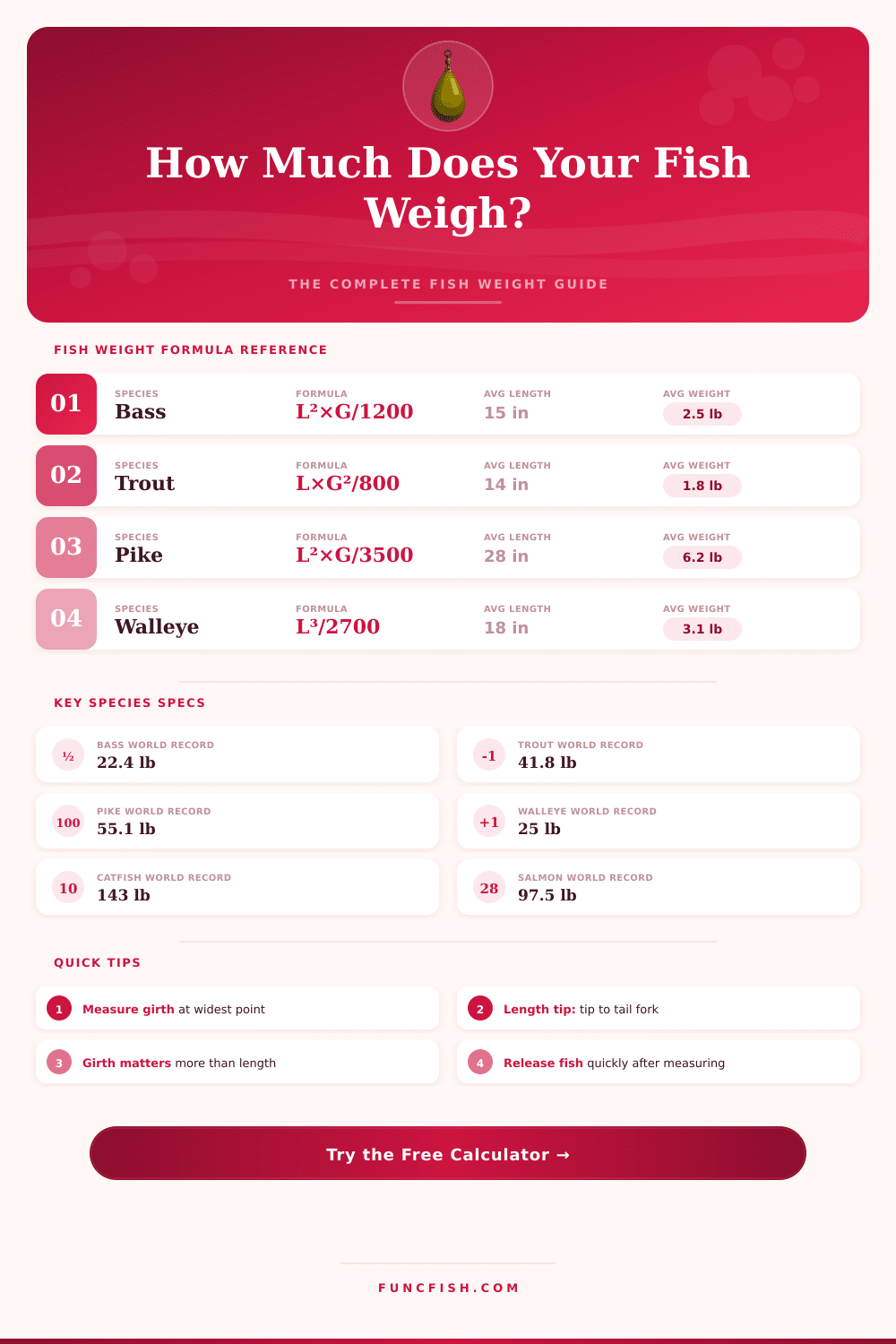
| Species | Typical Length Range | Typical Weight | World Record | Formula Divisor |
|---|---|---|---|---|
| Largemouth Bass | 10–24 in (25–61 cm) | 0.5–8 lb (0.2–3.6 kg) | 22.4 lb (10.1 kg) | 800 |
| Smallmouth Bass | 8–20 in (20–51 cm) | 0.5–5 lb (0.2–2.3 kg) | 11.9 lb (5.4 kg) | 900 |
| Rainbow Trout | 10–20 in (25–51 cm) | 0.5–5 lb (0.2–2.3 kg) | 48 lb (21.7 kg) | 900 |
| Brown Trout | 10–22 in (25–56 cm) | 0.5–6 lb (0.2–2.7 kg) | 41.4 lb (18.7 kg) | 950 |
| Walleye | 12–28 in (30–71 cm) | 1–10 lb (0.4–4.5 kg) | 25 lb (11.3 kg) | 2700 |
| Northern Pike | 20–40 in (51–102 cm) | 2–20 lb (0.9–9 kg) | 55.1 lb (25 kg) | 3500 |
| Muskellunge | 30–50 in (76–127 cm) | 5–30 lb (2.3–13.6 kg) | 67.5 lb (30.6 kg) | 3200 |
| Channel Catfish | 12–36 in (30–91 cm) | 1–20 lb (0.4–9 kg) | 58 lb (26.3 kg) | 1000 |
| Striped Bass | 18–40 in (46–102 cm) | 3–30 lb (1.3–13.6 kg) | 81.9 lb (37.1 kg) | 1200 |
| Chinook Salmon | 20–40 in (51–102 cm) | 5–40 lb (2.3–18 kg) | 97.5 lb (44.2 kg) | 1100 |
| Bluegill | 4–12 in (10–30 cm) | 0.1–2 lb (0.04–0.9 kg) | 4.7 lb (2.1 kg) | 1200 |
| Crappie | 6–14 in (15–36 cm) | 0.2–3 lb (0.09–1.4 kg) | 5 lb (2.3 kg) | 1500 |
| Formula Type | Formula | Best For | Accuracy | Notes |
|---|---|---|---|---|
| Standard Girth | L x G² / Divisor | All species | ★★★★☆ | Most accurate with girth |
| Length-Only | L³ / Divisor | When girth unknown | ★★★☆☆ | Estimates avg body shape |
| Weight Watchers | (L x G²) / 800 | Bass species | ★★★★★ | Bass-specific formula |
| Metric (Ricker) | W = a x L^b | Research/science | ★★★★★ | Requires species coefficients |
| Fish Length (in) | Fish Length (cm) | Est. Girth (in) — Bass/Trout | Est. Girth (in) — Pike/Walleye | Girth Ratio |
|---|---|---|---|---|
| 10 in | 25.4 cm | 7.5 in | 6.0 in | ~0.60–0.75 |
| 14 in | 35.6 cm | 10.0 in | 8.0 in | ~0.57–0.71 |
| 18 in | 45.7 cm | 13.0 in | 10.0 in | ~0.56–0.72 |
| 22 in | 55.9 cm | 15.5 in | 12.0 in | ~0.55–0.70 |
| 28 in | 71.1 cm | 19.0 in | 14.5 in | ~0.52–0.68 |
| 36 in | 91.4 cm | 24.0 in | 18.0 in | ~0.50–0.67 |
| 40 in | 101.6 cm | 26.0 in | 20.0 in | ~0.50–0.65 |
Get crisp skin on Fish fillets requires attention. When the fillet touches the hot pan, it tends to curl upward. That results in uneven cooking and soft skin.
Using Fish Weight one can fix that by flattening the fillet and pressing it down. So the skin gets a chance to crisp up, while the flesh cooks evenly. The Weight spreads equally over the whole surface.
Use a Fish Weight to Make Fillets Flat and Crisp
At first look, Fish Weight looks like a burger press. There are samples from stainless steel, that weigh around 1.8 kg, so almost 4 pounds.
Rating of Fish mass without use of Weight is a whole otehr cause. A common method for tricks is made up of taking the length, multiply it by the square of the girth and later divide by 800. The divider goes up or down according to whether the Fish weighs more or less than average.
However such calculations not always prove reliable. Thin and fat Fish of same length can have very different masses. Length alone does not suffice for a good estimate of Weight, especially for species like the pike.
Apps exist for help in that. One free program works without net, and you just need to enter the length and girth of the body. It counts the mass using trusted equations.
For direct weighing of Fish, Weight with whole lip grip works well. The setup keeps flat the center of the bottom jaw. At Weight with a simple hook, one can add a separate lip grip and take away its own mass.
Fish truly can lose Weight after capture. Bleeding, vomiting and waste our possible reasons. But usually the main cause is loss of water.
Alive Fish lives in water and always tries to keep proper water balance in its body through regulation.
Some anglers like to measure length instead of Weight. Mass changes easily up or down, but Fish length never shrinks. Keeping Fish outside water too long also hurts.
A good rule says: do not leave it outside more than the time that people can hold their breath.
Cod gives a funny sample about weights of little Fish. The average mass of more than 144 cods resulted in around 2.38 units for one Fish, all males. So roughly 6.75 cods in one pound.
The ratio of fillet to whole Fish mass is another interesting spot. A common guess says that fillet forms around 40 percent of the whole mass, without counting bellies, although exact data not always easilypresent.
Fish widely carries a lot of protein, little fat and few calories. Most species have only 1 to 5 percent of fat. Even so eating only Fish for a long time is not a good idea.
A diet low in fat can cause dry skin, hormone problems, hard focus, headaches and constant hunger.