Fishing Knot Rating Efficiency Calculator
Score how efficiently a fishing knot matches your line material, diameter, wraps, lubrication, seating, repeated load, target application, and safety factor, then translate the setup into a simple grade and rig-fit score.
📌Knot-efficiency presets
⚙Knot, line, and rig inputs
Knot rating results
Adjust the inputs or choose a preset to score the knot setup.
Calculation breakdown
💧Line material efficiency grid
Nylon Mono
Fluorocarbon
Braided PE
Wire Leader
📊Knot and application comparison grid
📋Reference tables
| Knot type | Best application | Mono score | Fluoro score | Braid score | Ideal wraps |
|---|---|---|---|---|---|
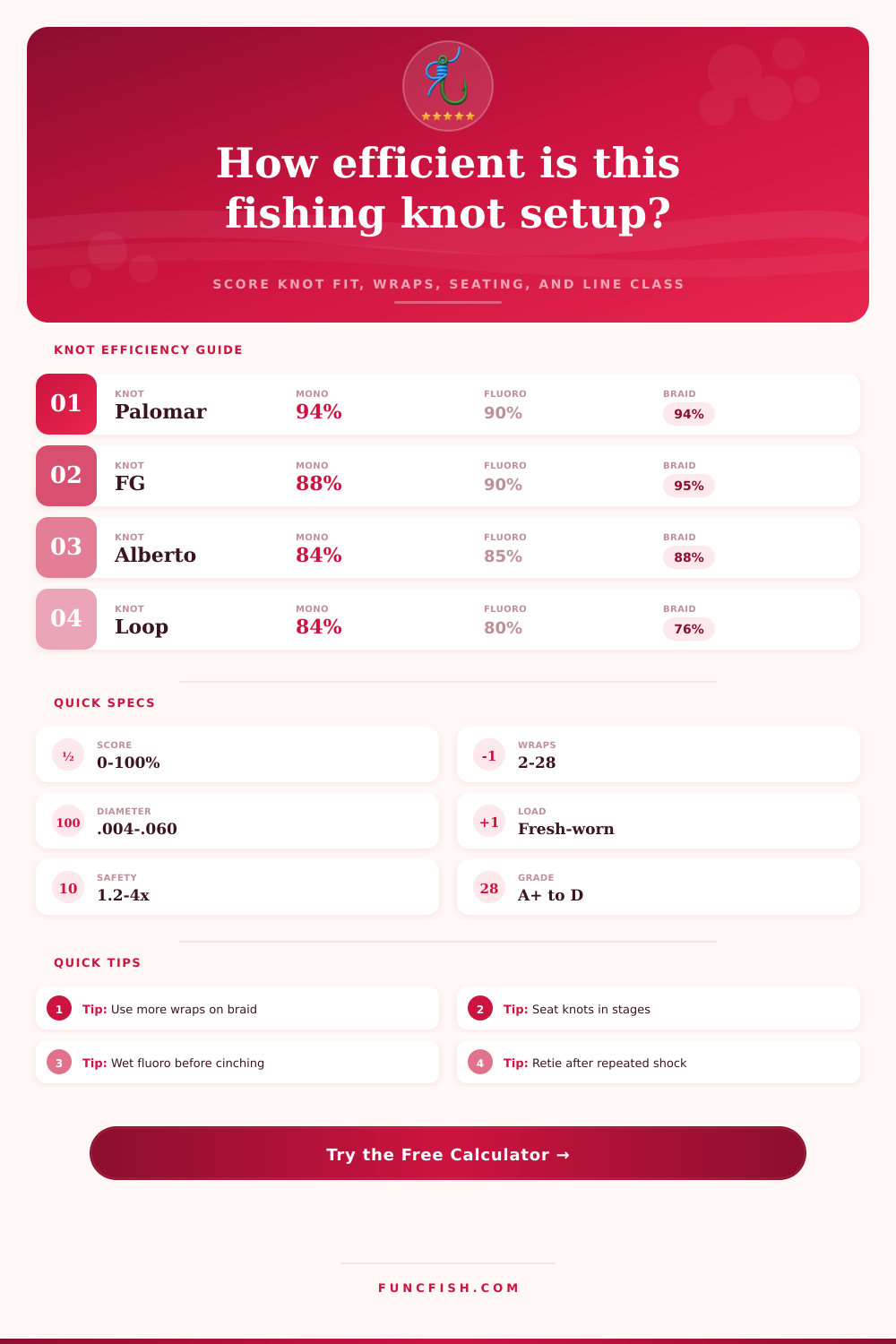
| Palomar | Terminal hooks, lures, swivels | 94 | 90 | 94 | 2 doubled passes |
| Improved clinch | Light mono terminal knots | 86 | 82 | 68 | 5-7 turns |
| Uni | All-purpose terminal and leader use | 88 | 85 | 82 | 6-9 turns |
| Double uni | Simple line-to-leader connections | 86 | 84 | 80 | 7-10 turns |
| FG | Braid to mono or fluoro leader | 88 | 90 | 95 | 16-24 wraps |
| Alberto | Compact leader or shock connection | 84 | 85 | 88 | 10-14 wraps |
| Bimini twist | Doubled line loop systems | 97 | 94 | 95 | 20-30 twists |
| Material | Diameter behavior | Seating need | Repeated load concern | Efficiency cue |
|---|---|---|---|---|
| Nylon monofilament | Forgiving as diameter increases | Moderate wetting | Memory coils and abrasion | Good visual dressing |
| Fluorocarbon | Stiff at heavy diameters | Full wet seating | Heat and flattened turns | No white burn marks |
| Braided PE | Thin and slick for its class | Extra grip turns | Guide wear on leader knots | No wrap gaps |
| Copolymer | Balanced stretch and diameter | Normal wet seating | Surface nicks | Clean tag and pull test |
| Fused superline | Slick coating can compress | More turns than braid | Coating wear | Retie after flattening |
| Coated wire | Kink-sensitive above sharp bends | Slow snugging | Kinks and coating cracks | High safety factor |
| Application | Preferred knots | Target score | Safety factor | Typical correction |
|---|---|---|---|---|
| Terminal hook or lure | Palomar, uni, snell | 85+ | 1.5-2.0x | Retie crossed loops |
| Main line to leader | FG, Alberto, double uni | 82+ | 2.0-2.5x | Add wraps on braid |
| Surf shock leader | Alberto, FG, Bimini systems | 88+ | 3.0x | Inspect after hard casts |
| Fly tippet and backing | Nail, surgeon, loop | 80+ | 2.5-3.0x | Seat tiny knots slowly |
| Wire bite leader | Uni variants, haywire style | 75+ | 3.0-4.0x | Avoid kinks at the bend |
| Offshore doubled loop | Bimini twist, loop systems | 90+ | 2.0-2.5x | Spread twists evenly |
| Field factor | Best score | Moderate score | Penalty trigger | Fix before fishing |
|---|---|---|---|---|
| Lubrication | Fully wet | Damp | Dry, fast cinch | Wet and draw down slowly |
| Seating quality | Staged pull test | Clean final pull | Pinched or crossed wraps | Retie if stack is uneven |
| Wrap count | At knot ideal | One or two turns off | Too few grip turns | Add braid wraps, remove bulk |
| Repeated load | Freshly tied | Hand tested | Hard shock or old knot | Retie after shock load |
| Diameter match | Inside knot comfort band | Near edge | Very thick or very thin | Choose a better knot family |
💡Efficiency tips
Score the whole system: a strong knot choice can still rate poorly when the diameter is outside its comfort range, the wraps are uneven, or the safety factor is too tight for the application.
Use the grade as a retie signal: if repeated load history or seating quality drags the grade below B, retie before increasing drag or casting a heavy rig through the guides.
Fishing knots is used to make connections between fishing lines or between a fishing line and a hook. The fishing knot should be able to hold a load that is placed onto the line. If the details of a fishing knot are incorrect, the fishing knot can fail.
In order to avoid this from happening, a rating system are used for each of the different fishing knot setups. A rating system will look at the overall fishing knot situation instead of just the fishing knot itself. The calculator ask for certain information from the angler before calculating the strength of the fishing knot.
How to Test and Improve Your Fishing Knots
The information that the angler requests include information regarding the fishing knot choice, the material of the fishing line, the diameter of the fishing line, the numbers of wraps for the fishing line, the quality of the seating of the fishing knot, the load that the fishing knot has experienced, and an safety margin that is to be used with the fishing knot. Each of these factors is important to the function of the fishing knot. For instance, a Palomar knot created with braided fishing line will have a different function than if that same Palomar knot was created with fluorocarbon fishing line.
Each of these factors will impact the function of the fishing knot and the strength of that fishing knot. The diameter of the fishing line is one of the most important factors of the fishing knot. However, many angler do not understand how the diameter of the fishing line can impact the function of the fishing knot.
If the line is too thin for the fishing knot, the wraps will not be able to gain enough bite into the fishing line. If the fishing line is too thick for the fishing knot, the wraps may pinch the fishing line or the thick fishing line may create a weak point within the fishing knot. Therefore, the diameter of the fishing line is important to the function of the fishing knot, and is factored into the calculation of the strength of that fishing knot.
The quality of the seating of the fishing knot is another important factor in the strength of the fishing knot. Many anglers rush the step of seating and lubricate the fishing knot. Anglers may experience the strength of the fishing knot when they first cast the line, but the fishing knot may fail later due to poor seating of the fishing knot.
The quality of the seating is an important factor in the calculation of the strength of the fishing knot. The load that has been placed onto the fishing knot is another important factor in the strength of that fishing knot. Fishing knots that are tied fresh will have more strength then fishing knots that have experienced a fight with the fish or many casts through the guides on the fishing rod.
The fishing line fibers will remember the stress that has been placed upon the fishing knot while in use. Therefore, the load factor is important to the calculation of the strength of the fishing knot. The factor of the fit of the fishing knot for the application that is to be used for the fishing line is an important factor in the calculation of the strength of the fishing knot.
For instance, a fishing knot may have a high rating for its use with terminal hooks on monofilament lines, but that same fishing knot may have a much lower score with its use in creating a shock leader for braided fishing line. This factor is important in that it will change the score of the fishing knot to ensure that it is an appropriate score for its designated use. Finally, the safety factor for the fishing knot is a critical factor in the fishing knot calculation.
Some anglers may wish to use a fishing knot with a tight safety margin to allow for increased distance casts with the bait or baited fish on the fishing line. Other anglers, however, may wish to use a fishing knot with a high safety factor if the breaking of that fishing knot would result in more higher consequences for the angler. Therefore, the safety factor is an important calculation of the fishing knot.
Many anglers make common mistake with the creation of fishing knots. For instance, many anglers may select a fishing knot that they are familiar with, even if that particular knot is not appropriate for the type of fishing line or the material of that fishing line. Anglers may also make the mistake of skipping the step of wetting the fishing knot if the fishing line being used is fluorocarbon, since fluorocarbon lines is slippery.
Finally, anglers often make the mistake of using an old fishing knot simply because it has held strength in the past; however, one strong fight with a fish can create enough stress within the fishing knot that it will no longer hold the same strength that it used to. These mistakes the fishing knot calculator cannot avoid, but the calculator does provide insight into the consequence of these mistakes. The reference tables included in this article is used as a general guide for the strength of each type of fishing knot.
These tables are not a means of replacing the judgment that the angler uses when creating a fishing knot. However, the reference tables can be used to provide the angler with a starting point for the testing of various fishing knot. If the grade that the fishing knot calculator provides is in the B range or lower, then the reference tables can be used to find an alternative type of fishing knot that can be used in the fishing line with potentially better results than the currently used fishing knot.
The overall goal of this fishing knot calculator is to provide an angler with a means of easily and simple comparing the different types of fishing knots before the angler leaves the house to go fishing. While the number that is provided by the calculator is less important than the ability of the angler to analyze their fishing rig, the angler can definitely use the fishing knot calculator to identify the weak point in the fishing rig. Whether that weak point is the line diameter, the number of wraps of the fishing line, the quality of the seating of the fishing knot, or the fishing knot that is being used itself, the angler will be able to decide if that weak point should be fixed or if the angler should simply accept the limitations of the fishing rig that they currently have in place.