Fishing Tag End Length Calculator
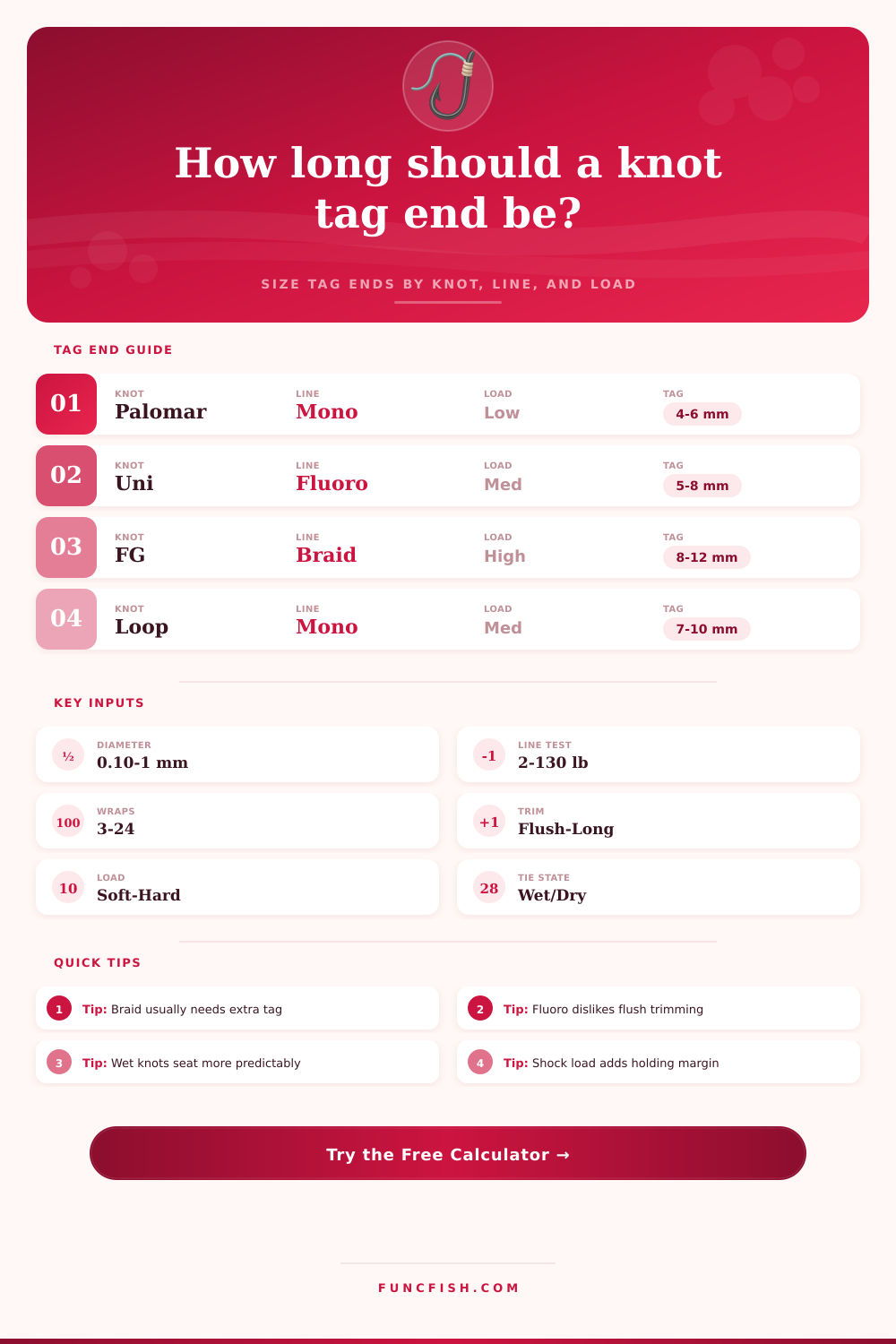
Estimate a practical tag end after tying by balancing knot type, line material, diameter, test, wraps, connection style, shock load, and trim preference.
📌Named knot tag presets
⚙Tag end settings
Tag end recommendation
Full breakdown
🧵Knot and material comparison grid
Monofilament
Fluorocarbon
Braid
Copolymer
Wire Leader
Dacron
Terminal Knots
Leader Knots
📋Knot tag preset table
| Knot type | Typical wraps | Base tag multiple | Best line match |
|---|---|---|---|
| Palomar knot | 2 strand pass plus cinch | 12x diameter | Mono, fluoro, braid to lure |
| Improved clinch knot | 5-7 turns | 16x diameter | Mono or light fluorocarbon |
| Uni knot | 4-8 turns | 18x diameter | Mono, fluoro, braid |
| Double uni knot | 5-10 turns each side | 25x diameter | Leader to leader joins |
| FG knot | 16-24 braid hitches | 30x diameter | Braid to fluorocarbon leader |
| Alberto / Albright knot | 7-12 wraps | 26x diameter | Braid to heavier leader |
| Snell knot | 5-9 wraps | 20x diameter | Hooks and bait rigs |
| Loop knot | 3-6 turns | 22x diameter | Hard baits and flies |
| Blood knot | 4-7 turns per side | 24x diameter | Similar diameter leaders |
| Trilene knot | 4-6 turns | 17x diameter | Fluoro or mono to lure |
📏Line diameter and test reference
| Line class | Typical diameter | Line test range | Starting tag window |
|---|---|---|---|
| Ultralight mono | 0.13-0.18 mm / 0.005-0.007 in | 2-6 lb / 1-3 kg | 3-5 mm / 0.12-0.20 in |
| Freshwater mono | 0.20-0.35 mm / 0.008-0.014 in | 6-20 lb / 3-9 kg | 4-8 mm / 0.16-0.31 in |
| Fluoro leader | 0.25-0.60 mm / 0.010-0.024 in | 8-50 lb / 4-23 kg | 6-12 mm / 0.24-0.47 in |
| Braid main line | 0.10-0.35 mm / 0.004-0.014 in | 8-65 lb / 4-30 kg | 6-14 mm / 0.24-0.55 in |
| Surf or offshore | 0.45-0.90 mm / 0.018-0.035 in | 30-130 lb / 14-59 kg | 10-22 mm / 0.39-0.87 in |
🔗Connection and load adjustment table
| Connection | Tag behavior | Shock modifier | Practical reading |
|---|---|---|---|
| Lure eye / jig hook | Tag can face weed or guide contact | Low to medium | Standard or short trim works after full seating |
| Swivel or snap | Hardware reduces bend movement | Medium | Use a visible tag when casting heavy rigs |
| Leader to leader | Two tags may enter guides | Medium to high | Keep enough tag, then dress the ends cleanly |
| Open loop to lure | Loop movement rubs the tag area | Medium | Longer tag protects the loop knot from creep |
| Snelled hook | Tag lies along hook shank | High | Extra wrap security matters more than a flush cut |
| Fly tippet splice | Small tags must pass through guides | Low | Fine diameter allows a short but not shaved tag |
💡Tag end checks
Tip: Treat burn bulbs and flush trims as finish choices, not strength guarantees. The calculator models them as neutral math adjustments, then still keeps a minimum safe tag.
Tip: After seating a wet knot, pull on both standing line and tag before final trimming. If the tag moves, increase wraps or leave the longer margin.
When a fish slips through the knot’s grasp, the length of the tag end can provide valuable informations regarding the reason for the failure of that particular knot. If the tag end is too short, it will slip out of the knot before the remaining line can fully seat into the knot. On the other hand, if the tag end is too long, it can either snag on weed or slap against the guide of the fishing rod.
If the tag end continues to slapping against the guides, it can loosen the previously tightened knot. The length of the tag end is important because it determines whether the knot remain secured to the fishing line when a fish pull on the line. People often base the length of the tag end on habit.
How Long to Leave the Tag End on a Fishing Knot
However, habits do not necessarly take into account all of the variable of the fishing situation. For instance, some may choose to cut the end of the fishing line flush with the knot as it looks the most best. However, it may not be secure.
Other people may leave the tag end long because of the way they were taught to tie the knot. However, the length of the tag end that is necessary for securing the knot depends on the material of the fishing line, the diameter of the line, the number of wrap that are used in the knot, and how much shock the knot will experience. The length of the tag end may be suitable for tying knots with 8-pound monofilament line.
However, it may result in the failure of the knot if used with braid line. A calculation tool can help determine the proper length of the tag end of the fishing line. The tool will ask for the type of knot that will be tied.
Additionally, the user can also enter the line material, the diameter of the line, the number of wraps in the knot, the connection style between the fishing line, and the expected load into the calculation tool. Based off the answers to these question, the calculation tool will provide three specific numbers that will help the person tie the knot proper. These three numbers will include the length of the tag end that is recommended based on the calculations.
The minimum length of the tag end that should be left behind will also be shown. The third number is the difference between the recommended and the minimum length of the tag end. This number indicates whether the line material is slick or if there is a shock load with the line.
The risk percentage for the knot will also be shown. However, this percentage isnt a guarantee of whether the knot will remain secure. Reference tables are included on the page to provide information on the different ranges of these number.
These tables indicate how different types of knots work with different line diameters. Additionally, the tables will indicate the difference in length for lines of different materials. This information dont need to be memorized.
However, it will be helpful to refer to these tables before tying in any number of knot. Many variables come into play while fishing. For instance, the contact between the fishing line and the fishing guides, the number of times the fishing rod is cast, and the temperature of the fishing water will all have an impact on the line.
Additionally, how the fishing line was stored in the package will also have an impact on the length of the line that should have a tag end. The length of the line that is measured proper when the line is not in use may move when being actively used for fishing. For these reasons, there is one step that you should of followed after calculating the proper length of the tag end.
The lines should be seated under even pressure. Additionally, the tag end should be given a firm but gentle tug to ensure that it is properly secure. Any trimming of the tag end should only be performed after this particular step has been followed.
Mistakes are often made when people focus on one factor that influence the length of the tag end while ignoring the other factors. For instance, people who always cut the tag end flush may not remember that fluorocarbon lines have a tendency to creep. Additionally, people who always leave the tag end long may not remember that a long tag end has a propensity to get snagged on the weeds while fishing.
It is a habit to adjust the length of the tag end to the specific situation that it will be use in. These principles also apply to individuals who fish with a variety of setups. For instance, the loop knot that is used for crankbaits has a different length for the tag end than the Palomar knot that is used for jigs.
Additionally, the double uni knot used to join the braid to the fluorocarbon line require extra length on each side of the knot. These ideas may be easily overlooked when tying knots in low light or with cold hand. Despite the calculation tool’s benefits, the fisherman must still make the decision of the length of the tag end.
The tool can calculate the length, but the person must make the decision of whether the length of the tag end is worth any risk of the line getting snagged on an object in the water. Additionally, the fisherman must decide whether a different type of knot can allow for a shorter length of the tag end. While the calculation tool handles the math, the person is in charge of the line and the security of the knots.