Fishing Line Pound to Kg Converter
Convert fishing line pound test to kilograms, reverse kg to pounds, and check drag load, usable strength, safety margin, species fit, line material, and leader or mainline role.
📌Line-test presets
⚙Converter inputs
Line conversion results
Conversion and drag margin are calculated from the selected setup.
Conversion breakdown
🧵Line material comparison grid
Mono
Fluoro
Braid
Wire
⚖Line, species, and drag comparison grid
Light Freshwater
2 to 8 lb / 0.9 to 3.6 kg line with 15 to 25 percent drag protects small hooks and fine leaders.
Bass and Walleye
8 to 20 lb / 3.6 to 9.1 kg is common; raise strength when cover or single-hook hooksets add shock.
Inshore Saltwater
10 to 50 lb / 4.5 to 22.7 kg handles docks, shell, and running fish when drag stays smooth.
Offshore Trolling
30 to 130 lb / 13.6 to 59.0 kg needs drag measured carefully because heat and surges stack quickly.
📘Reference tables
| Pound test | Kilogram test | 25% drag | 33% drag |
|---|---|---|---|
| 2 lb | 0.91 kg | 0.5 lb / 0.23 kg | 0.7 lb / 0.30 kg |
| 4 lb | 1.81 kg | 1.0 lb / 0.45 kg | 1.3 lb / 0.60 kg |
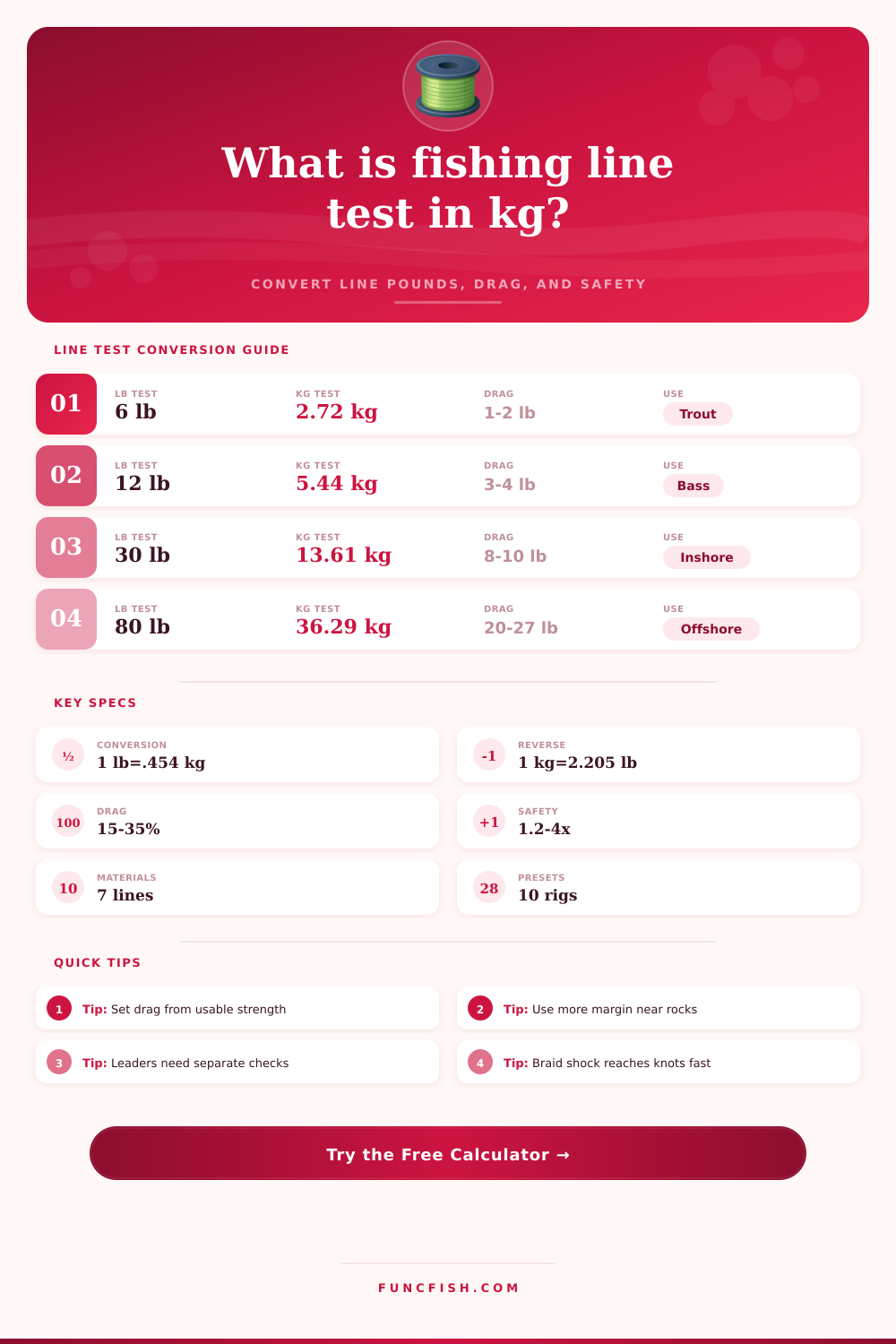
| 6 lb | 2.72 kg | 1.5 lb / 0.68 kg | 2.0 lb / 0.90 kg |
| 8 lb | 3.63 kg | 2.0 lb / 0.91 kg | 2.6 lb / 1.20 kg |
| 10 lb | 4.54 kg | 2.5 lb / 1.13 kg | 3.3 lb / 1.50 kg |
| 12 lb | 5.44 kg | 3.0 lb / 1.36 kg | 4.0 lb / 1.80 kg |
| 15 lb | 6.80 kg | 3.8 lb / 1.70 kg | 5.0 lb / 2.25 kg |
| 20 lb | 9.07 kg | 5.0 lb / 2.27 kg | 6.6 lb / 2.99 kg |
| 30 lb | 13.61 kg | 7.5 lb / 3.40 kg | 9.9 lb / 4.49 kg |
| 50 lb | 22.68 kg | 12.5 lb / 5.67 kg | 16.5 lb / 7.48 kg |
| 80 lb | 36.29 kg | 20.0 lb / 9.07 kg | 26.4 lb / 11.97 kg |
| 130 lb | 58.97 kg | 32.5 lb / 14.74 kg | 42.9 lb / 19.46 kg |
| Material | Usable factor | Best role | Drag cue |
|---|---|---|---|
| Nylon monofilament | 1.00x | Mainline, leader, shock leader | Forgiving stretch supports moderate drag |
| Fluorocarbon | 0.96x | Leader or clear-water mainline | Wet knots and avoid sudden dry cinch heat |
| Copolymer mono | 0.98x | All-purpose casting line | Use similar drag to mono but watch abrasion |
| Braided PE | 0.92x | Mainline with leader | Low stretch makes shock load reach knots fast |
| Fused superline | 0.90x | Thin mainline | Use extra knot margin if coating is slick |
| Coated wire leader | 0.84x | Bite leader | Kinks reduce real break point quickly |
| Fly tippet / backing | 0.94x | Fly leader or backing | Small knots need gentle drag checks |
| Species class | Common line | Drag range | Safety note |
|---|---|---|---|
| Panfish / perch | 2-6 lb / 0.9-2.7 kg | 15-22% | Small hooks open before line should fail |
| Trout | 4-10 lb / 1.8-4.5 kg | 18-25% | Clear water often favors lighter leaders |
| Bass / walleye | 8-20 lb / 3.6-9.1 kg | 22-30% | Cover and hook wire set the upper end |
| Catfish / carp | 15-40 lb / 6.8-18.1 kg | 25-33% | Long steady runs load knots repeatedly |
| Redfish / snook | 10-50 lb / 4.5-22.7 kg | 22-30% | Shell, docks, and leaders drive margin |
| Pike / musky | 30-100 lb / 13.6-45.4 kg | 18-28% | Bite leader damage matters more than mainline |
| Surf species | 12-60 lb / 5.4-27.2 kg | 20-28% | Shock leaders handle cast and wave load |
| Tuna / offshore | 30-130 lb / 13.6-59.0 kg | 25-35% | Heat, long runs, and drag smoothness matter |
| Role | Factor | What changes | Best check |
|---|---|---|---|
| Mainline | 1.00x | Rated test is the base strength | Measure drag from reel to rod tip |
| Leader or tippet | 0.94x | Extra knot and abrasion exposure | Compare to mainline and lure hook strength |
| Shock leader | 0.98x | Designed to absorb cast or surge load | Check peak load after cast or wave shock |
| Bite leader | 0.86x | Wire, hard fluoro, or tooth contact | Inspect for kinks, nicks, and cloudy spots |
| Rock contact | 0.78x | Hard edges reduce usable line fast | Add safety factor before increasing drag |
| Shell contact | 0.72x | Sharp surfaces create cut risk | Retie or replace leader after each hard rub |
💡Conversion checks
Drag tip: Convert the line rating first, then set reel drag from usable strength rather than the perfect printed rating. Knots, role, and cover all reduce the number that matters.
Leader tip: A leader can be stronger on the label but weaker at the knot. Check the leader role and safety factor before using a high drag percentage near cover.
Fishermen often use fishing line with a pound rating. However, the fish do not react to the pound rating of the fishing line. Instead, the fish reacts to the force that it exert on the fishing line, which can lead to the fishing line breaking.
The printed rating of the strength of the fishing line is often different than the actual strength of the fishing line. To understand the strength of the fishing line, many peoples use a pound-to-kilogram converter. Although pound-to-kilogram converters requires individuals to perform some mathematics, the math is only one part of the decision-making process regarding fishing line strength.
Understanding Fishing Line Strength and Drag
Anglers must also consider how much drag to use when fishing and how much reserve strength to leave in the fishing line to withstand the force of the fish. Fishing line spool labels will often indicate the strength of the line in pounds because that is the standard unit of measurement for North America. However, in Europe and in scientific documents, the standard unit of measurement for strength are in kilograms.
When converting the pound ratings for fishing lines to kilograms, anglers are making a change in the physics of the fishing line because the line will be exposed to a different unit of force. To calculate how strong a fishing line is, anglers can enter the test rating for the line, the material of the fishing line, the species of the fish that will be caught, and the type of cover that will be encountered while fishing. The output of this information in a fishing line strength converter is a converted figure.
This converted figure is not as important as the decisions that anglors make after they have entered all of the information into the calculator. One of the ways that anglers use the information from the fishing line strength converter is to set the drag on their fishing rod. For example, anglors who are fishing for bass in clean water can use twenty-eight percent of the fishing line test to set the drag.
However, using that same percentage with braided fishing line over a shell bottom may cause the fishing line knot to break. This is due to the difference in the materials of the fishing lines. Monofilament fishing lines provide cushioning for the fishing line when there are impacts with the fish.
Braided fishing lines does not provide that same cushioning for the fishing line. Therefore, twelve pounds of braided fishing line will behave more differently than twelve pounds of monfilament fishing line. The species of the fish that will be targeted also changes how much strength is needed from the fishing line.
For instance, anglers who are pursuing trout may use a four-pound tippet on their fishing line to protect their hook from damage. However, tuna fishermen may use eighty-pound monofilament to protect their knots from the heat of the tuna. While the fishing line strength converter does not create new rules for fishermen, it provides a visual reminder of the ranges of strength needed for different species of fish.
Anglers must also select a safety factor for their fishing line. Fishermen use factors of one point five when they assume that their knots are clean and that they are fishing in open water. Fishermen use factors of three when they assume that their fishing line will rub against rocks and coral underwater.
The types of leaders that are attached to the fishing line can change how much strength that the fishing line has. Depending on the type of fishing that is to be performed, anglors can use mainline fishing line, leader fishing line, shock leader fishing line, or bite leader fishing line. Each type of fishing line have a different strength.
For example, a leader has more knots and is exposed to more abrasion than the mainline fishing line. A bite leader made of wire will lose some of its strength if the wire kinks. Therefore, the strength of a bite leader is less than the strength of a mainline fishing line.
Using these types of leaders allows for the fishing line to have a drop in the output of its strength. The drop in strength in the leader ensures that the drag will be set to a realistic number for the fishing line. Fishing line strength calculators may seem to provide anglers with ideal conditions for their fishing lines.
However, the conditions of the actual fishing environment is rarely ideal. For example, a fisherman on a kayak could encounter a wave that nicked the fishing line on the kayak. Similarly, a pike may leave a tooth mark on the wire leader of the fishing line that is not visible until after the next fishing cast.
These types of damages to fishing lines can cause the fishing line to break. Therefore, many professional anglors who have encountered these types of problems with their fishing lines will use the information from the strength calculator as a starting point for their fishing line strength rather than an absolute maximum amount of strength. Reference tables exist that provide information for the different types of fishing line materials and the different species of fish.
While the anglors do not have to memorize the information in the tables, the fishermen should be able to recognize the pattern within these reference tables. The pattern within the reference tables is that the more abrasion the fishing line will experience, the lower the percentage of drag that should be used on the fishing line. This rule apply to every other decision that the anglor must make with the fishing line strength converter.
The printed pound rating for the fishing line is only for ideal conditions. The other factors that reduce the strength of the fishing line, such as knots, material, species, and underwater cover, must also be accounted for in the strength calculator. The line strength calculator will convert the strength of the fishing line to a number that the angler can use to set the drag of the fishing rod.
However, the angler must also decide, based off this same calculation, if they feel that there is enough strength in the fishing line to provide insurance for the type of water in which they are fishing.