Fishing Line Respool Waste Length Calculator
Estimate how much new line to pull, how much old line is discarded, and how much extra length disappears into knots, trimming, and handling during a respool.
📌Respool presets
⚙Spool and line inputs
Respool waste estimate
Formula breakdown
🧵Line material comparison grid
Mono
Fluoro
8-Carrier Braid
Wire
📋Reference tables
| Respool plan | Retained line use | Old line discard | Best fit |
|---|---|---|---|
| Full strip | Ignored | High | Unknown old line or severe twist |
| Keep backing | Measured backing reduces refill length | Medium | Braid or fresh mono over known backing |
| Top-shot | Lower spool stays in place | Low-medium | Trolling, surf, or big reel refresh |
| Reverse line | Reusable line is flipped | Low | Clean braid or Dacron with worn working end |
| Line material | 10 lb or near diameter | Typical waste driver | Calculator adjustment |
|---|---|---|---|
| Nylon monofilament | About 0.30 mm at 10 lb | Coil memory and overfill trimming | Baseline capacity and waste |
| Fluorocarbon | About 0.28 mm at 10 lb | Stiff loops and leader knots | Slightly higher handling loss |
| 4-carrier braid | About 0.25 mm at 20 lb | Slippery knots and backing needs | Thin diameter increases capacity |
| Lead-core | About 0.70 mm at 18 lb | Bulky metered segments | Heavy diameter lowers capacity |
| Wire line | About 0.35 mm at 30 lb | Kinks and coil memory | Higher trim and discard allowance |
| Fill target | Practical lip gap | Waste tendency | Where it helps |
|---|---|---|---|
| 82% | Large gap | Lowest new-line use | Beginner spinning reels and springy mono |
| 88% | Moderate gap | Controlled | Bank casting and mixed wind |
| 92% | Small gap | Normal | Most freshwater spinning reels |
| 95% | Very small gap | Higher overfill risk | Distance casting with managed line |
| 98% | Nearly full | Special use | Conventional, trolling, and levelwind reels |
| Printed capacity example | New line change | Capacity direction | Reason |
|---|---|---|---|
| 120 yd / 10 lb mono | 8 lb mono | More line fits | Smaller diameter takes less spool volume |
| 120 yd / 10 lb mono | 12 lb mono | Less line fits | Thicker line fills the arbor faster |
| 150 yd / 12 lb mono | 20 lb braid | Much more line fits | Braid diameter is thin for its strength |
| 300 yd / 20 lb mono | 30 lb wire | Less line fits | Wire is dense and kink-sensitive |
💡Respool checks
Tip: If the reel already has known backing, measure the retained section before adding new line. The calculator treats retained line as volume that the new line does not need to occupy.
Tip: For braid, count knot testing and leader changes as real waste. A short trim allowance often underestimates the length lost before the reel is ready to fish.
It’s happened to all of us before. We’re on the bank fishing. Then it hits you. You’ve got half a spool left, or worse, a spool full of old, sun-bleached line that isn’t what it used to be.
Respooling a reel is stuff nightmares are made of for many anglers. It just feels like a waste of time and a source of constant frustration. You pull line, cut line, tie line, untie line, cut off more line, and tie line again. Then you have a pile of discarded line worth about half the money you paid for it. The fact is that a good chunk of each spool find its way into the recycling bin or trash can.
How to Save Line When Respooling
Knowing this allow you to buy less line and spend more time out on the water. You can avoid all this guessing about how much line you’ll waste by plugging in your spool specs into the calculator above and letting it do the math for you. It spells out exactly how many feet of line you really need and how many you’re likely to toss aside when you finish.
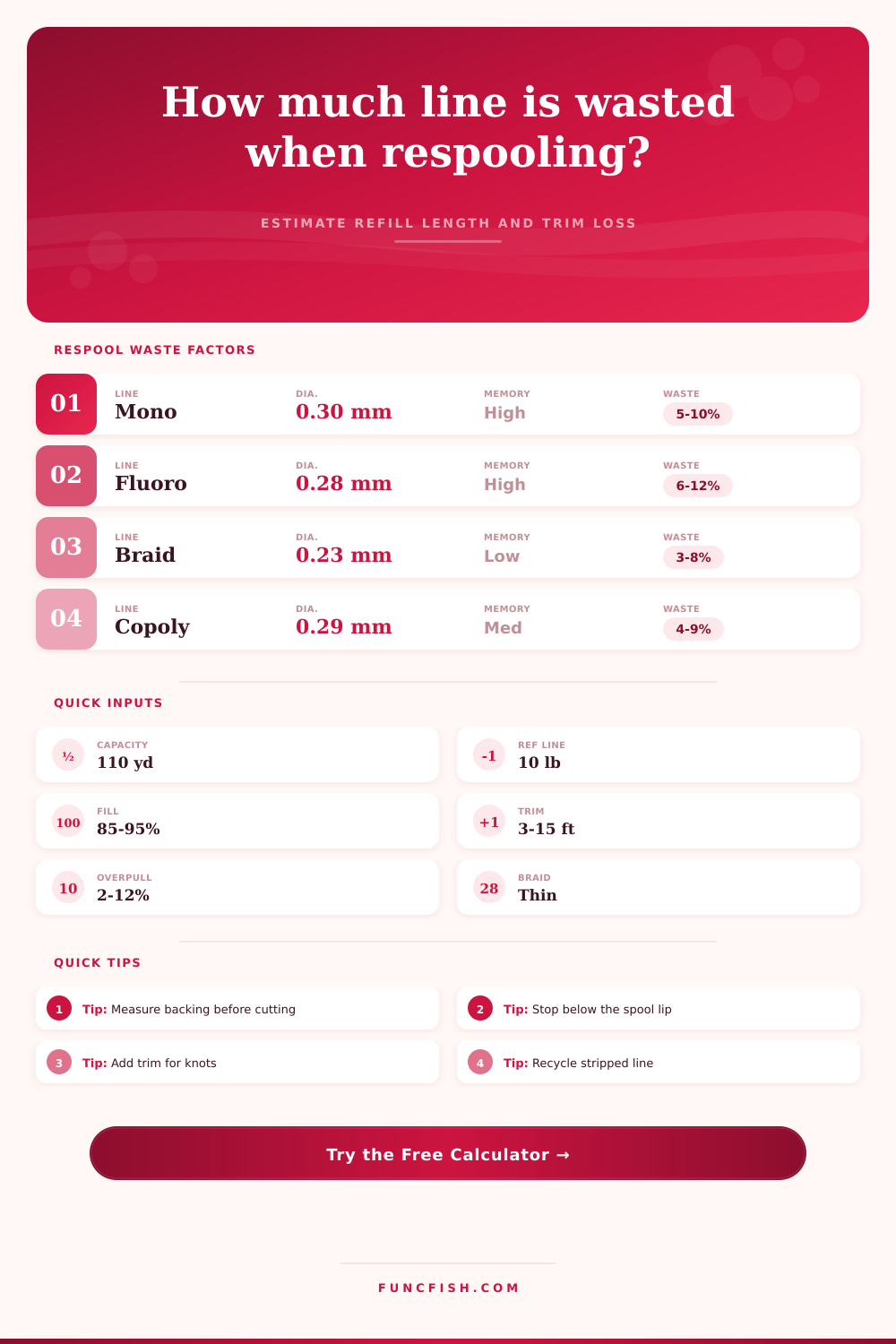
Everyone assumes their waste consist of the spent line they remove from the reel. Not so. That’s only part of it. The rest of the waste come from memory coils that won’t lay straight. It also comes from the extra pull needed to make sure it engages fully with the spool and the trimming needed to get knots seated correctly.
Because nylon monofilament has such a high memory, it doesn’t want to be anything other than what it was wound onto at the factory. This result in humps and loops that snag on your guides. You gotta cut ‘em out. Trimming loss is generally lower with braid. Fluorocarbon is also stiff, but it is even stiffer, which causes more trimming loss. While fluorocarbon is still stiff, it’s even stiffer, causing greater trimming loss. Braid on the other hand are slippery but has almost zero memory.
If you don’t use proper knot tying technique or lubrication then knots will slide, resulting in cut line, re-tying and more.
The most important thing is to define how you want to re-spool. Do you want to leave any backing on? Or do you want to take it all off? Leaving backing makes sense if you’re spooling braid onto a big conventional reel. Because braid is thin and pricey, you’ll put some more affordable line such as mono or dacron into the arbor initially. That provides a wider base for the braid to stack on. Your casts flys further.
If you leave the backing, the calculator reduces the amount of new line needed accordingly. You don’t have to fill the entire spool. You only need the upper part to provide the casting weight. So it’s a nice way to stretch expensive specialty lines.
The other thing that trips folks up is the hidden variable: Diameter. A spool has a capacity rating in terms of a certain line size. For instance, the spool may be rated at 120 yards of 10-pound mono. That’s assuming you’re using 10-pound mono. Change to 14-pound mono? The line is thicker. More volume per inch. You’ll get a lot less length on there. Switch to braided line, which is quite a bit thinner than an equal-strength mono. Now you have so much more.
What the calculator does is take into account how different diameters relate to each other (the diameter ratio) and adjusts the capacity accordingly. Why? The amount of space the line uses increases based off the area it occupies. Think about that. Volume increases as the square of the diameter. So the capacity get adjusted by squaring the diameter ratio. Why do we do it this way? It’s a small detail. It also helps explain why you get so many feet out and still feel like you have a bunch left on the spool.
Another area where being careful saves money is the fill level. Overfilling your spinning reel to the brim of its lip is asking for trouble. When the line runs over the top, it catches under the line above. This forms a difficult nest that gums up the drag. For freshwater spinning you typically want about ninety-two percent full so there’s a slight separation between layers to avoid any overlap. You might want a bit more if it’s blowing out on the water or if you’re fishing a heavy line. The calculator will account for this desired fill by adjusting the pull length accordingly. You know right how much to measure before pulling.
Good respooling is more than just a number game. It’s about knowing how much to buy and not panicking when you run out in the middle of the wind. It means saving money by not trimming off excess and dropping it on the ground. It also means having a certain rhythm to your respooling that doesn’t come down to calculating. It’s a matter of patience, consistency and tension, but having those numbers will help you plan for it. It makes it go from a chaotic chore to a well-planned task.
Pull the line, wind it tight and walk away with a full spool and a full wallet. You should of used the calculator earlier.