Fishing Line Twist Per Cast Calculator
Estimate twist added on each cast from lure rotation, reel pickup, line memory, swivel efficiency, drag slip, and the amount of line moving through the system.
📌Scenario presets
⚙Line twist settings
Line twist forecast
Full breakdown
📋Line material twist reference
Light Mono
Fluorocarbon
Thin Braid
Wire
📊Reference tables
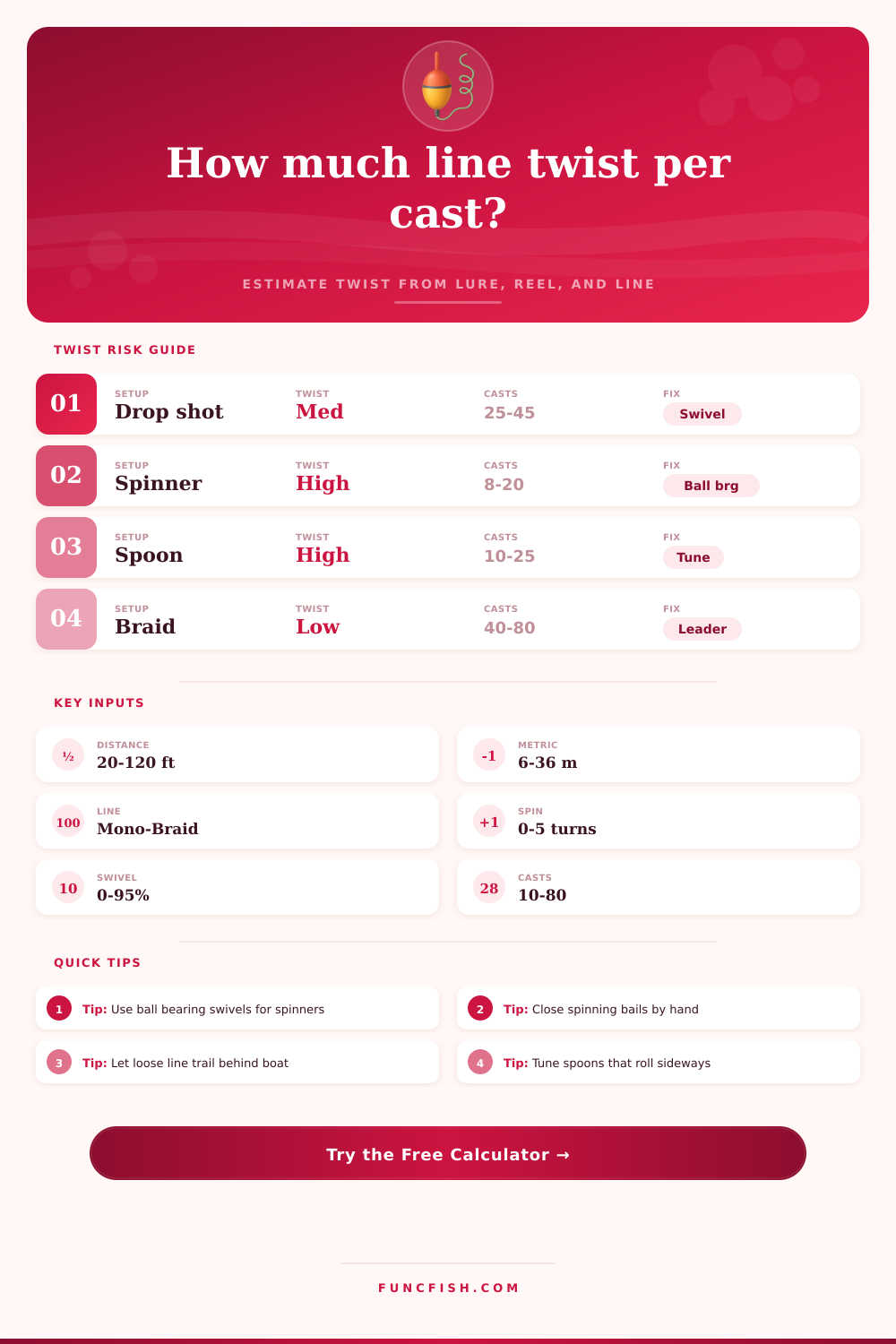
| Terminal rig | Typical spin source | Model range | Useful control |
|---|---|---|---|
| Straight jig or worm | Minor bait roll | 0.0 to 0.8 turns per cast | Rig straight and retie kinked leaders |
| Drop shot or nose-hooked bait | Bait helicoptering on fall | 0.8 to 2.4 turns per cast | Add a swivel above the leader |
| Inline spinner | Shaft and blade rotation | 2.5 to 7.0 turns per cast | Use a quality ball bearing swivel |
| Casting spoon | Side roll or wobble rollover | 2.0 to 6.0 turns per cast | Tune, slow down, or add a swivel |
| Dodger or flasher | Repeating roll cycle | 3.0 to 8.0 turns per pass | Use heavy swivels fore and aft |
| Swivel type | Twist relief used | Best match | Note for calculator |
|---|---|---|---|
| No swivel | 0 percent | Jigs, worms, fixed rigs | All lure rotation reaches the main line |
| Snap swivel | 35 percent | Casual spoon changes | Convenient but can bind under load |
| Barrel swivel | 55 percent | Drop shot, bait, light trolling | Good relief with moderate tension |
| Rolling swivel | 70 percent | Spinners and live bait rigs | Better under uneven pull |
| Ball bearing swivel | 88 percent | Inline spinners, spoons, trolling | Highest relief in this model |
| Risk rating | Net twist per cast | Typical symptom | Session action |
|---|---|---|---|
| Low | Under 1.0 turn | Line lays normally | Keep fishing and monitor loops |
| Moderate | 1.0 to 2.5 turns | Occasional coils near tip | Stretch or trail line after the spot |
| High | 2.5 to 4.5 turns | Coils jump from the spool | Add swivel or change retrieve speed |
| Severe | Over 4.5 turns | Wind knots and leader pig-tails | Stop and remove twist before more casts |
💡Practical checks
Tip: Count lure rotations by watching the bait beside the boat or bank for one normal retrieve. Use that count as the lure rotation input.
Tip: If twist climbs after only a few casts, the biggest improvement usually comes from reducing lure roll or upgrading swivel efficiency.
So what’s going on? You pull a leader from water, it’s all coiled up and twisted. Looks like it came through the dryer! This happens on almost every fishing trip. You pick up a wobbling spoon or an inline spinner and after twenty casts, your main monofilament line has become a knotted mess.
Frustrating, right? It cause wind knots and destroys presentations. When you begin to find fish, it also weakens the line and causes the lure to move poorly in water.
How to Stop Line Twisting
It’s all pretty basic physics versus complicated tackle. As a lure spins on the retrieve, that spin gets sent along the line until stopped somehow. And inline spinners, by design, are supposed to spin. The line attached to that spinny thing want to spin too because the whole point of an in-line spinner is a shaft that spins. A casting spoon rolls over on its side, increasing that rotational force. On a spinning reel, there’s also the bail arm throwing another wrench into the works. Each time the bail opens out-of-sync with your turn of handle, you create loop after loop. If a heavy fish pulls on line while you are retrieving, you also deal with drag slip, how well the swivel stops the line from twisting, and memory of the line itself.
The calculator above take all this and estimates number of twists for you. Most anglers leave the swivel out of consideration until damage is done. To realy prevent twist on an inline spinner, you want a ball bearing swivel. This allow the lure to spin freely while bearings do not pass any twisting force back to main line. As shown in the table on this page, different types of swivels will still reduce twist by different percentages. While a barrel swivel will help some, it won’t be enough to make a difference with higher spinning lures. Your best bet in your tackle box is generally upgrading to a good quality ball bearing swivel. It’s the least expensive and most effective fix.
The type of line also makes a bigger difference different than you’d expect. Mono remembers every twist and turn you put it through. Once you take the twist out, mono still remember those bends and twists. There’s just about zero memory in braid. Braid resists any coiling and you can run lots of lures without a swivel because of this. As far as memory goes, fluorocarbon hovers around midway point with slightly more memory towards mono side of the range. So if you roll a lure with fluorocarbon and cast it out, your twists will build up quicker then you think.
To understand when it’ll become too dangerous for your reels, use the calculator to get an idea of how many casts you can reasonably make before it gets risky. It provides a threshold based off the type of line you choose.
The second part involve the retrieval technique. Cranking harder will affect it too. The slower you reel, the longer it has to spin compared to the water flow. Fast retrieves often result in less twist because the lure changes direction more frequently, giving it less time to spin with each foot of line pulled in. There’s also the hidden influence of drag slip. When we’re fighting current or reeling in a fish, our drag lets line peel off. Those additional inches of moving line can introduce slack loops which tighten into knots.
Do not count the twists on each cast. The whole point of being on the water is to avoid the boredom of calculating twist on each cast. Use the tool, however, to give yourself an idea of your own level of risk before leaving the dock. Do you know that you’ve got a high-risk setup? Plan on changing lines earlier in the day or have a backup rig rigged and ready. When you’re heading home at night and sitting down to pack up, check those leaders. Are they coiled like springs? Adjust your plans for tomorrow’s bite to match.
Knowing how the twist happens will help you prevent it from happening at all. There’s already enough knot-tying to do without having to fight with tangled line throughout the day. Keep ‘em straight and the bite coming. You should of checked that line earlier!