🎣 Fishing Reel Gear Ratio Calculator
Calculate line retrieve per crank, compare reel speeds & match the perfect gear ratio to your technique
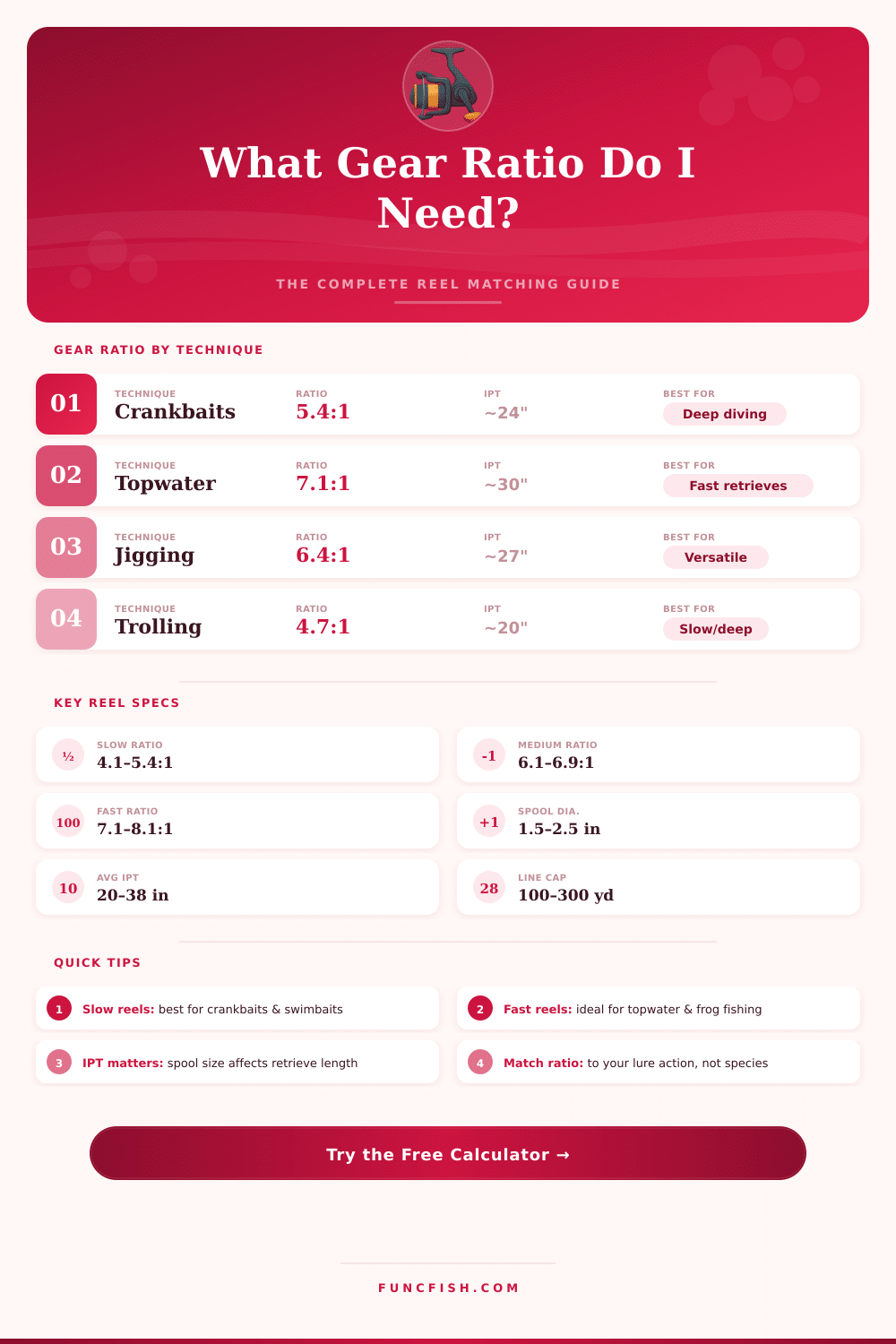
| Technique | Recommended Ratio | IPT Range | Why It Works |
|---|---|---|---|
| Deep Crankbait | 5.0:1 – 5.4:1 | 20–23" | Keeps lure in zone longer |
| Shallow Crankbait | 6.2:1 – 6.6:1 | 26–28" | Versatile retrieve control |
| Topwater / Frog | 7.1:1 – 8.1:1 | 29–35" | Fast pickup on hookset |
| Swimbait / Paddle Tail | 5.0:1 – 5.4:1 | 20–23" | Maintains natural swim action |
| Jigging (vertical) | 6.4:1 – 7.0:1 | 26–30" | Good pump-and-drop cadence |
| Finesse / Drop Shot | 6.2:1 – 6.4:1 | 25–27" | Controlled slow presentations |
| Offshore Trolling | 4.2:1 – 4.9:1 | 18–22" | Power to fight big fish |
| Surf Casting | 5.6:1 – 6.2:1 | 23–27" | Line recovery vs. waves |
| Species | Typical Weight | Best Gear Ratio | Reel Type |
|---|---|---|---|
| Largemouth Bass | 1–8 lb (0.5–3.6 kg) | 6.4:1 – 7.5:1 | Baitcaster / Spinning |
| Smallmouth Bass | 0.5–5 lb (0.23–2.3 kg) | 6.2:1 – 7.0:1 | Spinning |
| Walleye | 1–10 lb (0.45–4.5 kg) | 5.2:1 – 6.4:1 | Spinning |
| Northern Pike | 3–20 lb (1.4–9 kg) | 6.4:1 – 7.1:1 | Baitcaster / Spinning |
| Trout (stream) | 0.25–5 lb (0.1–2.3 kg) | 4.7:1 – 5.4:1 | Spinning / Fly |
| Striped Bass | 5–50 lb (2.3–23 kg) | 5.6:1 – 6.4:1 | Spinning / Conventional |
| Catfish | 2–30 lb (0.9–14 kg) | 4.7:1 – 5.4:1 | Baitcaster / Spinning |
| Offshore (Tuna) | 20–200 lb (9–90 kg) | 4.2:1 – 4.9:1 | Conventional / Trolling |
| Reel Type | Spool Dia. (in) | Spool Dia. (cm) | Typical Gear Ratio Range |
|---|---|---|---|
| Ultralight Spinning | 1.3" – 1.5" | 3.3–3.8 cm | 4.7:1 – 5.2:1 |
| Mid-Size Spinning (2500) | 1.7" – 1.9" | 4.3–4.8 cm | 5.0:1 – 6.2:1 |
| Large Spinning (4000+) | 2.0" – 2.3" | 5.1–5.8 cm | 5.2:1 – 6.4:1 |
| Low-Profile Baitcaster | 1.7" – 2.0" | 4.3–5.1 cm | 5.4:1 – 8.1:1 |
| Round Baitcaster | 2.0" – 2.5" | 5.1–6.4 cm | 4.7:1 – 6.4:1 |
| Conventional / Trolling | 2.2" – 3.0" | 5.6–7.6 cm | 3.8:1 – 5.4:1 |
In the world of fishing by means of reels, the Gear Ratio shows how many times the spool or the rotor twists during every full turn of the handle. For instance, a Gear Ratio of 6.1:1 means that for every single turn of the handle, the spool does 6.1 circles. You will always meet such values: 5.1:1, 7.1:1, 8.0:1 and many others in similar range.
The main difference lies here, that spinning reels count the circles of the rotor, while baitcasting reels consider the turns of the spool itself.
What Gear Ratio Means for Fishing Reels
Here these folks commonly mix up. A Gear Ratio of 6:1 gives faster retrieval, not stronger. It is like gears on a bike.
Less height in gears help to turn the handle more easily during heavy load, just as low gear on a bike helps to climb hills wihtout too much effort.
This part upsets many anglers. A high Gear Ratio number does not necessarily mean more line seized. The size of the spool, its depth and width all seriously affect how many inches of line actually comes in for one turn of the handle.
One calls it IPT (inches each turn). Two reels with same Gear Ratio can retrieve line entirely differently because of differences in IPT. A Fishing Reel turning at 7.3:1 or 8.1:1 does not necessarily pick more then one with 7.1:1, everything depending on the build of the spool.
Anything under 5:1 falls in the category of low speeds. Gear Ratio between 4.4:1 and 5.2:1 are very liked for vertical jigging or fishing with baits, when one likes big species in shallow water. A low Gear Ratio provides more torque and pulling power, what matters during struggle with heavy fish to keep it away from rocks and logs before it breaks the line.
Here low Gear Ratio reels truly shine, especially with big crankbaits, that resist during retrieval.
Most spinning reels sit between 5.2:1 and 6.2:1, although producers now offer models above 7.0:1 for bass anglers, that want to quickly pull rigs from the depth. Baitcasting reels are another case, reaching from 8:1 until 10.1:1, as in the Abu Garcia Dream Rocket. Spinning reels usually have maximum around 7.1:1.
High Gear Ratio reels shine during times to maximize impact between casts or to follow fast fish. In trout fishing especially, a high Gear Ratio helps to keep the line tight, when the fish runs. Reels at 7.1:1 or higher work well for ripping lipless crankbaits through grass or for buzz bait above the water surface.
That same Gear Ratio range works for spinnerbaits andchatterbaits also.
Having two or three reels with different Gear Ratio in your tackle box gives more flexibility than simply baits, that you already have. More time in the strike zone during the day improves the chances greatly.