Fishing Rod Fighting Butt Length Calculator
Estimate a fighting butt or rear extension length from rod length, technique, drag load, reel weight, forearm clearance, existing rear grip, cap style, and balance target.
📌Fighting butt presets
⚙Rod, drag, and fit inputs
Fighting butt sizing result
Calculation breakdown
🔧Component data used by the calculator
Lightest feel for trout, finesse fly, and short fighting plugs.
Common medium-density choice for bass, inshore, and kayak rods.
Dense saltwater grip with good rib and forearm contact.
Adds harness compatibility and measurable rear balance weight.
📊Fighting butt comparison grid
Best when casting feel matters more than forearm bracing. Common on trout fly rods and light spin rods.
Useful for bass fly, inshore spinning, kayak rods, and rods that see moderate drag pressure.
Helps vertical jigging, surf plugging, musky casting, and sustained pressure with heavier lures.
Fits heavy drag, harness plates, and short offshore rods where fighting support outranks casting length.
📘Reference tables
| Rod setup | Typical rod length | Working drag | Common butt length | Main design pressure |
|---|---|---|---|---|
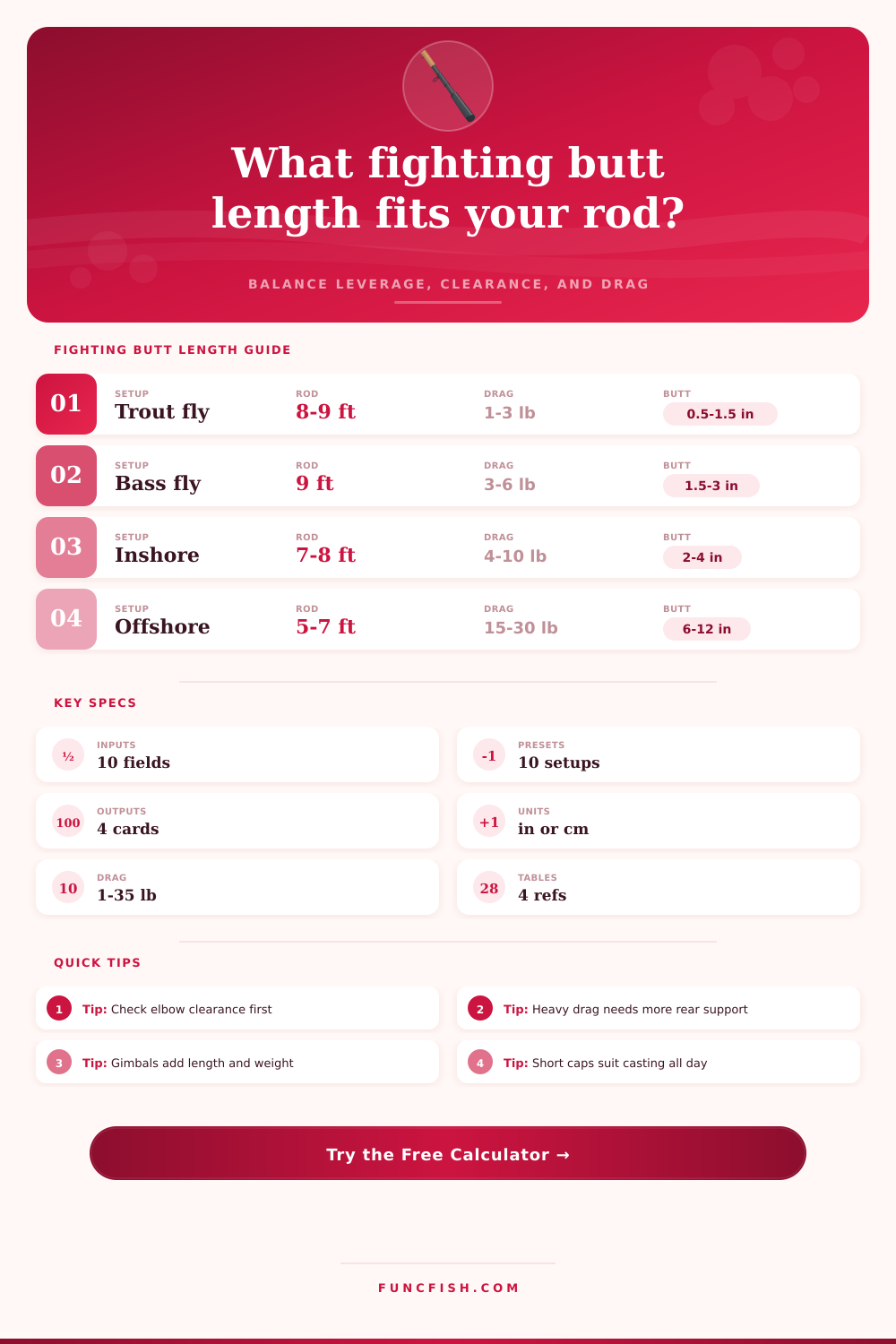
| Light trout fly | 7.5-9 ft / 2.3-2.7 m | 1-3 lb / 0.5-1.4 kg | 0.5-1.5 in / 1.3-3.8 cm | Do not interfere with casting stroke |
| Bass or saltwater fly | 8.5-9.5 ft / 2.6-2.9 m | 3-7 lb / 1.4-3.2 kg | 1.5-3.5 in / 3.8-8.9 cm | Forearm brace without snagging clothing |
| Inshore spinning | 7-8 ft / 2.1-2.4 m | 4-10 lb / 1.8-4.5 kg | 2-4.5 in / 5.1-11.4 cm | Balance lures, reel weight, and fish pressure |
| Surf plugging | 9-11 ft / 2.7-3.4 m | 5-12 lb / 2.3-5.4 kg | 3-6 in / 7.6-15.2 cm | Clear long casts while giving two-hand leverage |
| Vertical jigging | 5.5-6.5 ft / 1.7-2.0 m | 8-18 lb / 3.6-8.2 kg | 4-8 in / 10.2-20.3 cm | Rib and forearm pressure during short pumps |
| Offshore stand-up | 5-7 ft / 1.5-2.1 m | 15-35 lb / 6.8-15.9 kg | 6-12 in / 15.2-30.5 cm | Harness/gimbal alignment and heavy drag load |
| Cap material | Weight estimate | Diameter tendency | Best fit | Calculator effect |
|---|---|---|---|---|
| Cork cap | 0.16 oz/in / 1.8 g/cm | Small to medium | Trout fly, finesse spin | Lowest balance penalty |
| EVA fighting butt | 0.24 oz/in / 2.7 g/cm | Medium | Bass fly, inshore, kayak | Neutral default density |
| Rubberized composite | 0.31 oz/in / 3.5 g/cm | Medium to wide | Surf, musky, heavy casting | Adds rear mass and brace feel |
| Hypalon saltwater | 0.34 oz/in / 3.8 g/cm | Wide | Jigging and offshore | Favors short but powerful support |
| Carbon sleeve | 0.20 oz/in / 2.2 g/cm | Slim | Light custom builds | Moderate length with lower weight |
| Gimbal butt | 0.38 oz/in + cap / 4.2 g/cm | Wide or slotted | Harness, rail, stand-up | Adds minimum support allowance |
| Rod power | Line range | Drag range | Support target | Length bias |
|---|---|---|---|---|
| Ultralight | 2-4 lb / 1-2 kg | 0.5-2 lb / 0.2-0.9 kg | Grip cap only | Subtract 0.4 in / 1.0 cm |
| Light | 4-8 lb / 2-4 kg | 1-4 lb / 0.5-1.8 kg | Compact support | Subtract 0.2 in / 0.5 cm |
| Medium | 8-17 lb / 4-8 kg | 3-8 lb / 1.4-3.6 kg | Balanced brace | No bias |
| Medium-heavy | 12-25 lb / 5-11 kg | 5-12 lb / 2.3-5.4 kg | Firm forearm brace | Add 0.5 in / 1.3 cm |
| Heavy | 20-50 lb / 9-23 kg | 8-22 lb / 3.6-10 kg | Extended brace | Add 1.0 in / 2.5 cm |
| Extra-heavy | 50 lb plus / 23 kg plus | 15-35 lb / 6.8-15.9 kg | Gimbal-ready brace | Add 1.8 in / 4.6 cm |
| Clearance check | What it means | Good range | Watch if | Adjustment |
|---|---|---|---|---|
| Elbow clearance | Butt plus rear grip versus forearm length | 25-45 percent | Over 55 percent | Shorten for casting comfort |
| Drag leverage | Drag load divided by rear support length | 0.8-2.5 lb/in | Over 3.0 lb/in | Add support or lower drag |
| Added rear weight | Butt weight compared with rod and reel | 2-8 percent | Over 12 percent | Use lighter cap material |
| Transport penalty | Permanent added length past the cap | Under tube limit | Travel rod case is tight | Use removable extension |
💡Fighting butt sizing tips
A fighting butt adds something to how a rod performs. If you’ve experienced a fish biting and your rod bend excessively, it’s because there is no part of the rod to brace your forearm on. From that point forward, you must rely on wrist strength different than leverage to fight a fish. With a fighting butt, you create a fulcrum point that allows you to fight with your body weight rather then tendons. Not only does it give you a spot to put your hand, but…
The majority of guys goes with what fits on their other rods, or they guess at a cap size. How a rod look has nothing to do with leverage. If the butt is too long, it beats into your ribs on the cast and messes up your stroke. Too short, and it hurt like hell when a fish fires off. Find that fine line between clearance and support.
Why Rod Butts Matter for Fishing
But how does it know? Well, the calculator will do all that math for you. Inputs include forearm length, drag pressure, reel weight, and more. This is because the physics of light trout rods differs from heavy offshore rods. If your rod sits in a harness or has a gimbal butt, the tool takes into account additional length required to position the plate. Otherwise, the system could of been off-balance prior to casting.
Rod behavior are also influenced by material. Cork is light and neutral, which keeps the rod tip feeling alive during delicate presentations, while EVA foam is denser and provides more substantial bracing for heavier line. Adding mass at the back of the rod with a rubberized or hypalon option move the balance point toward your hand. This makes it feel stable at rest but tiresome to cast all day. See table below to compare support level and density.
Many folks forget about drag setting as well. The heavier the drag on the reel, the more it’s going to transmit into your forearm during a run. For example, if you have three pounds of drag on a reel versus 15-pound drag, the heavier drag will require more support in the rear. When you reduce the butt length with increased drag, your leverage is reduced. Instead of your bones and muscles absorbing impact, it’s your wrist. That’s the give-and-take between fighting enjoyment and potential injury.
Forearm clearance is also key. You must have space for forearm motion without the butt cap rubbing against your body or clothes. This are determined by the arm length and how much clearance space you prefer. It makes no sense to have an extension that obstructs your cast. On the other hand, I have no desire to have it in the way during line presentation and the fight.
It’s not an accessory, but part of the total system. It fits your size, the reel seat, and the guide spacing. More importantly, a proper fit result in better control and less fatigue. It lets the rod do what it was made to do while you exert efficient control over the pressure applied.
You’ll notice the tool. Type in your equipment specs and watch what happens. Swap out drag types and drags, change materials, and note where the advice adjust. It eliminates guess work for decisions that are typically made by trial-and-error. That doesn’t mean you shouldn’t test it yourself. Get it in your hands, but it helps eliminate glaring misses.
When designing or changing rods, keep in mind that leverage starts at the back and works forward. The butt size play a big part in a good feeling rod to hold onto. A good butt gives confidence to a potentially weak feel. It allows the rod to become an extension of arm instead of another item to control. That combination of freedom and support is what makes fishing fun even during fish battles.