Fishing Rod Power to Lure Ratio Calculator
Compare the true lure load against rod power, action, line, rod length, and casting force so the setup sits in a usable working window.
📌Scenario presets
⚙Rod and lure inputs
Rod power match
Formula breakdown
📋Rod material comparison grid
Fiberglass
Composite
Graphite
High Modulus
📊Rod power and lure reference
| Rod power | Typical lure range | Metric range | Common line | Ratio sweet spot |
|---|---|---|---|---|
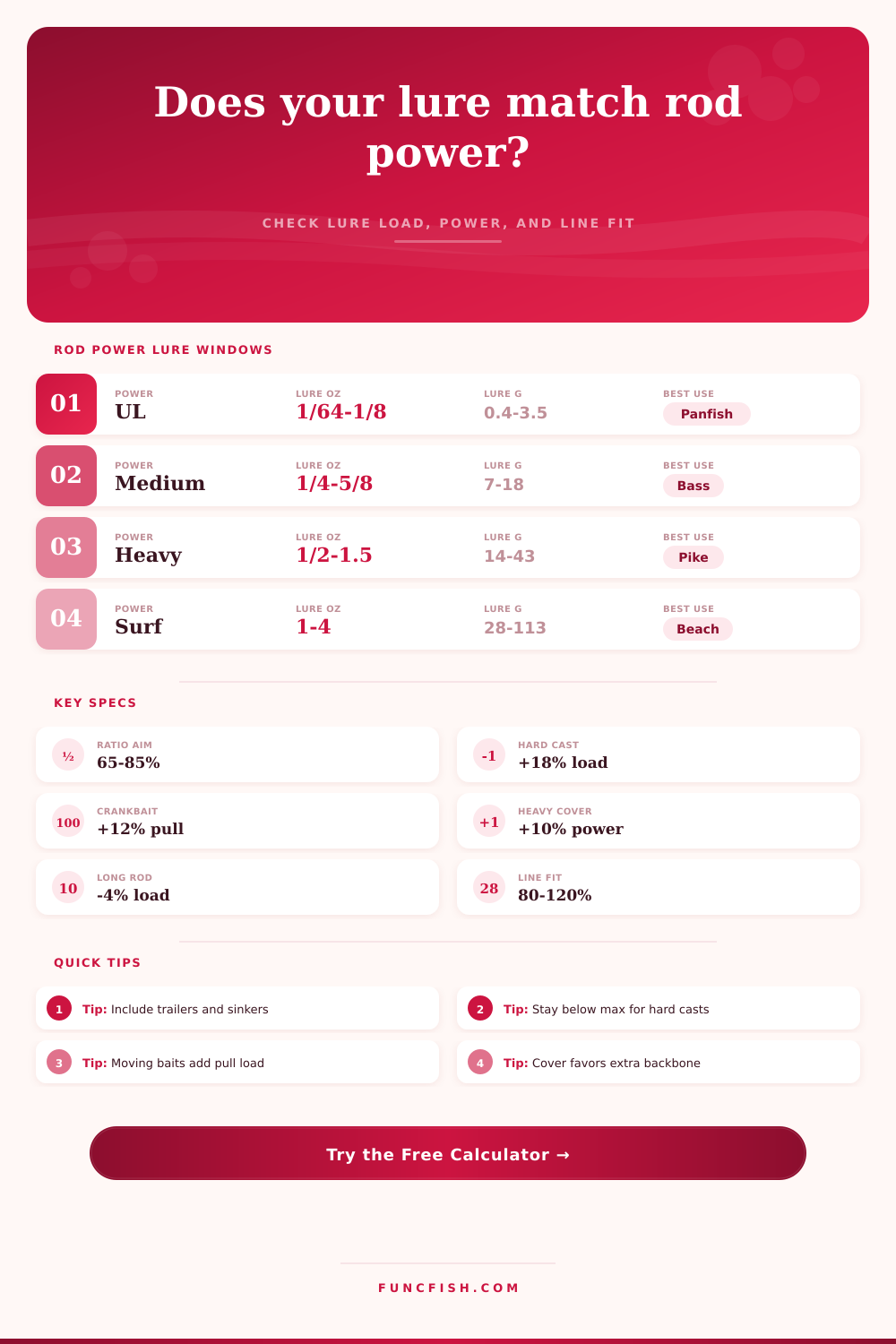
| Ultralight | 1/64-1/8 oz | 0.4-3.5 g | 2-6 lb | 60-82% |
| Light | 1/16-1/4 oz | 1.8-7 g | 4-8 lb | 62-84% |
| Medium light | 1/8-3/8 oz | 3.5-10.5 g | 6-10 lb | 64-86% |
| Medium | 1/4-5/8 oz | 7-18 g | 8-14 lb | 65-87% |
| Medium heavy | 3/8-1 oz | 10.5-28 g | 10-20 lb | 66-88% |
| Heavy | 1/2-1 1/2 oz | 14-43 g | 14-30 lb | 66-88% |
| Extra heavy | 1-3 oz | 28-85 g | 20-50 lb | 62-85% |
| Surf heavy | 1-4 oz | 28-113 g | 20-60 lb | 58-82% |
| Lure or rig type | Load multiplier | Why it changes ratio | Best rod behavior |
|---|---|---|---|
| Micro spoon | 0.98 | Low pull, tiny payload | Soft loading tip |
| Inline spinner | 1.06 | Blade resistance adds pull | Light to moderate tip |
| Jig or jighead | 1.00 | Lead weight dominates load | Fast response |
| Soft plastic rig | 1.04 | Trailer and hook add mass | Medium-fast recovery |
| Crankbait | 1.12 | Lip digs and loads blank | Moderate bend |
| Topwater plug | 1.03 | Surface pull is intermittent | Balanced tip |
| Swimbait | 1.14 | Body wobble adds drag | Deep loading power |
| Bottom rig | 1.10 | Sinker and bait load together | Strong lower blank |
| Trolling plug | 1.22 | Water pressure stays constant | Forgiving pull curve |
| Fishing scenario | Typical rod power | Lure range | Line window | Load note |
|---|---|---|---|---|
| Panfish docks | Ultralight | 1/64-1/16 oz | 2-4 lb | Tip must load early |
| Trout stream | Light | 1/16-3/16 oz | 4-6 lb | Keep margin for roll casts |
| Bass finesse | Medium light | 1/8-3/8 oz | 6-10 lb | Center the lure window |
| Bass moving bait | Medium | 1/4-5/8 oz | 10-14 lb | Drag lifts effective load |
| Walleye jig | Medium light | 1/8-1/2 oz | 6-10 lb | Current can double feel |
| Inshore paddle tail | Medium | 1/4-3/4 oz | 10-20 lb | Wind raises cast load |
| Pike swimbait | Heavy | 3/4-2 oz | 20-40 lb | Use backbone reserve |
| Surf metal | Surf heavy | 1-4 oz | 20-50 lb | Distance casts need margin |
| Ratio result | Meaning | Casting feel | Adjustment |
|---|---|---|---|
| Below 45% | Underloaded blank | Flat, low feedback | Use lighter power or heavier lure |
| 45-64% | Usable low end | Controlled but short | Fine for close work |
| 65-85% | Centered match | Clean load and release | Keep this pairing |
| 86-100% | Upper working edge | Loads deep | Avoid violent casts |
| Over 100% | Above adjusted rating | Risky on hard casts | Step up rod power |
💡Calculation notes
Tip: Weigh the whole casting package, including jighead, trailer, sinker, swivel, and bait. A rod rated for a lure weight sees the full payload during the cast.
Tip: Moving baits, trolling plugs, deep rigs, and heavy cover add resistance after the cast. The calculator treats those as load multipliers instead of ignoring them.
The key is matching your rod power to the lure weight. Otherwise you’re not getting good performance and will probably break your gear. If it’s a mismatch, the rod feel weak or stiff. While many of us concentrate on rod action, power is actualy the more important consideration. What power means is amount of load that the rod can absorbs. That defines its effective working range.
Now we see how the calculator fits in; it give you those numbers, but only if you understand physics behind them. Not all companies standardize their rod power ratings. For example, a medium power rod in one company might have a very different feel to a medium power rod in another. Just because a lure rates at your preferred power doesn’t mean it will be. Keep that whole system in mind.
Why Matching Rod Power Matters
Weight of the line. Weight of the sinker. The bait cause drag. Sticker weight on a lure doesn’t tell the whole story. That’s why I like converter. It gives you an idea if the whole system is going to work. Hydrodynamic load adds more weight when in the water. Although a crankbait might only weigh a half ounce out of the water, the water will push back on that lip. This means your rod is experiencing more weight then what the lure weighs. Adding a multiplier for moving baits makes it adjust to this.
If you don’t add this adjustment, you are at the uppermost end of the rods range. When you overload the rod, it reduce both casting distance and sensitivity. Energy transfer is poor so you can no longer feel bottom structure. A second issue is under loading the rod. When you pair ultralight rods with heavy fluorocarbon leaders it throw off the balance point. It’s mushy when you cast because the tip doesn’t load correctly. Rather than moving all the way to the tip, energy spreads out in the middle section.
A line test of twelve pounds on a light rod will make a big difference. The line test is used to adjust recommendation to keep it realistic. Power, How hard does it take to get the rod to bend. Action is where along the length of the rod it will bend. Moderate and fast action rods can have identical power ratings. Sixty five to eighty five percent is the sweet spot on a given rod. Going over one hundred percent means you are risking breakage on hard casts. At less than forty-five percent, you feel as if you’re fishing with a dead stick.
Reserve is good for flex, it helps with accurate casting and fighting fish. The rods handling of load is also affected by the materials used. Glass rods absorbs shock better, bend further, and are forgiving when a mistake occur. Graphite rods on the other hand are stiffer, more sensitive, and telegraph subtle bites, but provide less leeway for mistakes. A stiff graphite rod can be overloaded to catastrophic failure. The same load may simply cause the fiberglass rod to bend. Knowing what material is in the blank helps you understand what happened.
Cover creates resistance, wind creates drag and a swimbait feels heavier in heavy grass than a jighead does in open water. The calculator normalizes those variables. Then you can input your situation and determine where it lands you. If it’s not right then you tweak either the lure or the rod until you get it right. That helps you use your gear longer and eliminates frustration and wasted time. It also makes your rods last longer. Abuse a rod and it will break, respect it, however, and it’ll last a lot longer.
The math adds up to control and clarity. Math provides control to help you make the right match. Overloading a rod reduces its sensitivity and turns signals into noise. Not enough strength in the rod will drown out the signal altogether. You’re looking for the balance of turning random hookups into intentional connections. Begin by looking at the total load then power rating, let the math be your guide. When the gear does its job, the cast feels smooth and the rod comes alive. The right equipment make it easier to learn technique. You’ll feel it on the first cast.