Fishing Rod Weight Grams to Ounces Converter
Convert rod grams to ounces or ounces to grams, then score the reel-matched setup by length, blank material, power, action, balance point, and fishing technique.
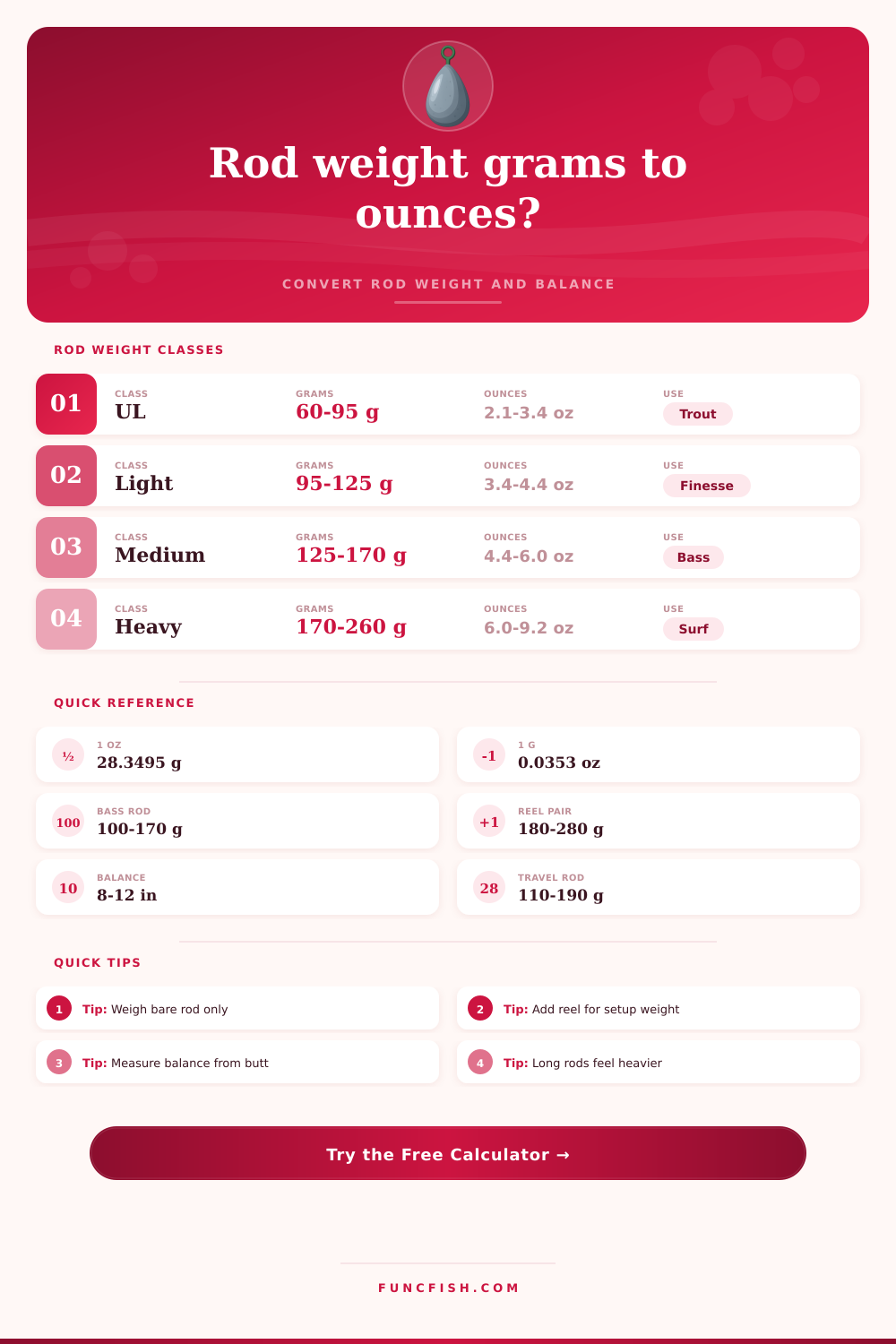
Rod weight range by common build type
| Rod type | Typical grams | Typical ounces | Best-fit techniques |
|---|---|---|---|
| Ultralight spinning, 5 ft 6 in to 6 ft 6 in | 60 to 95 g | 2.1 to 3.4 oz | Panfish, stream trout, micro jigs |
| Light finesse spinning, 6 ft 6 in to 7 ft 3 in | 95 to 125 g | 3.4 to 4.4 oz | Ned rigs, dropshot, small swimbaits |
| Medium bass casting or spinning | 125 to 170 g | 4.4 to 6.0 oz | Jigs, Texas rigs, spinnerbaits, crankbaits |
| Medium-heavy to heavy casting | 150 to 220 g | 5.3 to 7.8 oz | Frogs, pike lures, heavy cover, big jigs |
| Surf, catfish, or trolling rod | 220 to 520 g | 7.8 to 18.3 oz | Long casting, sinker rigs, trolling spreads |
Power and action adjustment guide
| Power/action | Weight expectation | Balance habit | Rod feel note |
|---|---|---|---|
| Ultra light / fast | Lowest total blank mass | Feels best near reel stem | Crisp tip, low fatigue, quick hooksets |
| Light / moderate fast | Low to moderate blank mass | Can tolerate slight forward balance | Good for small treble lures and trout spoons |
| Medium / fast | Middle of most freshwater rods | Neutral balance is ideal | Useful all-round class for bass and walleye |
| Medium heavy / extra fast | Higher blank wall and guide load | Forward feel is common | Works for jigs, frogs, heavy line, and cover |
| Heavy / moderate | Highest blank and handle load | Reel match matters more | Built for big baits, bottom rigs, and trolling |
Rod, reel, and technique matching grid
| Technique | Rod weight target | Reel weight target | Balance point target |
|---|---|---|---|
| Ultralight trout and panfish | 60 to 105 g / 2.1 to 3.7 oz | 145 to 200 g / 5.1 to 7.1 oz | 18 to 24 cm / 7 to 9.5 in |
| Bass finesse spinning | 95 to 135 g / 3.4 to 4.8 oz | 190 to 260 g / 6.7 to 9.2 oz | 22 to 29 cm / 8.5 to 11.5 in |
| Moving bait casting | 120 to 175 g / 4.2 to 6.2 oz | 185 to 240 g / 6.5 to 8.5 oz | 24 to 33 cm / 9.5 to 13 in |
| Kayak inshore | 135 to 195 g / 4.8 to 6.9 oz | 230 to 330 g / 8.1 to 11.6 oz | 23 to 31 cm / 9 to 12.25 in |
| Surf or catfish bottom rigs | 240 to 520 g / 8.5 to 18.3 oz | 430 to 760 g / 15.2 to 26.8 oz | 36 to 55 cm / 14 to 21.5 in |
Balance score reference
| Score band | Setup feel | Likely cause | Interpretation |
|---|---|---|---|
| 85 to 100 | Very balanced | Reel weight and handle length match blank length | Comfortable for repeated casts and rod-tip work |
| 70 to 84 | Good balance | Small offset from the technique target | Fishable without major fatigue for most sessions |
| 50 to 69 | Noticeable bias | Forward balance, long rod, or heavy blank material | Works, but long sessions may feel slower |
| Under 50 | Poor match | Rod, reel, and balance point are far from target | Expect tip-heavy or handle-heavy feel |
Rod weights is another important factor to consider when you are fishing because the weight of your fishing rod will impact the length of your cast and how the rod feel in your hand. The weight of your rod will impact how quickly the tip of your rod will return to its original position after you have cast, as well as the balance of the rod overall when you have mounted your reel on the rod. For some individuals, the rod may feel heavier or more light than what you might have expected with the rod.
In these instances, the few gram of difference in the weight of the rod may be the cause of the discrepancy. While it is possible to convert these grams to ounces, it is important to understand what the weight of a fishing rod mean to your fishing technique. The conversion of grams to an ounce is often necessary when individuals purchase fishing rods from different manufacturers.
Why Rod Weight Matters
For instance, a European manufacturer may state the weight of the rod in grams, while an American manufacturer may state the same weight of the rod in ounces. Both of these units of measurement refers to the weight of the bare rod, which does not factor in the weight of the fishing reel, fishing line, or bait. Thus, both unit of measurement must be consistently used when considering the specifications of fishing rods.
Beyond the weight of the rod, there are other factors that may impact how a given rod weight may feel to the individual. Factors like the use of high-modulus graphite can shed some of the weight of the rod, while materials like fiberglass adds both weight and durability to the rod. Materials that fall somewhere in between these two materials will have weights that are in between the two extremes.
Thus, two fishing rods of the same gram weight may feel differently due to each of these factors. Another factor that may impact the way a fishing rod of a certain weight may feel to the individual is the power and action of the rod. For instance, manufacturers create medium-fast rods with more material than ultralight rods to allow for the movement of bait, thus making medium-fast rods heavier than ultralight rods.
However, an ultralight rod may feel light in the handle of the rod due to the balance point of the rod. For instance, long surf rods can have a high weight, such as 380 grams, yet be manageable with the correct type of surf fishing rod. The balance point of the rod will have an impact on the number of hour that you feel fatigued while fishing with that rod.
For instance, if the balance point of the fishing rod is too far forward from the angler, the angler will develop fatigue in those areas much faster than if they were fishing a rod with the same weight yet with a balance point closer to the butt cap. A balance point too far from the butt cap will require the angler to continuously adjust the rod with their wrist. This factor is more important for anglers using longer rods.
The length of time that you fish will also impact how important the rod weight and balance point are to you. For instance, an angler may not notice the forward balance point of the rod while fishing for only two hours, but will find the forward balance point to be annoying after five hour of fishing. Many individuals make mistakes when measuring the weight of their fishing rods.
For instance, many anglers may weigh rods while the reel is mounted to the rod, or the angler may have forgot to remove the rod sleeves and hook keepers prior to weighing the rod. Additionally, another common mistake is using a very light fishing reel for a very heavy fishing rod blank. If such a rod is used, the angler will feel the weight of the rod in the handle, which will force the angler to use extra effort to each cast that is made with that rod.
Another factor that will impact the weight of the fishing rod that is appropriate to be used by an angler is the angler’s fishing technique. Finesse fishing techniques require that the angler use a lighter fishing rod, typically under 135 gram in weight to avoid developing strain in the angler’s shoulders when using small plastics. Surf fishing techniques, on the other hand, can benefit from the use of rods that have heavier blanks than those used in finesse fishing.
An angler can use a reference table to determine the relationship between the weights of fishing rods and the various fishing techniques. Finally, the gram and ounce rating of the fishing rod are the starting points for the angler. Beyond the factors mentioned herein, each angler should also run the weight, the balance point, the length, and the material of the fishing rod through a calculator.
The fishing rod calculator can be helpful in that it accounts for the balance of the fishing rod and for the way in which the angler is to use it. Thus, the overall goal of the anglers when purchasing a fishing rod is to ensure that the total weight of the fishing rod and its components land somewhere in a comfortable range for the number of hours that the angler plans to fish.