Fishing Sinker Bank Weight Calculator
Estimate practical bank sinker weight for rivers and lakes from depth, current, bottom grip, bait weight, line angle, boat or bank position, rig type, target species, and line test.
📌Bank sinker presets
⚙River and lake inputs
Bank sinker match
Choose a bank sinker size that balances bottom contact, drift control, rig load, and line angle.
Full breakdown
📋Bank sinker, rig, and species comparison grid
Creek Bank
Lake Bank
River Bank
Catfish Bank
Dock Bank
Carp Bank
Tailrace Bank
Heavy River
📐Reference tables
| Bank sinker size | Metric equivalent | Typical water | Best use |
|---|---|---|---|
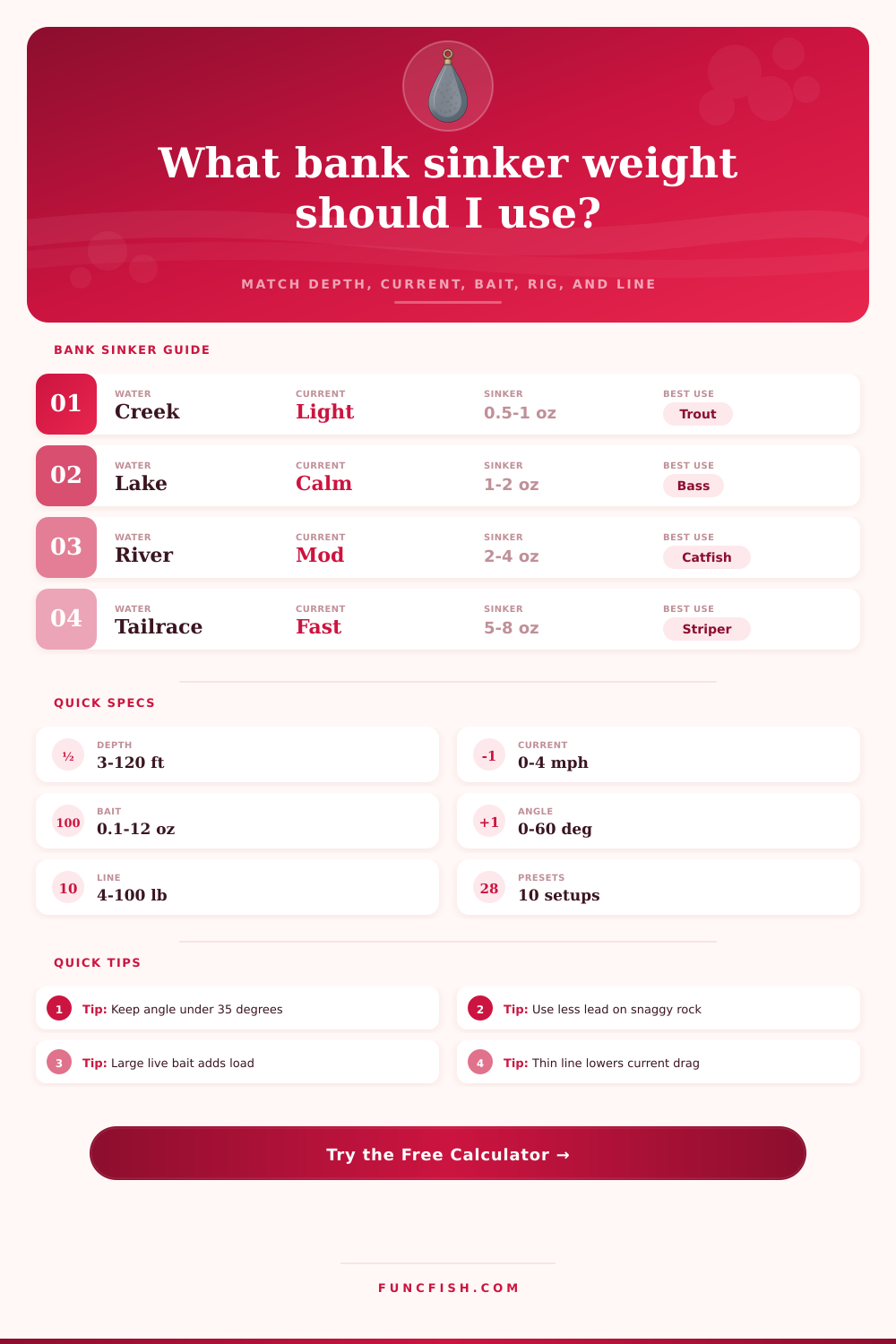
| 0.25-0.75 oz | 7-21 g | Creeks, ponds | Trout, panfish, finesse drifts |
| 1-2 oz | 28-57 g | Calm lakes, light rivers | Bass, carp, walleye edges |
| 3-5 oz | 85-142 g | Moderate river current | Catfish, drum, deeper bank sets |
| 6-10 oz | 170-283 g | Fast rivers, tailraces | Striper, heavy catfish, live bait |
| 12-16 oz | 340-454 g | Heavy river holes | Sturgeon, big bait, high line angle |
| Bottom type | Bank sinker grip | Snag release | Adjustment note |
|---|---|---|---|
| Mud / silt | High | Moderate | Can use a lighter rounded sinker because it settles |
| Sand | Baseline | Good | Predictable for bank sinkers in lakes and rivers |
| Gravel | Medium | Good | Round stones can make bank sinkers roll under current |
| Rock ledge | Low | Fair | Use enough weight for contact but avoid wedging |
| Wood / brush | Low | Best | Bank shape lifts cleaner than angular sinkers |
| Weed bed | Low | Moderate | Grass adds drag to line and bait |
| Rig type | Drag factor | Bank sinker role | Typical line angle |
|---|---|---|---|
| Slip sinker rig | Low | Anchors while bait moves naturally | 15-35 degrees |
| Carolina rig | Medium | Keeps bait ticking bottom | 10-30 degrees |
| Three-way rig | Medium-high | Separates dropper from bait leader | 20-45 degrees |
| High-low rig | Medium | Hangs two baits above bottom | 10-35 degrees |
| Santee rig | High | Controls float and cut bait in current | 20-45 degrees |
| Live bait bottom rig | High | Offsets bait swimming and lift | 15-40 degrees |
| Target species | Common bank size | Line test range | Load note |
|---|---|---|---|
| Trout | 0.25-1 oz | 4-8 lb | Light drift or small bait |
| Bass | 0.5-2 oz | 8-20 lb | Carolina and bottom rigs |
| Walleye | 1-3 oz | 8-20 lb | Current edges and gravel seams |
| Carp | 1-4 oz | 10-25 lb | Long bank sets and dough bait |
| Catfish | 2-8 oz | 15-50 lb | Cut bait and river holes |
| Striped bass | 4-10 oz | 20-60 lb | Tailraces and live bait |
| Sturgeon | 8-16 oz | 50-100 lb | Heavy current and big bait |
💡Bank sinker checks
Angle check: If the line angle climbs past 35 degrees, move up one common bank sinker size or reduce line belly before adding a much heavier rig.
Snag check: In rock or wood, use the lightest bank sinker that still taps bottom. The rounded shape helps release, but excess weight can wedge deeper.
Fishing from the bank require you to choose a sinker weights that will allow your bait to remains in a specific area of the water column. The sinker weight should be heavy enough to prevent the bait from float to the surface, but it should also be light enough to avoid rolling the bait downstream. Using a sinker weight that is too light will cause the bait to drift away from the area that you want to fish.
Additionally, using a sinker weight that is too heavy may cause the bait to get stuck on bottom. The weight of the sinker that you should use in bank fishing depend on several different variables. These variables include the depth of the water, the speed of the current in the area that you are fishing from the bank, and the type of bottom that lie beneath the water.
Pick the Right Sinker Weight for Bank Fishing
In areas with slow currents and soft bottoms, such as lakes, using a light sinker will allow the bait to settle on the bottom. In areas with fast moving currents and rocky bottoms, like rivers, a heavier sinker will help maintain contact with the lake floor. Additionally, the weight of the bait itself will affect the sinker weight necessary to maintain contact with the bottom.
Using a large piece of bait will create more drag in the water current. The angle of the fishing line will also affect the sinker weight necessary. If the line isnt vertical with respect to the water’s surface, it will catch more of the current.
The calculator located on this page will provide you with the mathematical calculations necessary to determine the proper sinker weight. The calculator will consider various factors about the fish species that you are targeting and your position on the bank to suggest a proper sinker weight. This will eliminate the guesswork in determining sinker weight and save you time on your fishing trip.
Additionally, the reference tables located on this page will allow you to compare your calculations to the weights of sinkers that you typically use in fishing for trout, bass, catfish, and stripers. Bank sinkers are typically rounded in their shape to allow the bait to rest on the lake or river bottom. The rounded shape allows the sinker to rest on the lake or river bottom without dig in with the bottom.
This is particularly useful when fishing around logs or rocks in the water as the round sinker will easily slide over them. In contrast, angular sinkers such as pyramid sinkers will grip the lake or river bottom better in sandy bottoms. However, the angular sinkers may get stuck in the crevices of the lake or river bottom.
Additionally, the fish are less likely to mistake the rounded shape of bank sinkers for the lake or river bottom. It is common for individuals to use the same size sinker weight that they used during there last fishing trip. However, you should not make such assumptions.
The characteristics of the lake or river may have changed since your last fishing trip. For instance, the depth of a lake or the speed of the current in a river may have changed after there was rainfall. Each time that you go fishing, you should check the characteristics of the water.
Additionally, if your fishing line is particularly heavy, you will need a heavier sinker to fight against the drag that the line will create in the water current. You can determine if the sinker weight that you are using is the correct weight by observing the angle of the fishing line. If the angle of the fishing line is more than 35 degree from the vertical, the sinker weight is too light or the length of the line is too long.
In these situations, you should move up to the next size of sinker weight. Using a larger sinker weight will typically fix the issue created by the too large angle of the fishing line. However, be sure not to use a sinker weight that is too large for the bait that you are using.
The composition of the lake or river bottom will affect the sinker weight that is used. If the lake or river bottom is comprised of mud, the sinker will be able to settle and remain on the lake or river bottom with less weight. However, if the lake or river bottom is comprised of gravel and shells, the sinker will not be able to hold as well to the lake or river bottom.
In these situations, using a heavier sinker will be necessary. Additionally, if you are fishing in areas with weed beds, the vegetation will catch the fishing line and the bait. In these situations, you will need to use a sinker weight to ensure that the bait will maintain contact with the lake or river bottom without getting snagged on the weed.
The type of fishing rig that you use will change the sinker weight that should be used. For example, if you use a slip sinker, the bait will be allowed to move in relation to the sinker. However, three-way rig will allow the dropper of the rig to separate from the leader of the rig.
Live bait rig will allow the bait to move in a natural manner in the water. The calculator takes these types of rig into account when it calculates the proper sinker weight. The behavior of the fish that you are targeting will change the sinker weight.
For example, trout and crappie fish will require the use of a light sinker weight. Catfish and stripers will require the use of a heavier sinker weight because these types of fish are typically located in areas with strong current in the lake or river. Each species of fish will have a line test that will allow you to determine the maximum amount of weight that the fishing line can hold before it begins to break.
By using the sinker weight calculator that is located on this page, you will eventually be able to recognize which sinker weights are required in different water condition. By using this calculator a variety of times, you will be able to notice which sinker weight are required for various depth or currents. While you will still have to input each of the fishing variable each time you go fishing, the process will become faster over time.
Using this calculator will result in fewer instances where you will lose your sinker with the fish and more time fishing with your bait. While the sinker weight calculator will help you to determine the proper sinker weight for your fishing trip from the bank, you will also have to adjust for various environmental factor. Factors such as the wind may affect the tension on your line.
Thus, while you can use the calculator to determine the sinker weight that you should use, your experience on the water will also play a factor in determining the correct sinker weight for your fishing trip.