Fixed Paternoster Length Calculator
Calculate a fixed paternoster rig body from top loop to sinker link, including dropper branch length, hook swing, lower drop, casting force, current, and leader stiffness.
📌Scenario presets
⚙Rig inputs
Fixed paternoster layout
Set inputs and calculate to see the rig layout.
Calculation breakdown
📊Material and layout data
Light Mono
Shore Mono
Stiff Trace
Reef Trace
📐Fixed paternoster reference tables
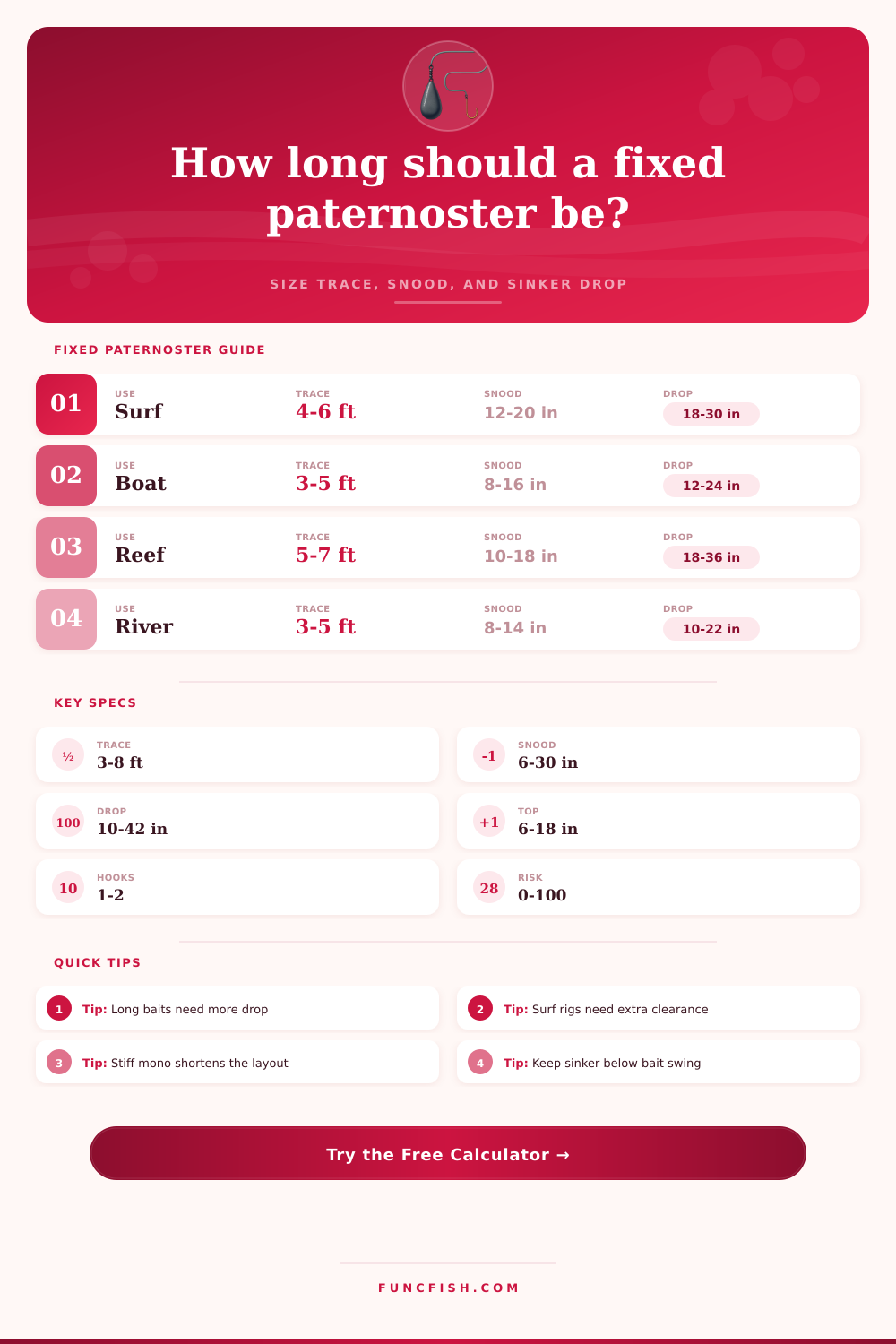
| Rig use | Typical branches | Branch length | Lower drop | Total trace body |
|---|---|---|---|---|
| Short boat paternoster | 1 to 2 | 8-14 in / 20-36 cm | 12-20 in / 30-51 cm | 3-4.5 ft / 0.9-1.4 m |
| General shore fixed rig | 1 to 2 | 12-20 in / 30-51 cm | 18-30 in / 46-76 cm | 4-6 ft / 1.2-1.8 m |
| Power cast beach rig | 1 | 16-24 in / 41-61 cm | 24-36 in / 61-91 cm | 5-7 ft / 1.5-2.1 m |
| Heavy reef paternoster | 1 to 2 | 10-18 in / 25-46 cm | 20-36 in / 51-91 cm | 5-7 ft / 1.5-2.1 m |
| Deep water fixed drop | 1 to 2 | 8-16 in / 20-41 cm | 26-42 in / 66-107 cm | 6-8 ft / 1.8-2.4 m |
| Target group | Hook branch | Bait swing | Body strength | Layout note |
|---|---|---|---|---|
| Whiting / surfperch | 10-16 in / 25-41 cm | 1-2 in / 3-5 cm | 30-50 lb | Two branches can stay compact |
| Flounder / flatfish | 18-30 in / 46-76 cm | 2-4 in / 5-10 cm | 40-60 lb | Long branch needs longer lower drop |
| Snapper / reef fish | 10-18 in / 25-46 cm | 2-5 in / 5-13 cm | 60-80 lb | Abrasion margin beats compactness |
| Catfish / carp | 8-16 in / 20-41 cm | 3-6 in / 8-15 cm | 40-80 lb | Keep bait above debris and sinker |
| Cod / haddock | 14-24 in / 36-61 cm | 3-6 in / 8-15 cm | 60-80 lb | Use generous sinker clearance |
| Condition | Extra clearance | Best material | Handling target | Risk control |
|---|---|---|---|---|
| Calm vertical drop | 0-2 in / 0-5 cm | Mono or fluorocarbon | Rig shorter than rod | Compact drop is fine |
| Normal surf | 3-5 in / 8-13 cm | 50 lb mono | Body near half rod length | Keep sinker below bait swing |
| Power casting | 6-10 in / 15-25 cm | Stiff 60 lb mono | Avoid very long double rigs | One branch casts cleanest |
| Strong tide | 5-8 in / 13-20 cm | Hard mono or boom | Short branches resist twist | Add drop or shorten branch |
| Deep water angle | 8-14 in / 20-36 cm | Hard mono | Longer drop protects bait | Plan for line bow |
🚩Rig length notes
The calculator treats the hook branch as a swing radius, then adds bait tail, hardware, current, casting load, and material stiffness before sizing branch spacing and lower drop.
A fixed paternoster that is longer than the rod can still fish well, but it is harder to cast, unhook, and land cleanly from tight shore or boat positions.
Finished rig body length is measured from the top loop or swivel connection to the bottom sinker link. It excludes shock leader above the rig and any detachable sinker tail below the clip.
So, you chuck out your rig and see it settle down, then as soon as you get your slack back the line has gone into a knot. Well this is one frustration that this paternoster length calculator help with. It works out the length of trace required to hit bottom. It also takes into account the science of how your rig move through the water, the properties of the materials used, and the geometry of your setup.
Most people work it out from experience. What worked last time in flat conditions. But the minute the tide change or the current flows the game changes. The calculator will do it for you and turn guesses into a accurate set-up that respects both structure and fish behaviour.
Why Use a Paternoster Length Calculator
Swing radius is where the issue lies. Your hook branch has a sort of pendulum effect when you make your cast. So if your sinker doesn’t fall far enough, the bait crashes into lead and can get all tangled up in your main line. And if it falls too far, you will lose sensitivity as well as risk getting hung up on bottom. This tool solves this by measuring how long your hook branch is and then adding on how long your bait tail is which creates a definite safe zone.
Then it takes into account what kind of material you’re going to be fishing it on. This is an important detail a lot of folks miss. A floppy piece of fluorocarbon leader doesn’t act the same way that stiff, sixty-pound monofilament does. One flops around, the other one holds its shape and chops through the water with more resistance. That’s why the calculator factors that in and changes how long of a drop you need so you still have something that works no matter what kind of line you use.
The strength isn’t all about materials. It is about how a line are going to affect the whole profile of the rig in the water. A surf whiting run around the shore isn’t a great use for heavy abrasion resistant line; it cast poorly and adds bulk when it is more than you need. Fishing for reef fish out deep requires a light leader material, but runs the risk of failure each time a fish take off towards cover. Each of these common situations has its own table in the tool where you’ll notice the variation in branch length based off your situation (catfish vs. Porgy).
That’s why there’s no need to commit these to memory. Pick your fishing scenario, pick your desired species, and the recommended inputs will be based on tested configurations instead of guesswork. But there’s one other factor that a static illustration can’t account for: casting conditions. For example, when making a power cast from the beach, you want a more streamlined rig with less “slack” in it to reduce air resistance and help avoid loop formation as you’re casting. Conversely, on strong currents or tides, you’ll want enough length in your leader so your sinker stay on the bottom, but not so much that the bait gets swept up by the moving water and junk.
The calculator factors in both your selected condition and the rig’s physical dimensions to provide an estimate of how likely you are to get tangled. If the risk is high, it will tell you outright that something needs to be trimmed back or modified to allow for the desired hardware. One often overlooked thing regarding practicality is the overall handling limit. I know guys who have made a long-rig body, but can’t throw it because their rod won’t reach its full length. And then they can’t get it up onto the line in front of them and off at the boat side or down the line in the surf either. Your total length should be manageable. There’s a handling check on the tool for this reason.
Efficiency is as important than catch potential. What good is a perfectly rigged bait if you can’t hook it clean? A paternoster is a balancing act. You need it long enough to get it in front of them and also far enough away from the sinker so the hook doesn’t get caught up on it. But you don’t want it so long that it’s unwieldy and gets tangled. This calculator removes the guessing from this equation and makes all of the variables work together to create a complete layout.
It acknowledges that we’re not static fishermen. The fish will move into shallow water or drop into deep water. The wind blows different and the current changes. So having something that starts off as a mathematically sound layout gives you a solid base from which to make tweaks throughout the day. You act with confidence that the geometry is correct. And then it’s simply a matter of waiting on the bite.