Flapper Rig Length Calculator
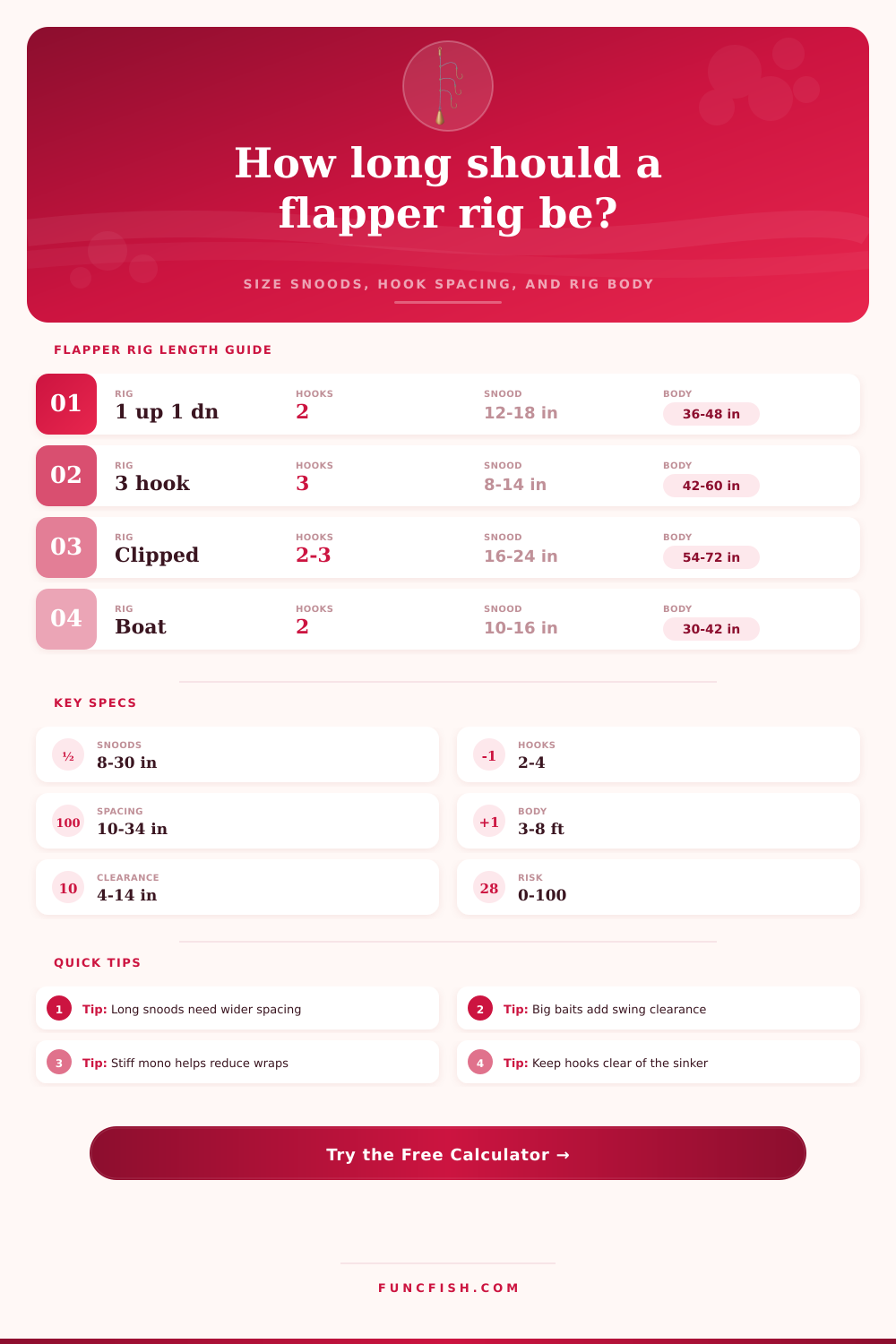
Calculate rig body length, snood spacing, hook layout, and sinker clearance for 1-up-1-down, two-hook, three-hook, clipped, surf, and boat flapper rigs.
📌Scenario presets
⚙Rig inputs
Flapper rig length results
Set the stops so each snood can swing without the hook or bait crossing the next snood.
Calculation breakdown
🧵Rig body material reference
30 lb mono
General shore flappers and light mixed fishing.
50 lb mono
Common rig body for beach work and power casts.
Stiff 60 lb
Cleaner hook separation for clipped or long snood rigs.
Wire boom
Best stand-off effect, but less subtle in clear water.
📊Reference tables
| Flapper style | Typical hooks | Common snood length | Hook spacing guide | Best use |
|---|---|---|---|---|
| Two-hook surf flapper | 2 | 14-24 in / 36-61 cm | 18-30 in / 46-76 cm | General beach, pompano, surfperch |
| Three-hook beach flapper | 3 | 8-16 in / 20-41 cm | 12-22 in / 30-56 cm | Whiting, dabs, match fishing |
| 1-up-1-down flapper | 2 | 15-24 in / 38-61 cm | 20-32 in / 51-81 cm | Baits held apart above and below |
| Clipped distance flapper | 2-3 | 18-30 in / 46-76 cm | 24-36 in / 61-91 cm | Power casting with bait clips |
| Short boat flapper | 2 | 10-18 in / 25-46 cm | 14-24 in / 36-61 cm | Vertical drops and light tide |
| Target group | Typical hook | Bait tail allowance | Snood range | Body note |
|---|---|---|---|---|
| Whiting / dab | Size 4-2 | 1-2 in / 3-5 cm | 8-14 in / 20-36 cm | Three hooks can stay compact |
| Pompano / surfperch | Size 2-1 | 1.5-3 in / 4-8 cm | 12-20 in / 30-51 cm | Leave extra surf clearance |
| Flounder / flatfish | Size 1-1/0 | 2-4 in / 5-10 cm | 18-30 in / 46-76 cm | Longer snoods improve movement |
| Cod / haddock | 2/0-4/0 | 3-6 in / 8-15 cm | 16-28 in / 41-71 cm | Use heavier body and tail clearance |
| Snapper / reef fish | 1/0-4/0 | 2-5 in / 5-13 cm | 12-24 in / 30-61 cm | Abrasion margin matters around reef |
| Condition | Spacing add-on | Body strength | Sinker clearance | Tangle control |
|---|---|---|---|---|
| Calm estuary | 0-2 in / 0-5 cm | 20-30 lb | 4-8 in / 10-20 cm | Light mono is acceptable |
| Normal surf | 2-4 in / 5-10 cm | 40-60 lb | 6-10 in / 15-25 cm | Use beads and trapped swivels |
| Strong tide | 4-8 in / 10-20 cm | 50-80 lb | 8-14 in / 20-36 cm | Shorten snoods or stiffen body |
| Power cast | 6-10 in / 15-25 cm | 50-80 lb | 8-14 in / 20-36 cm | Clip baits and add top clearance |
| Weedy bottom | 4-8 in / 10-20 cm | 50-80 lb | 10-16 in / 25-41 cm | Lift bottom hook above debris |
🚩Rig length notes
The calculator treats each snood as a swing radius, then adds bait tail, terminal tackle, current, and casting allowances before placing the next hook stop.
If the result is longer than your rod, shorten snoods first, reduce hook count second, and reserve clipped rigs for distance casting.
Measured rig body length excludes the shock leader above the top loop and the detachable sinker link below the bottom clip or swivel.
When you lob it out there with the best intentions only to pull up a twisted mess of knots, you know exactly the frustration I’m talking about. We’ve all been there; whether its hooks crossing, the bait wrapping around itself, or the line coming back stiff and tangled. Your casts was dialed-in, your target hit dead-on and now you’re standing in boat or on the shore trying to figure out where you went wrong.
More often than not, it wasn’t your casting delivery but rather the geometry of your flapper rig. To make one that’ll fly through the air without breaking and land flat on bottom, you need to understand the interplay between material stiffness, hook spacing and swing radius. It is less about physics and more about space planning. Plug your variables in to the calculator above and let it do the complicated math for you.
How to Stop Tangled Rigs
No more guesswork over whether or not your snoods are too long for distance between stops. Think of every snood on the rig as its own pendulum, gravity and momentum pull them down and out as you make your casts. When you put two hooks too close together on the rig body, they’ll inevitably cross each other’s arc path as they descend. Tangle city.
Leave enough room between the knots or swivel on each end so neither can come anywhere near the other, even with a bent rod and current kicking in while dragging a sinker. The tool helps you visualize this. It figures out how far apart your loops should be by factoring in length of your bait and the droppers’ loops to give you a minimum safe separation. Measurable clearance makes intuitive sense.
The material selection is a bigger part of the equation here than many would imagine. Lots of folks grab big mono because it seems like it’s going to hold up well, but thicker = stiffer. Stiffer leader material want to coil instead of fall straight. This causes the material to keep the coiled shape from the spool, making it hard to keep the hooks vertically separated.
Softer lines, or specially made no-memory monofilament, will let the rigs fall more cleanly. This keeps the swing radii separate and parallel. The chart on the page does a good job laying this out as the heavier lines needed to be spaced wider apart to get the same clean separation as you can easily obtain with lighter line. And again, it’s a give take where you may not be able to have both high abrasion resistance and high hydrodynamic cleanliness without changing the physical characteristics of the rig.
Your geometry is dictated by your bait presentation too. Small baits such as lugworms or small shrimps takes up less space compared to large baits such as bulky cut bait or whole fish. The larger bait lags farther back and swings out farther in the cast. Use a compact three-hook rig with a big bait and you’re asking for trouble; the heavy bait’s going to drag through the water column, tangling the bottom hook with the middle one.
Here’s where shortening the snoods can help, but again only to a point. You still want them long enough so the fish can see the offering and strike it naturaly. That’s where experience plays into the equation, finding that balance between calculation and experience. You don’t want the bait pinned tight against the main line, you want it looking alive in the water.
Another thing you don’t really think about till you get smoked is how far off the bottom do you want that weight. Too much weight on the bottom hook will tear across the top of weeds or whatever else you might be fishing around and raise the whole outfit off the bottom. This takes your bait out of the strike zone for bottom feeder and ruins your presentation.
Leaving yourself with a good gap gives the weight something to hold onto and keep you there. It also puts the hook in the strike zone where they really hunt. It also keeps your sinker from plowing into the rocks on the retrieve. This not only wears down your tackle over time but could of also snap your line if your hook catches before the weight hits something. Spacing it right takes the stress off things and protects your equipment.
Creating a solid flapper rig is very precise and patient work. Long before you even make your first knot you’re thinking about 3 dimensional issues in 2 dimensions. Before you even cast this thing out, you’ve got to think about how each piece will be pulled by gravity, water resistance, and your rod’s action. You must also consider these factors during both the cast and the drop.
When you get it dialed in it translates into not losing as many baits and spending more time fishing than unwinding line. That’s what makes for that nice, straight plunge into the depths and is the difference between being a frustrated weekend angler and the guy who goes home with a cooler full of dinner.