
There’s always a point where you know fish at the opposite end of the line isn’t going to play nice. It strips bank out from under you and slams into your drag with a solid thud. You know you’re tied into a ball of river current condensed into one powerful body. That is essence of the flathead catfish experience.
They are strong ambush predators with bodies loaded with muscle and far more pounds per inch than most people might guess. Their body mass make traditional weight estimation charts useless for them, and knowing how they grow are important if you want to target trophy class fish. Here’s where that disproportionate mass realy becomes clear. And I mean, it adds up quick. A few more inches and those fish will adds some serious pounds.
How Flathead Catfish Grow and How to Catch Them
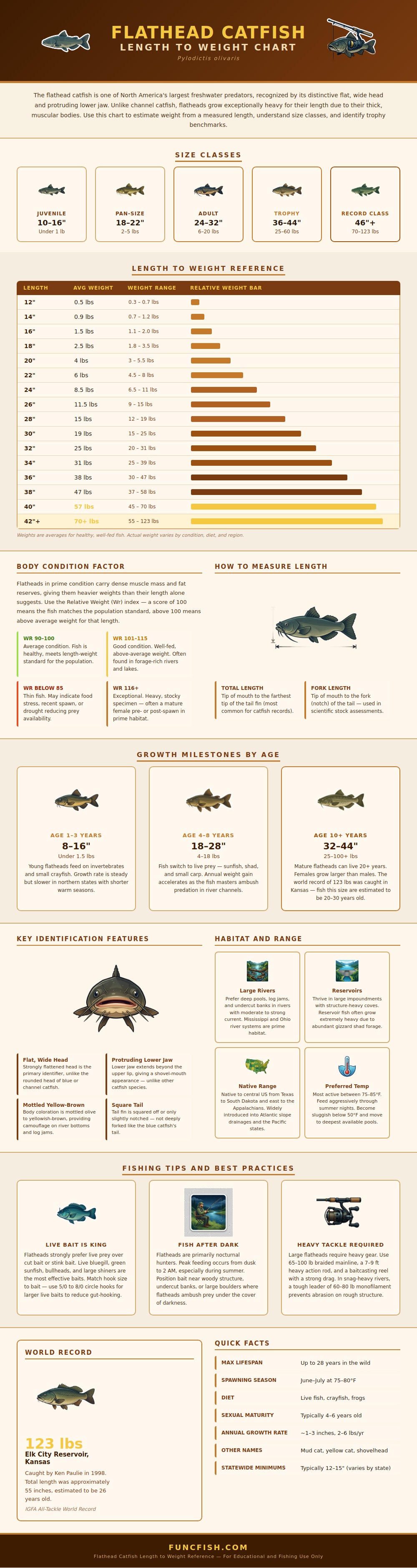
Flatheads don’t get long and slender like channel catfish. They grow out into that stocky frame making them incredibly heavy for their length. That’s why the leap from twenty-four to thirty-six inches is such a huge leap in weight different than length. In fact, a flathead 32-incher is frequently 5-10 pounds heavier then its 30-inch brother thanks to all that extra girth. If you’re thinking about your tackle selection or measuring for regulation purposes, don’t expect that length to give you a good idea of what kind of fight lie ahead.
Body condition factors also play a huge role in all of these weight estimates as the infographic points out. A fish with a relative weight score over one-hundred is a healthy flathead with fat reserves and lots of muscle mass. So it’s probably livig in a river or reservoir where there is a lot of shad or other forage. When you get down to lower numbers like less than eighty-five, those fish are typically thin and show signs of either past spawning activity or lack of sufficient food. That makes a big difference when considering their handling, as a fat thirty-inch flathead will behave much more different than a skinny thirty-inch flathead. Length isn’t everything. How well it feed and where it lives is another factor.
So what does that tell us about where to catch ‘em? Knowing their life stage should of help you understand. Young flatheads, those less than a foot and a half long, tend to stay hidden in deep pools and undercut banks where casual glances won’t reveal much. These young flathead are stealthy bottom feeders that relies mostly on invertebrates. As they grow larger (typically beyond four years), they begins hunting live prey such as small carp and other sunfish which they stalk with terrifying efficiency. This dietary change pushes them into faster growth rates, also called their sub-adult growth phase.
During this time, they’ll reach the twenty-to-thirty-inch range and pose a serious threat to anything resembling bait within striking distance near a piece of cover. Instead of roaming freely, they sticks close to structure and wait for a meal to swim by. Live bait includes these big, old, nighttime creatures that do not respond well to cut bait. They are too powerful and picky to readily accept dead offerings in their mouths. Live bullheads and bluegills around deep channel breaks and log jams in the evenings is your best bets.
To tackle these beasts, make sure to use appropriate gear. Strong leaders and heavy braid will be needed as you work through snag-ridden waterways. Hook up with one of these bad boys and keep in mind that this is a patient, historic animal. This is a slow-growing giant that, if lucky enough, has lived for decades and now grown into a real river monster. He’s got power, patience, and history all wrapped into a single, massive thump on the end of your line.