
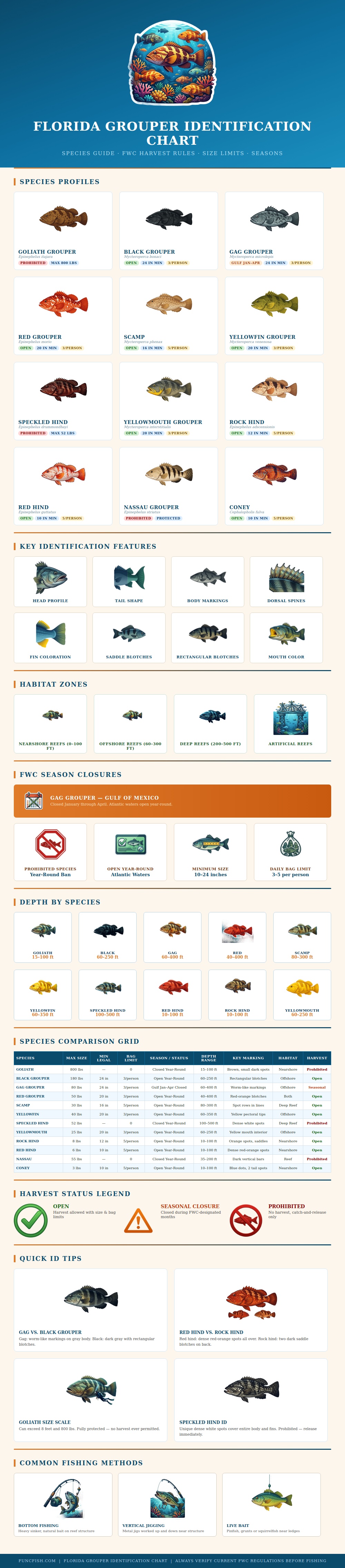
Here’s what you need to know about catching Florida Grouper. Identify your fish before she come up. If you’re going to get into the battle with a grouper, be sure to identify her size and species first. Some fish is illegal to keep. You might think you had a great time on the water, only to find out you didn’t actualy catch a keeper.
Having the right tools will help, but learning how to visually distinguish between the species are also critical. Below is a chart identifying 12 of the most common species you’ll encounter off the Florida Coast. This includes both their physical characteristics and harvest status. This includes both their physical characteristics and whether or not you can keep them. This serves as a filter system you can follow once you’ve got fish in the boat.
How to Identify Florida Grouper
A lot of these species appear to be nothing more than a blob of brown or gray until you inspect there distinguishing patterns. For instance, the black grouper is very dark with subtle rectangular blotches, while the gag grouper have unique side markings that look almost like worms. Both of these species has very similar looking bodies. This is why many folks mistake one for the other. You just have to really take a good look at their skin pattern to make the distinction.
Habitat is also going to help you identify what fish it is that you’re seeing. Do they live in shallow water near shore reefs? Or do they stay out deep in hundreds of feet of water? The rock hind and red hind will often be seen on those smaller reef closer to shore. The yellowfin grouper and scamp tends to stay near deeper structure. So when you target those fish you know you’re most likely fishing offshore. Knowing how deep you are help to narrow it down further. When you finally get a good look at the fish, you’ll have a better idea of what it might be. You won’t drop a jig next to a bridge piling in 5 feet of water and hook up on a scamp, so context does half the battle for identifying fish.
Do not take protected species, even if they’re tempting. Even though some of them are massive, you can’t keep them. The three most popular protected species (goliath grouper), speckled hind and Nassau grouper, is all off limits. Speckled hind in particular is difficult because it appear similar to several different groupers except for its heavy spotting. It’s fully covered with tight clusters of small, white spots on both its body and fins, making it very identifiable. So, if you spot any of those spots, release the fish at once. The chart highlights these prohibited species clearly so you don’t accidentally keep a fish that belongs to someone else or, more importantly, to the ecosystem.
Depending on the time of year and where you are traveling, there may also be harvest restrictions that can throw a wrinkle into your plans. For instance, although gag grouper is open year round in the Atlantic, they are closed in the Gulf of Mexico from January-April. Different harvest restrictions between regions will catch many people off guard because they may be used to catching gag throughout the winter months in the Atlantic. If you were to drift up into Gulf waters during the closed period however, you risk breaking the law. Again, it’s a little detail with a big price tag, so make sure to know the current laws before getting underway. Things change quicker then fish do and ignorance is never an excuse for violating rules.
One other common mistake occurs in size limits. For example, minimum sizes range from 10 inches for small fish like red hind and coney to 24 inches for giants like black and gag groupers. Maintain a measuring tape within reaching distance anytime you are fishing. If a fish is even remotely close to a limit, you should of make sure to get an accurate measurement. Because stress kills ’em quicker than any hook in their mouth, a quick release goes right back into the water if it measures short.
Bottom line, identifying grouper requires careful observation and respect for the limits set to preserve the reef. Do yourself a favor and take a second to make sure you know what you caught correctly so the ecosystem remains healthy for years to come. Nobody wants the hard hit on the end of the line to turn out to be a mistake. So watch your depth, keep the chart handy, and let those go that shouldn’t stay. Next one will be better any ways.