Fluke Rig Leader Length Calculator
Estimate leader length, teaser spacing, sinker dropper length, and line strength for summer flounder rigs using drift speed, depth, bottom type, bait profile, and rig style.
📌Fluke rig presets
⚙Rig and drift settings
Use the average depth while drifting the rig, not the deepest mark on the drift line.
Longer leaders help in slow, clear water; shorter leaders keep contact in hard current.
Fluke leader layout
Calculation breakdown
🎣Gear and fluke size comparison grid
Back Bay Keeper
Reef Fluke
Doormat Rig
Surf Fluke
📏Leader length reference by rig
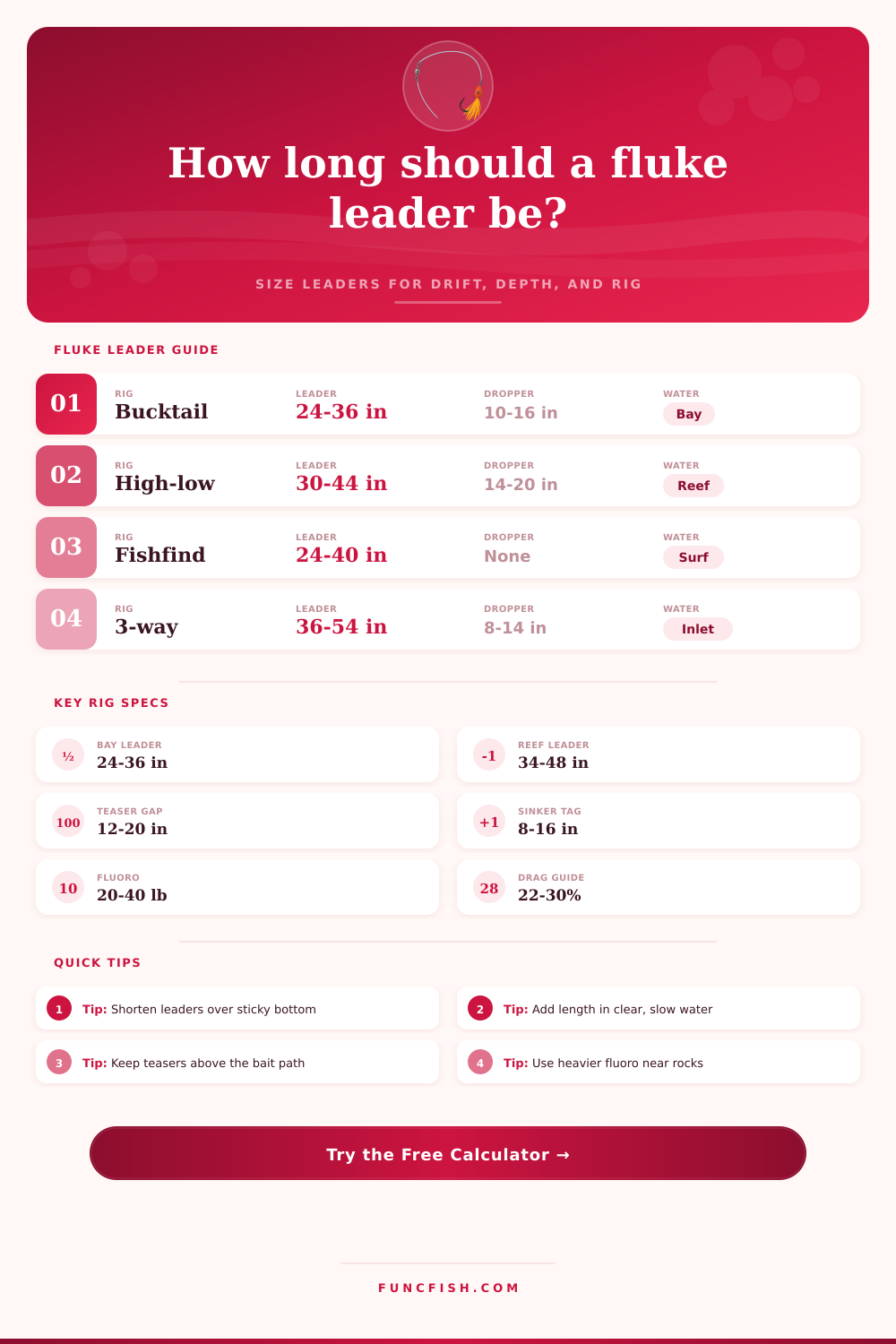
| Rig style | Primary leader | Teaser or dropper | Sinker trace | Best use |
|---|---|---|---|---|
| Bucktail with teaser | 24-36 in / 61-91 cm | 10-16 in / 25-41 cm | Direct jig, no trace | Bay, kayak, channel drift |
| High-low fluke rig | 30-44 in / 76-112 cm | 14-20 in / 36-51 cm | 8-14 in / 20-36 cm | Reef, ocean drift, mixed bait |
| Fish-finder leader | 24-40 in / 61-102 cm | No fixed dropper | Sliding sinker clip | Surf, long strip, natural bait |
| Three-way swivel rig | 36-54 in / 91-137 cm | 8-14 in / 20-36 cm sinker arm | 8-14 in / 20-36 cm | Inlets, live bait, heavy sweep |
| Double bucktail rig | 28-42 in / 71-107 cm | 12-18 in / 30-46 cm | Lower jig carries contact | Fast drift with active jigging |
| Short wreck-edge rig | 18-30 in / 46-76 cm | 8-12 in / 20-30 cm | 6-10 in / 15-25 cm | Sticky bottom and hard structure |
🌊Depth, drift, and bottom adjustment table
| Condition | Leader adjustment | Dropper adjustment | Sinker trace adjustment | Reason |
|---|---|---|---|---|
| Slow drift under 0.7 kn | Add 4-8 in / 10-20 cm | Add 1-2 in / 3-5 cm | Standard length | Gives bait more natural sweep |
| Fast drift over 1.8 kn | Subtract 4-10 in / 10-25 cm | Subtract 1-3 in / 3-8 cm | Shorten 2-4 in / 5-10 cm | Keeps rig from lifting and tangling |
| Depth over 70 ft | Add 2-6 in / 5-15 cm | No change | Add 1-2 in / 3-5 cm | Maintains separation in long line angle |
| Clean sand or mud | Add 2-4 in / 5-10 cm | Standard length | Standard length | Low snag risk allows more movement |
| Rock, wreck, cable, debris | Subtract 6-12 in / 15-30 cm | Subtract 2-4 in / 5-10 cm | Shorten 3-6 in / 8-15 cm | Reduces wrap-ups and abrasion exposure |
🧵Leader material and line matching table
| Leader material | Typical test | Diameter feel | Best pairing | Calculator effect |
|---|---|---|---|---|
| 20-25 lb fluorocarbon | Light bay and clear water | Thin, low visibility | 10-20 lb braid | Allows slightly longer leader |
| 30 lb fluorocarbon | Standard fluke leader | Balanced stiffness | 15-30 lb braid | Baseline strength rating |
| 40-50 lb hard fluorocarbon | Reef and doormat rigs | Stiffer, abrasion resistant | 20-40 lb braid | Adds abrasion margin, may shorten droppers |
| 30 lb nylon mono | Surf bait and forgiving rigs | Softer, more stretch | 15-30 lb braid or mono | Longer leader okay in open sand |
| 35 lb copolymer | Mixed bay and ocean use | Medium stiffness | 20-30 lb braid | Neutral length adjustment |
| 60 lb abrasion leader | Wreck edge and rough bottom | Heavy and stiff | 30-50 lb braid | Shortens rig to control bulk |
🐟Species and presentation comparison
| Target | Presentation | Leader length | Hook class | Leader test |
|---|---|---|---|---|
| Short fluke and mixed bay fish | Small strip, spearing, 3-4 in grub | 24-32 in / 61-81 cm | 1/0-2/0 | 15-25 lb |
| Keeper fluke | Strip bait, bucktail teaser, minnow | 28-40 in / 71-102 cm | 2/0-4/0 | 20-30 lb |
| Large ocean fluke | Long strip, 5-6 in grub, live bait | 36-52 in / 91-132 cm | 4/0-6/0 | 30-50 lb |
| Doormat fluke | Live spot, big strip, heavy bucktail | 42-60 in / 107-152 cm | 5/0-6/0 | 40-60 lb |
| Bycatch: sea bass, porgy, dogfish | Short bait above bottom | 20-32 in / 51-81 cm | 1/0-3/0 | 20-40 lb |
💡Leader layout tips
Formula tip: Treat the calculator result as the finished distance from swivel to hook or jig. If you tie large loop knots, add the knot allowance before trimming so the final leader still matches the result.
Rig tuning tip: If the rig spins, tangles, or planes high, shorten the main leader first, then shorten the teaser gap. If bites are timid in clear water, add length in 2 inch or 5 cm steps.
When you’re floating across some sweet fluke terrain and you get a tickling bite, then nothing, you’re hung up. A loop of leader material comes off the hook. Ugh! That’s happened to all of us. Most times it’s not luck that got you there. It’s geometry. And the science behind getting your leader length dialed in depend on knowing how physics relate to your presentation in drift fishing situation.
There aren’t as many hard-and-fast rules here. If you plug your bottom structure, your depth, and your drift speed into the calculator above, it do the math for you. No more guessing if conditions change. You’re going to want your bait close to the bottom where the flounder are cruising so that part’s pretty self-explanatory. But it isn’t just depth. Leader length also depend on current speed. The slower the current the longer leader you can get away with. The natural drift of the bait will take it away from the boat as it wanders along, giving you an advantage with line shy fish who don’t see that line hanging out there. With added slack, you have room for a strip or squid bait to swim around instead of having to drag it along awkwardely behind the sinker.
How to Choose the Right Leader Length
But when you’re floating fast over rough bottom such as rock, that long leader start getting in your way. Too much lift, and it snags on other stuff and tangles up on itself. This is why tool shortens the suggested length as you increase your drift speed and move into rougher bottom.
Length isn’t everything though, material selection is important too. Because fluorocarbon sinks. This help the bait stay down in the water column. However, heavier fluoro are stiffer. Stiff line doesn’t lay flat on bottom of the current. It will hold its shape and sometimes create drag that will lift the bait higher than what was intend. So if you’re fishing a mussel bed or wreck with heavy abrasion resistant leader, you may have to go a little short with your rig to account for that extra stiffness. Because mono sinks slower and stretches more, you can use longer leaders in sand channels without the bait lifting off the bottom. It’s a little thing. But when you’re trying to finesse a picky fish, it make a difference.
Most anglers mess up on the spacing of their teasers. Teasers should be spaced just enough to get a fish’s attention but not so far away as to interfere with main bait. Too close together and the fluke sees the jig and won’t bother the natural bait behind it. Too wide apart and you have an unstable rig in current. This chart does a good job explaining it all for various situations on page. A rig differs between an ocean reef and one for back bay strip bait.
In summer, the water is clear and the fish are wary and see everything. That bait need more separation from the boat’s shadow and noise. So a longer leader makes the bait look like it has more separation and increases the odds of it getting bit. In winter, the water is muddy so that separation isn’t as important since they don’t see well anyhow. Then you could of gone with short rigs and not spook the target.
Keep the fish species in mind as well. Doormats measure thirty inches while keepers are only twelve inches. Aggressive larger fluke runs deeper into the column, bite harder and with sharper teeth. They’ll cut through soft line like butter. Leader size should match the structure of the fish. You’re wasting your time with the right length if they cuts you off at the first hookset. The idea is to find the balance between sensitivity and survivability. The calculator suggest this based off the bottom and your target size.
“Fluke fishing is all about manipulating your surroundings. The tide, the weather, they’re beyond your control. What’s under your control though is what your rig does in those conditions. Lengthen your leader to account for depth, current, and structure. Turn a wild ride into a precise presentation. The tool provides you numbers. Now start there. Observe the behavior of your bait underwater. Shorten the leader if it’s dragging too much. Cut your line if it floats too high. Add some weight. It’s a tune-up. Get the geometry dialed in and knots become irrelevant. Bites stick and that’s where the fun starts.”