Fluoro Sink Rate by Diameter Calculator
Estimate fluorocarbon line sink rate from diameter, grade density, slack angle, salinity, temperature, lure load, current, and the amount of line settling below the surface.
📌Scenario presets
⚙Fluorocarbon diameter and water settings
Use actual package diameter when available; same test rating can vary by brand.
Fluorocarbon sink-rate estimate
Calculation breakdown
🧵Fluorocarbon grade data
Supple Main
Standard Main
Hard Leader
Premium Dense
Coated Casting
Shock Leader
Ice Fluoro
Heavy Leader
📏Diameter, test, and bare-line sink reference
| Nominal fluoro test | Common diameter | Approx bare-line sink | Wet negative buoyancy | Typical rig use |
|---|---|---|---|---|
| 3 lb finesse / ice | 0.145 mm / 0.0057 in | 3.8 in/s / 9.7 cm/s | 0.30 g per 100 ft | Ice jigs, tiny spoons |
| 4 lb trout tippet | 0.165 mm / 0.0065 in | 4.1 in/s / 10.4 cm/s | 0.39 g per 100 ft | Stream nymphs, clear water |
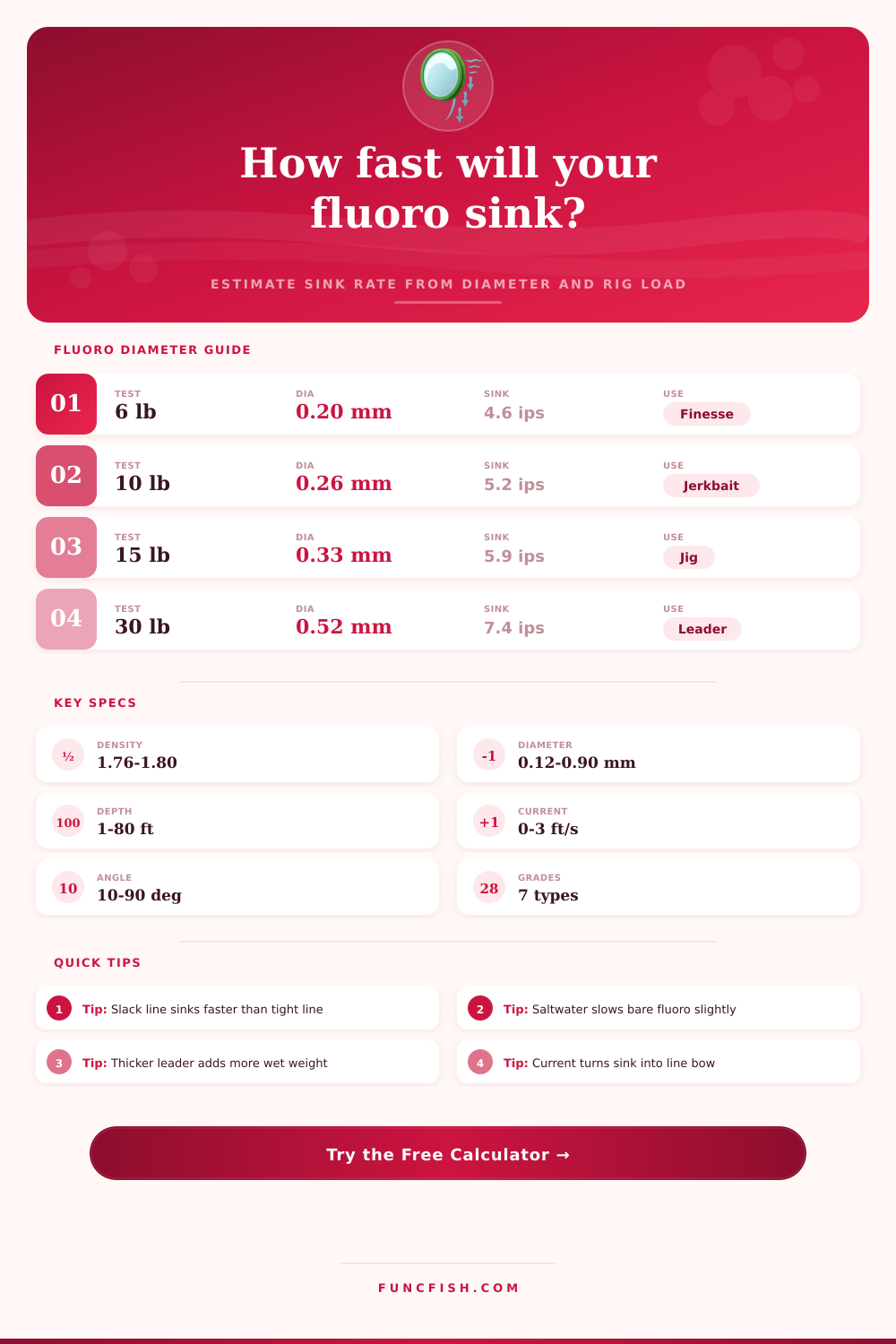
| 6 lb finesse | 0.205 mm / 0.0081 in | 4.6 in/s / 11.7 cm/s | 0.60 g per 100 ft | Drop shot, Ned rigs |
| 8 lb light spinning | 0.235 mm / 0.0093 in | 4.9 in/s / 12.4 cm/s | 0.79 g per 100 ft | Shaky head, small jerkbait |
| 10 lb casting | 0.260 mm / 0.0102 in | 5.2 in/s / 13.2 cm/s | 0.97 g per 100 ft | Jerkbait, light crankbait |
| 12 lb crankbait | 0.285 mm / 0.0112 in | 5.4 in/s / 13.8 cm/s | 1.16 g per 100 ft | Crankbait, finesse jig |
| 15 lb jig line | 0.330 mm / 0.0130 in | 5.9 in/s / 15.0 cm/s | 1.56 g per 100 ft | Football jig, worm |
| 20 lb leader | 0.405 mm / 0.0159 in | 6.6 in/s / 16.8 cm/s | 2.35 g per 100 ft | Swimbait, inshore leader |
| 30 lb shock leader | 0.520 mm / 0.0205 in | 7.4 in/s / 18.8 cm/s | 3.86 g per 100 ft | Surf leader, heavy cover |
| 50 lb offshore leader | 0.740 mm / 0.0291 in | 9.0 in/s / 22.9 cm/s | 7.82 g per 100 ft | Topshot, tuna leader |
🌊Water and rig modifier table
| Condition | Calculator factor | Sink-rate effect | Useful range | Interpretation |
|---|---|---|---|---|
| Cold freshwater | 1.000 density | Baseline to slightly slower | 35 to 55°F | Dense water resists line settling a little more |
| Warm freshwater | 0.997 density | Standard freshwater model | 56 to 82°F | Best all-purpose reservoir and river estimate |
| Brackish water | 1.010 density | About 1 percent slower | Estuaries, tidal creeks | More buoyant water reduces net fluoro weight |
| Full saltwater | 1.025 density | About 2 percent slower | Surf, bay, offshore | Still sinks because fluoro is much denser than water |
| Free slack | 1.05 tension | Fastest line-only fall | Cast-and-feed presentations | Little rod tension holding line near the surface |
| Tight line | 0.52 tension | Much slower apparent fall | Swimming bait, crankbait | The lure path, rod load, and line belly dominate |
🐟Gear and species comparison grid
| Species / setup | Common fluoro diameter | Depth window | Sink-rate target | Adjustment note |
|---|---|---|---|---|
| Stream trout nymph leader | 0.145 to 0.180 mm | 1 to 6 ft | 3.8 to 4.3 in/s | Small diameter drifts naturally with less line drag |
| Clear-water bass drop shot | 0.185 to 0.235 mm | 8 to 35 ft | 4.4 to 5.0 in/s | Semi-slack line keeps the bait connected without floating |
| Suspending jerkbait pause | 0.235 to 0.285 mm | 3 to 12 ft | 4.9 to 5.5 in/s | Thicker fluoro can pull the nose down on long pauses |
| Deep crankbait main line | 0.260 to 0.330 mm | 8 to 22 ft | 5.2 to 5.9 in/s | Line diameter affects dive depth and bow after the cast |
| Football jig or Texas rig | 0.310 to 0.370 mm | 8 to 35 ft | 5.7 to 6.3 in/s | Slack-line sink helps maintain bottom contact |
| Inshore seatrout leader | 0.370 to 0.435 mm | 2 to 10 ft | 6.2 to 6.8 in/s | Current and lure weight matter more than density alone |
| Surf leader for pompano | 0.435 to 0.620 mm | 3 to 15 ft | 6.8 to 8.1 in/s | Saltwater slows it slightly, but thick leader still settles |
| Offshore tuna topshot | 0.620 to 0.910 mm | 20 to 80 ft | 8.1 to 10.0 in/s | Heavy diameter adds wet weight but current creates broad bow |
⚖Rig load and line angle reference
| Rig state | Line angle | Terminal load | What changes | Calculator use |
|---|---|---|---|---|
| Long cast, slack loops | 12 to 22° | 1/16 to 1/8 oz | Slow vertical component and more surface bow | Use free or semi-slack tension |
| Normal bottom contact | 30 to 45° | 1/4 to 3/4 oz | Balanced line sink and lure pull-down | Use semi-slack for most jig and worm casts |
| Steep bank or dock pitch | 45 to 65° | 1/4 to 1 oz | Faster depth change with less lateral drift | Use contact if you keep a bowed but controlled line |
| Vertical boat drop | 70 to 90° | 1/8 to 2 oz | Line, lure, and weight fall in the same column | Use vertical tension and low current |
| Moving bait pause | 20 to 35° | 1/4 to 5/8 oz | Line pulls lure nose down as slack develops | Use moving-bait scenario and contact tension |
| Saltwater leader drift | 15 to 40° | 1/8 to 1 oz | Current adds bow before the leader fully settles | Use saltwater leader and measured current speed |
💡Calculation tips
Reading the sink rate: The result estimates the vertical settling rate of the fluorocarbon section, not the exact fall speed of the lure. Lure shape, hook mass, knots, vegetation, and rod movement can overwhelm bare-line behavior.
Using diameter correctly: Fluorocarbon density changes only slightly across grades, so diameter and line tension usually explain more of the difference. Compare actual millimeter diameter when two lines share the same pound test.
So there you go; you’ve got your line out and let the lure sink to the bottom. Something doesn’t feel right, though. Either way, your strike indicators twitches too soon, or they don’t move at all… And now you’re wondering if it’s just a matter of time until a fish finally shows up or if you’re just sitting in a bunch of weeds.
This disconnect typically happens because people do not know how fluorocarbon behaves under water. While fluorocarbon is denser than water, so it sinks, no, it doesn’t fall like a rock. Fluorocarbon falls in subtle ways. This depend on the line diameter, the tension of your rod, and the current pulling at it (even the current you can’t see). Knowing fluorocarbon sink rate is less about remembering any physics formula and more about understanding when your line are doing the work for you.
How Fluorocarbon Sinks Underwater
Fluorocarbon has a density closer to 1.78, so it’s going to try to sink towards the bottom instead of floating upwards as monofilament do. But there is more to it than just that density number. You’re only putting a portion of the material in the water column, and that is the true variable here. Heavier weight affects how quickly something sinks, but so do drag and volume. For example, a four-pound tippet are not going to sink nearly as fast as a thick thirty-pound leader. That’s where the calculator comes in. You can plug in certain diameters and see their corresponding vertical speed. This gives you an idea based off how to play with your line size and how much you can cut down time to get a bait into the strike zone by using a heavier leader or not.
Where most anglers gets thrown off on this issue is on a slack line situation. The second you cast out that drop shot rig or a bass worm, the line isn’t going to go straight down right away. Your rod tip holds the lure back while weight tries to move forward. This leaves you with a bunch of slack in the line, creating a bellied-out section in the water. What does this mean? Your sink rate loses much of its vertical component. In other words, if you’re fishing over some rocky bottom structure, it’s huge. You may think you’ve just sent your bait back down when in reality it’s already sitting on top of nasty stuff. Being aware of this time lag allows you to adjust your retrieve accordingly and avoid unnecessary snags.
But there’s one more complication that current adds which weight charts alone can not account for. A gentle two-foot per second current can moves a lightweight fluorocarbon line to the side which results in a long bow that will slow its fall. It slows down the fall a little bit, but noticeably so, a phenomenon compounded in saltwater where the denser seawater has a little bit more buoyancy. The result is your topshot leader won’t fall vertically downward, but instead drift off to the side away from your boat. Again, this is not something wrong with the line; it is just a matter of water movement. When you are considering the current, understand that you will need to give your bait more time to reach its target depth. You would of also likely need a heavier weight to balance out the drift.
Another unexpected factor here is line memory. If you’ve ever spooled up new fluorocarbon, you know what I’m talking about. Coils seem to never go away. They grabs water and impede the initial fall rate until the line is fully extended. This can be fixed by wetting the line before casting or using a more supple main line grade. This is just another little thing that will make a noticeable difference if you’re finesse fishing and need to touch bottom immediately.
The reference table on this page shows how different line grades behaves under the same conditions. Stiffer abrasion-resistant leaders drag more as they come untwisted while supple lines sheds water better and sink faster at first. So really, learning fluorocarbon sink rates boils down to simply being aware of what’s going on under the water. It’s not just about choosing the right pound test; diameter matter too. Your own fishing style matters. The water condition matters. How your line sinks impacts the way you present it, and it also affects your ability to read the bottom. From pitching a jig into heavy cover to drifting a nymph in a cold trout stream, knowing your line’s fall gives you a better sense of what’s in front of you.
Your bait shows up and you no longer guess, now you control where it sits. And that, from rod tip to river bed, is what translates missed opportunities into consistent catches.
Your line is tight. Your mind is clear. Your sink rate quietly works for you below.