Fluorocarbon Leader Cost Calculator
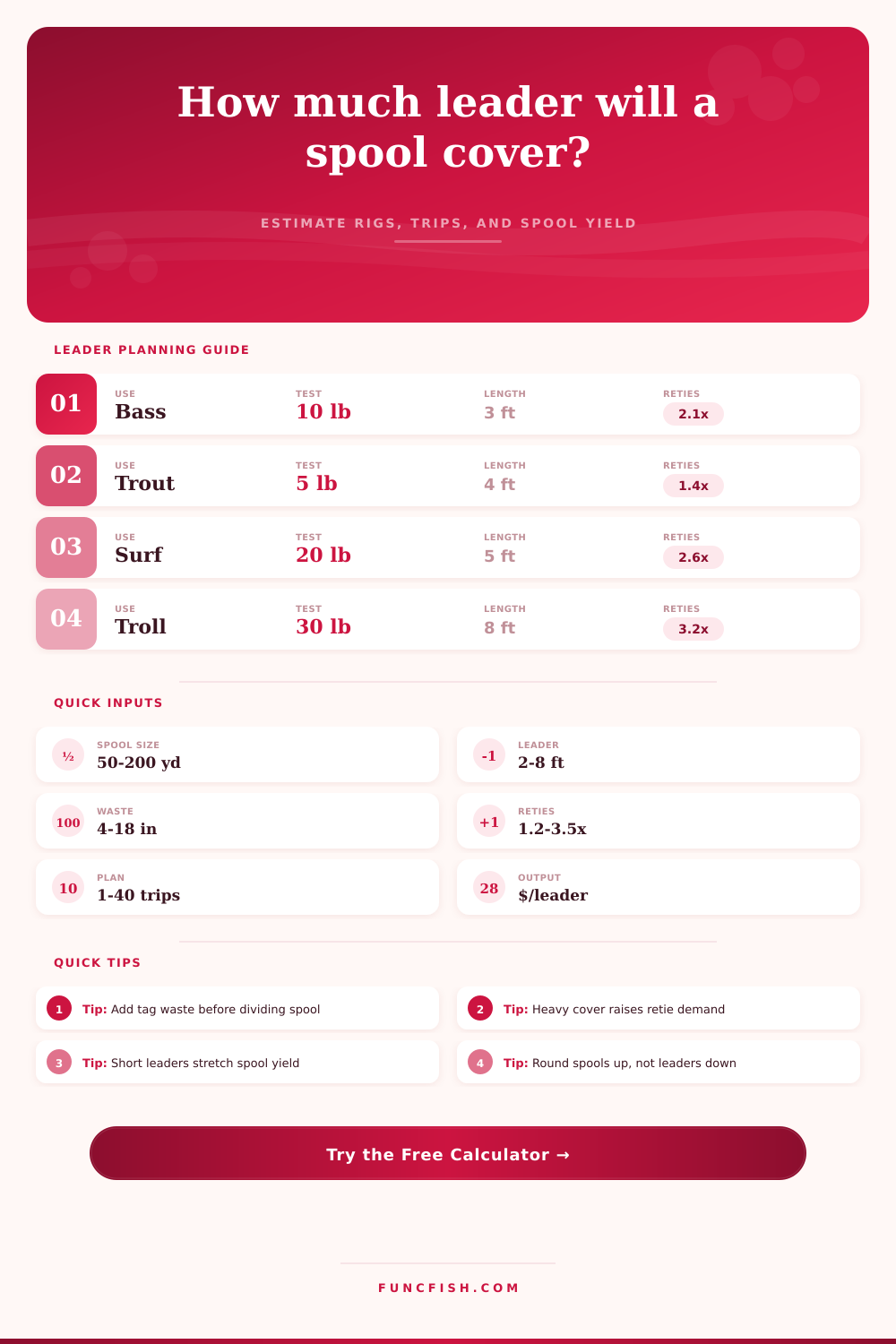
Estimate how many leaders a spool really gives after knots, trims, reties, and technique-specific waste.
📌Leader presets
⚙Spool and leader inputs
Leader cost forecast
Formula breakdown
📋Fluorocarbon material grid
4 lb finesse
8 lb utility
15 lb inshore
30 lb heavy
📐Leader reference tables
| Fluoro class | Approx. diameter | Suggested leader range | Planning note |
|---|---|---|---|
| 4 lb / 1.8 kg | 0.18 mm | 2-4 ft / 0.6-1.2 m | Low waste, small knots, clear-water rigs. |
| 6 lb / 2.7 kg | 0.22 mm | 3-5 ft / 0.9-1.5 m | Trout and light spinning leaders. |
| 8 lb / 3.6 kg | 0.25 mm | 3-6 ft / 0.9-1.8 m | Balanced freshwater leader class. |
| 10 lb / 4.5 kg | 0.28 mm | 3-6 ft / 0.9-1.8 m | Common bass spinning and casting setups. |
| 12 lb / 5.4 kg | 0.33 mm | 4-7 ft / 1.2-2.1 m | Extra abrasion margin around rock. |
| 15 lb / 6.8 kg | 0.37 mm | 4-8 ft / 1.2-2.4 m | Inshore leader with moderate trim waste. |
| 20 lb / 9.1 kg | 0.43 mm | 5-9 ft / 1.5-2.7 m | Shock sections and heavier bite leaders. |
| 30 lb / 13.6 kg | 0.52 mm | 6-12 ft / 1.8-3.7 m | Heavy trolling and rough leader handling. |
| Fishing plan | Base waste factor | Leader pace | Cost sensitivity |
|---|---|---|---|
| Finesse freshwater | 4% | Light reties | Most sensitive to tag waste. |
| Clear stream trout | 5% | Frequent tippet changes | Short leaders help stretch small spools. |
| Rocky jigging | 9% | Moderate reties | Abrasion checks drive extra leaders. |
| Inshore flats | 8% | Mixed reties | Long leaders make spool yield drop quickly. |
| Surf bait leader | 12% | Rough reties | Shock leaders consume material fast. |
| Toothy fish shock section | 14% | High inspection rate | Use a conservative spool count. |
| Offshore trolling | 16% | High leader turnover | Large knots and cuts dominate waste. |
| Fly tippet changes | 6% | Small repeated cuts | Trip cost rises with fly changes. |
| Spool size | 2 ft leaders plus 8 in waste | 4 ft leaders plus 10 in waste | 6 ft leaders plus 14 in waste |
|---|---|---|---|
| 25 yd / 22.9 m | 28 leaders | 15 leaders | 10 leaders |
| 50 yd / 45.7 m | 56 leaders | 31 leaders | 21 leaders |
| 100 yd / 91.4 m | 112 leaders | 62 leaders | 42 leaders |
| 200 yd / 182.9 m | 225 leaders | 124 leaders | 84 leaders |
| Leader material | Visibility profile | Abrasion behavior | Planning effect |
|---|---|---|---|
| Fluorocarbon | Low underwater visibility | Strong against light abrasion | Higher per-foot cost, lower replacement rate in clear water. |
| Monofilament | More visible than fluoro | Moderate abrasion resistance | Lower per-foot cost, often more stretch in long leaders. |
| Wire | Highly visible | Best for teeth | Short bite sections can beat long heavy fluoro on toothy fish. |
| Braid main line | Very visible as leader | Can fray on rock | Usually paired with fluoro instead of used as final leader. |
💡Calculation tips
Tip: Enter the finished leader length separately from tag waste. A 3 ft leader with 10 in of knots and trimming uses 3.83 ft of spool before extra handling waste.
Tip: For heavy cover, use the rough or tournament retie pattern when planning a full trip set. It is better to carry one extra spool than run short after repeated abrasion checks.
Okay, you’ve tied something that appears like a good knot. You cast it out and there’s a solid bite. And then you get hooked up and lose the fish, either because of another fish or a snag. So you pick the tippet apart, cut it off and start over again. By lunchtime you’ve done this three times and now your spool of fluorocarbon doesn’t weigh as much as it did on the peg board.
What happened? Bad luck, right? Well yes, bad luck plays into it but oftentimes what happens is we don’t plan ahead for our material consumption. We purchase line based off the yard or pound. But we don’t figure out how many damn leader are going to come from that spool. That takes into account breakage, trimming error, and number of knots we’ll tie. That’s where most folks go astray.
How to Calculate Fishing Line Waste
Once you plug in how much waste to expect, how long of a leader you want, and your spool size, it will do the math for you on the page. No need to mess around with conversions or coefficients. It makes you face the fact that three feet of finished leader is not three feet of line you’re going to have. That only changes if you don’t waste any line when tying knots. And then there’s the waste on cutting a piece off a spool and having to straighten it out.
If you’re not super-consistent with those and just tie a bunch of practice ties at the beginning, that stuff adds up pretty quickly too. You waste all of 10 inches per leader. That doesn’t seem like much. But times that by 50 leaders and that’s over four yards of nothing but junk. This explains that by taking your specified trim waste and adding it onto the finished length. Then it divides total spool volume by that number.
How do you know which line type to purchase? It depends more on how you fish than on your ability to tie knots. Are you trolling for stripers in rough surf? Are you fishing heavy cover for bass? Teeth and abrasion will eat away at your leader. Offshore trolling has been known to result in as much as sixteen percent waste (see the tool’s reference tables). So for every six feet purchased, almost one foot doesn’t make it back up. At that level, wasting money makes sense (go with a bargain-priced bulk spool).
On the other end of the scale, finesse trout fishing in a clear stream may only cost you five percent. Not great, either, but the ratio is more friendlier. It allows you to determine if spending big bucks for a high-performance spool makes sense or not. So if you burn through line like a tournament angler, it’s not going to matter and you’ll simply purchase additional spools. However, if you’re a careful angler who values that increased sensitivity, the extra cost may be worth it because you will get more leaders for your money.
Most folks don’t give enough thought to the retie pattern input. I mean, you just tie a new leader at the beginning of every trip, right? Nope. Inspecting fish multiple times, having worn-out knots, or dealing with fraying from abrasion means you might need to change your leader more than once. If using them normally, figure one and a half times as many leaders is changed per outing. For a rough cover pattern, that’s two and a half times.
The multiplier takes us to the trip cost output. This tells you exactly how much line material you spend each day. It is not each spool. And that makes all the difference in the world if you’re trying to make a budget for a season. One spool can last you one trip or three trips depending upon condition.
And don’t overlook the material grid. Thicker lines has more abrasion resistance but also more visibility and stiffness. Thinner lines break quicker on pointy things but go unnoticed in the water. The calculator isn’t judging. It is just quantifying the cost of that decision. A thirty-pound leader consumes significantly more material per foot than a four-pound tippet. Swap out ultralight trout fishing for heavy saltwater trolling and your spool count will suddenly increase. Plan for that and stock up on spools. Better to have a spare in the tackle box than be standing on the bank wishing you’d of calculated this before now.
Money and time spent fishing is an investment. The tools used for that investment should support it, not drain it. Knowing how much line you can actualy use means you don’t buy based on guesswork any longer. You buy out of data. What’s sitting on the shelf is only the beginning. What’s in your hand are leaders. Know exactly how much that next spool of line is really going to cost before you leave the driveway. Measure twice, cut once. Turn wasted money into planned success, one leader at a time. That is disciplined work.