Fly Casting Haul Distance Calculator
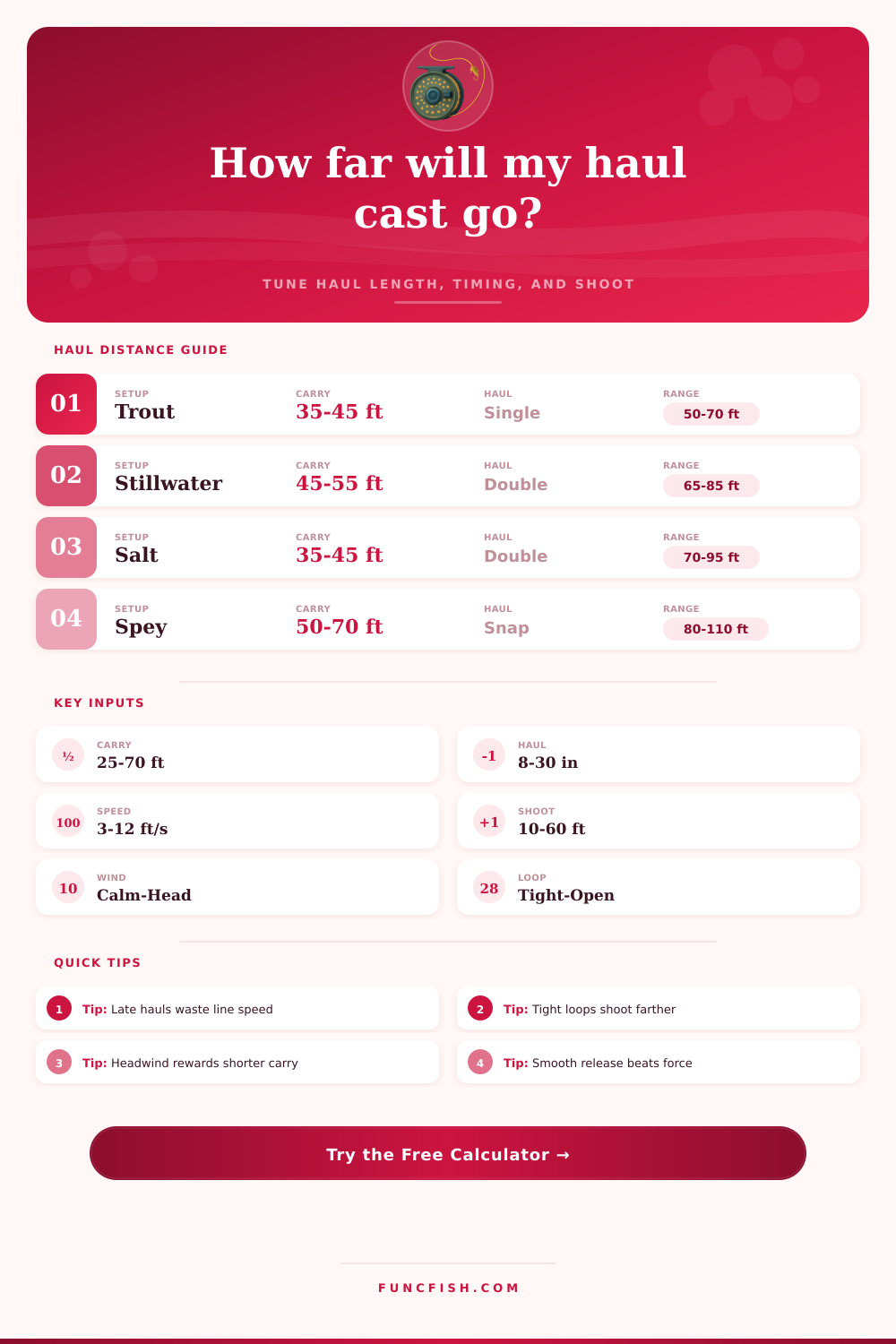
Estimate cast distance from line carried, haul stroke length, haul hand speed, timing, loop shape, shooting line, wind, fly resistance, and rod action.
📌Scenario presets
⚙Cast and haul settings
Fly casting haul forecast
Full breakdown
📋Line and haul reference grid
WF Trout
Stillwater
Saltwater
Shooting Head
| Haul pattern | Typical stroke | Speed gain | Best use |
|---|---|---|---|
| No haul | 0 in / 0 cm | 0% | Short casts and accuracy |
| Single haul | 10-20 in / 25-51 cm | 8-18% | Trout, nymphs, controlled pickup |
| Double haul | 16-26 in / 41-66 cm | 16-32% | Stillwater, saltwater, distance |
| Power double haul | 22-32 in / 56-81 cm | 24-42% | Heavy flies, shooting heads, wind |
| Late haul release | 12-24 in / 30-61 cm | 10-26% | Quick shots when timing is clean |
| Condition | Distance effect | Haul adjustment | Calculator note |
|---|---|---|---|
| Tight loop, calm air | +8% to +15% | Longer smooth haul | Line speed converts to shoot efficiently |
| Headwind | -12% to -24% | Shorter carry, sharper stop | Loop quality limits distance more than force |
| Open loop | -8% to -18% | Reduce power first | Wide loops burn line speed quickly |
| Big air-resistant fly | -10% to -25% | Slower acceleration | Haul helps, but turnover becomes the gate |
| Dirty line or wet grip | -6% to -14% | Clean line, open hand | Shooting loss rises after the stop |
💡Practical checks
Tip: If the calculator shows high haul gain but low timing score, shorten the haul stroke and pull later into the rod stop before adding more hand speed.
Tip: If effective shooting line is much lower than available line, improve loop shape, clean the line, or reduce fly resistance before trying to carry more line.
We all know that sinking feeling when your rod tip goes limp and you’re left dangling a heavy length of line helplessly over surface as the fish inches away, whether we’re just learning how to stop making loops or fighting a bonefish in hard breeze. For most people, it’s not about brute force. It almost always come down to timing and energy transfer.
You’re not throwing the fly; you’re building up momentum in a column of line then bringing it instantly to halt at end of your rod. This allow the kinetic energy captured there to propel leader forward. With a haul added into the mix, you have second accelerator.
How to Cast Further with Better Timing
With a few inputs (hand speed and carry length), the calculator does all math for you (above). You no longer has to guess with conversions and coefficients. It’s also weighted towards your actual effective stroke length. This means it turn raw pull strength into an estimate of distance based off how much of your pull effectively becomes forward momentum.
Hauling “hard” isn’t the key input; hauling at the right time relative to the rod stop is. Haul too soon and you’re simply pulling against friction with no leverage. Haul too late and you’ve missed acceleration window because the rod has unloaded. The tool measures that time discrepancy and illustrates exactly where you’re leaking energy before it ever gets to the loop.
Most anglers mess up by treating haul as a separate motion, like an extra step added to cast. Instead, if the rod load is timed right with the forward stroke, you should of feel one continuous movement during your proper haul. I have illustrated the difference between single and double haul in table at the top of page. The main point is how consistent the process are. Many times a crisp, short haul timed precisely to end of your forward stroke will be more superior than a long, sluggish pull that comes just a fraction of a second too late. You’re making a trade-off: precision for stroke length.
That trade-off becomes even more important when you are battling headwind or throwing big flies. In those cases, loop tightness is more important than raw power. The wind is a game changer. Because it serves as a brake on your loop. An open loop carries decent distance on inertia, even in calm air. But when you get a good bit of headwind blowing, that open loop falls apart. Instead of moving forward, it waste energy against the air resistance. So you gotta tighten up the loop.
You accelerate slower at first and speed up more later. And this is where the haul matters. It enables keeping the line speed high without blowing out width of the loop. It enables keeping the rod angle shallow for distance, but getting needed amount of force applied. Why we see more aggressive hauls and heavier lines used for saltwater casts: the air density hurt any inefficiency in transferring energy.
The last few yards matter more than you’d think for line condition. The line wants to fly out there, but all friction from dirty guides and wet line eats into it. Even with a tight loop and perfect timing, draggy line eating its way through guides will severly reduce your effective distance. It’s not something any extra power can cures; it’s a mechanical loss. Keep your hand open on the stop and clean your line, two easy solutions with huge impacts. Sometimes they’re more important than upgrading your rod.
The bottom line: Control leads to distance. After the stop, you want the line to go free. You are not fighting with air drag or friction. Use a marker down range in practice on the lawn. Feel for the rod bending and straightening then extend that action with the haul… Don’t add the haul to what you are already doing.
What we are trying to do is get the line moving longer without increasing arm movement. It’s not about how fast you move your arms. Once the timing clicks, the distance just happens. You know where the fly will be, so it is not guesswork anymore. It becomes confidence. This transforms whole thing from a frustrating struggle into a dependable delivery system.