Fly Casting Loop Size Calculator
Estimate practical fly casting loop width, vertical window, line speed demand, and turnover margin from rod setup, carry length, fly load, wind, and caster control.
📌Scenario presets
⚙Loop and casting settings
Fly casting loop forecast
Full breakdown
📋Loop family reference grid
Tight Trout
Medium Utility
Open Load
Anchor Cast
📊Reference tables
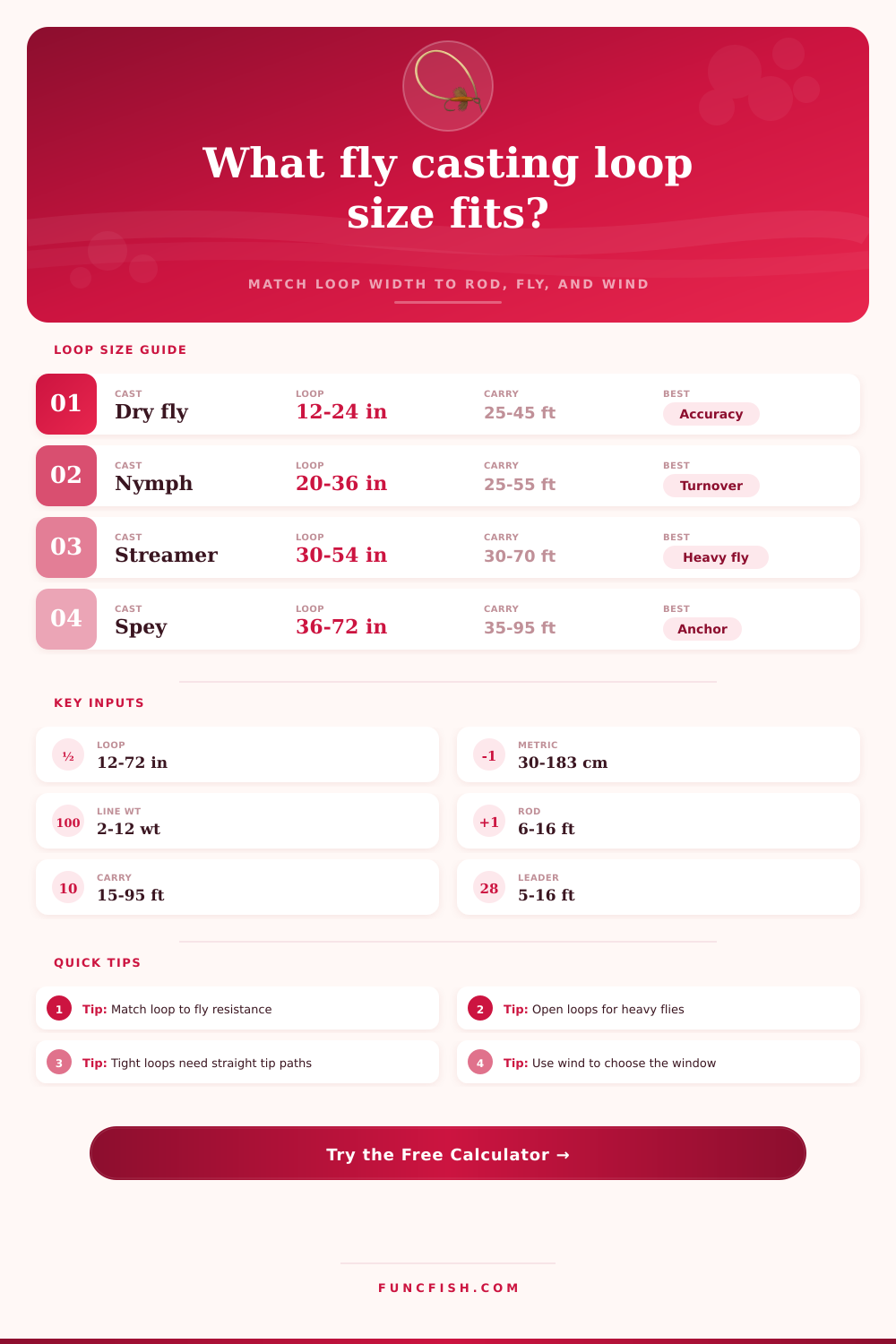
| Loop class | Width range | Best use | Common tradeoff |
|---|---|---|---|
| Extra tight | 10-16 in / 25-41 cm | Calm dry fly accuracy | High tailing-loop risk |
| Tight | 16-24 in / 41-61 cm | Trout, wind, quick shots | Needs straight tracking |
| Medium | 24-42 in / 61-107 cm | Nymphs and general fishing | Less wind penetration |
| Open | 42-60 in / 107-152 cm | Streamers and bass bugs | More air resistance |
| Very open | 60-78 in / 152-198 cm | Spey anchor or heavy tips | Slower, wider delivery |
| Line family | Typical carry | Loop tendency | Turnover note |
|---|---|---|---|
| Double taper trout | 25-55 ft / 8-17 m | Medium tight | Smooth loops and roll casts |
| Standard WF trout | 25-45 ft / 8-14 m | Tight to medium | Balanced front taper |
| Compact streamer head | 20-35 ft / 6-11 m | Medium open | Heavy fly turnover |
| Shooting head | 24-38 ft / 7-12 m | Medium | Carry the head and shoot |
| Skagit head | 18-32 ft / 5-10 m | Open | Sustained anchor and tips |
| Long belly Spey | 55-85 ft / 17-26 m | Open controlled | Rewards smooth sweep |
| Fly load | Suggested loop shift | Leader effect | Practical cue |
|---|---|---|---|
| Tiny dry fly | -4 to -8 in | Longer leader okay | Pointed, quiet loop |
| Bead nymph and indicator | +6 to +14 in | Shorten if hinging | Open top leg slightly |
| Weighted streamer | +12 to +22 in | Use shorter leader | Oval or Belgian cast feel |
| Foam bass bug | +14 to +26 in | Strong butt section | Let the fly trail outside |
| Sink tip rig | +18 to +30 in | Tip counts as load | Open loop prevents collision |
💡Practical checks
Tip: If the fly or indicator clips the line, open the loop before adding more power.
Tip: If a tight loop tails, reduce force, smooth the stroke, or widen the target loop by a few inches.
So there you are standing on the bank sending a stroke out front with the rod tip low. And what happens? A tight little loop forms and goes thirty feet with a lot of energy behind it. The dry fly turns upside down as it hits the water like a brick. The nymph hitches. The streamer crashes in its own leader. What’s wrong?
You didn’t make a mistake casting. You just matched the loop size to the job at hand. That’s the distinction between really fishing and just throwing line.
How to Change Your Loop Size for Better Casting
Loop width isn’t something most anglers think about, it’s something we assume is simply an attribute of our rods. But in reality, it’s a dial. When we want to make a tight loop, we can does so in a headwind with great precision; the loop has far less surface area on which the wind can grab hold. It transfer energy cleanly into leader.
But when we go to land a big bulky bass bug or a heavy sink tip, the same aerodynamics that made the loop efficient cut the other way. There is too much mass in fly for the loop to carry it without collapsing. Tailing loops occurs, and the tail leg slaps the front leg. The calculator quantifies this trade off based off the actual terminal tackle drag vs. It depends on weight of the line taper you are using. It removes the guesswork and lets you know your target width before picking up rod.
Think about what you’re putting into it. What do you think creates the same loop on every cast with a nine-foot rod? Use the tool to understand how action work. Because the fast-action tip craves to snap back rapidly, it requires a narrower track to maintain its cleanliness. Allow your hand to stray two inches one way or the other and that fast tip will punish you with a wider messy loop losing distance in the process.
On the other hand, the slower rod will forgive sloppy hands while generating wider loops by nature simply due to length of time the line remains in the air throughout the cast cycle. This is where the tool’s scenario presets are spot-on. Where a standard dry fly cast calls for a narrow box to hit within, a weighted streamer bank cast begs for an open loop in order to turn over well.
It isn’t about hucking harder. It’s about forming the energy properley. In the real world, the neat categories we place in our heads don’t exist. Fish roam from deep pool to shallow riffle. Wind shifts directions every 10 minutes. That means switching up big patterns to nymph rigs. The only way to do this isn’t changing rods mid-cast, but adjusting your hand path at rod tip to alter loop size.
Here’s where the tracking tolerance comes into play. This is a precise way to determine how straight your hands need to be to maintain the loop shape you want. For example, if the tool says you should of use a tight loop to penetrate wind, it will also inform you that you have no margin for error here. When attempting to cheat the wind, you have to pay closer attention to mechanics. After years of casting you start to intuitively know what you’re doing, but that doesn’t mean it’s not easy to learn the fundamentals right away.
More weight on the end require more line speed to turn over. This means you will tend to open up the loop to let the energy transfer slow. You don’t want to tighten down the loop with a heavier fly because then you’re essentially telling your rod tip to pick up the slack by accelerating even further. That might make up for the lack of momentum in a tighter arc, but it will be both mechanically wasteful and physically hard on your casting arm. Opening up the loop a little take pressure off your casting arm. It also makes a nice soft presentation much more likely.
So what should it feel like? Wherever your results land on that scale, the quick sanity check comes from the reference tables. These show normal range of actions for various types of lines. Skagit lines wants wide sweeping action while double tapers enjoy a medium loop. Consider them more a map than a rule book.
You’re after smooth delivery. So much so that if you start fidgeting and trying to force some arbitrary number then you’ve lost the plot completely. Because when the loop size fits the load you get this effortless sense of “that’s the best I can cast”. It’s not about the muscles doing the work anymore; now it’s all about the line. Get the shape right, trust the taper, let the water take the fly.