
Sometimes we get excited about a new fly rod because it balances well in the store, only to realize it cast awkwardly when we’re out fishing. Perhaps the line turns over slow or the loop wobbles. It could be the wind or maybe it’s our own lack of skill, but more times then not, it’s due to poorly positioned guides.
Guides aren’t merely for looks. They manages the energy transfer between your hand and the fly. Poor guide shape results in friction at an improper location, disrupting the smooth flow required to cast effectiveley. A bad rod can never be corrected by practice.
How Fly Rod Guides Affect Your Casting
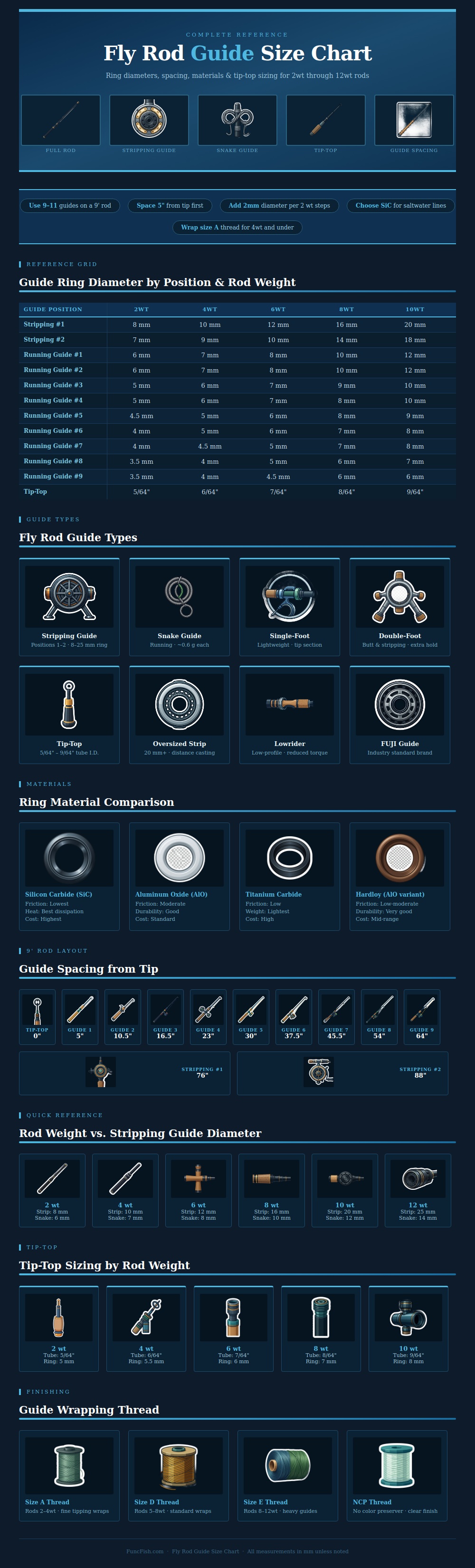
As the weight of your rods gets heavier, you’ll notice the diameter of their rings has to be larger. The reason for this is so the line doesn’t rub on a smaller ring above it or bunch up on a bigger one below. If you compare a light two-weight rod to a heavy ten-weight rod, you’ll see that the stripping guides near the butt section has a much larger diameter. Why? Because heavier rods is used with thicker lines.
To reduce line roll on long casts, big guides are needed. Without them, there is resistance on that first guide. This take energy away from the loop, causing a loss of distance and accuracy before the fly lands.
People tend to think about just the tip-top when starting out. They don’t realize that the bulk of the rod consist of running guides. Notice how size of rings gradually gets smaller as you look at exact taper in the infographic. That’s because it keeps an even line positioning. Too big near the tip and the line tends to slide down to next set of guides when the going gets tough. Then the guide breaks or hangs up.
The gap between the guides matter as well. You don’t want the guides clumped too much on a nine-foot rod. It weighs down your top section unecessarily. Your tip feels heavy and sluggish. With good space, the blank flexes freely with no trouble.
A second consideration on guide material selection different than size is the material itself. High-end saltwater rods often use silicon carbide rings because they are very low friction. They also don’t heat up much and resist line melt with long casts. A solid mid-range alternative is aluminum oxide, known for its durability and suitability for freshwater applications. Lighter titanium carbide comes with a premium but it do offer weight savings. The best fishing isn’t always about the most expensive material, but rather having the right material for where you fish.
If you have cheap guides on a high-performance rod, the contact points won’t be right. You would of waste the engineer’s work on the rest of the rod.
The final step involves wrapping the guides nice and tight. According to the chart, use a specific diameter of thread depending off your rod weight. Lighter rods should of been wrapped with finer thread because they get beat up less. A heavy thread isn’t as important for them. Big rods take more abuse so the thicker the better.
A nice tight wrap finishes off your guide and seals the fibers in the blank from abrasions and moisture. If everything lines up, the rod will perform nicely. The ring size must be right for the line weight, the spacing must allow the rod to flex properly, and the material must be able to withstand the heat. Then it casts effortlessy.
And that’s what we’re looking for when we’re standing there at the water’s edge waiting on that line to turn over just right.