Fly Tying Dubbing Quantity Calculator
Estimate dubbing weight for a tying batch from hook size, fly style, body length, body diameter, fiber type, packing method, accent blend, and trimming waste.
📌Fly tying presets
⚙Dubbing batch inputs
Dubbing quantity results
Calculation breakdown
🧪Dubbing material data
Very airy floating blends for emergers and sparse dries.
Slim dry fly bodies with low bulk and clean taper.
Natural nymph dubbing with guard hair and moderate spike.
Spiky, durable collars that need more weight per volume.
📊Material comparison grid
Best for slim mayfly, caddis, and midge bodies where over-dubbing quickly spoils the taper.
Good all-around nymph fiber; guard hairs add volume, so the calculator raises trim allowance.
Synthetic flash reads bulky but weighs moderately; useful for hotspots and collars.
Long staple fibers are efficient in loops, though clipped waste can be higher on compact heads.
📘Reference tables
| Fiber type | Practical use | Mass factor | Typical waste |
|---|---|---|---|
| Superfine synthetic | Dry fly abdomens, midges, small caddis | Very light | 6% to 12% |
| CDC blend | Emergers, floating thorax, cripple patterns | Airy | 8% to 14% |
| Hare's ear mask | General nymphs, thoraxes, wet flies | Medium | 12% to 20% |
| Squirrel blend | Spiky nymphs, collars, buggy legs | Heavy | 16% to 28% |
| Ice dubbing | Flash thorax, hotspot, attractor bodies | Moderate | 10% to 18% |
| Seal substitute | Spey flies, leeches, streamer heads | Medium-long | 15% to 30% |
| Hook range | Common dubbed length | Average diameter | Typical fly |
|---|---|---|---|
| #22 to #18 | 2.5 to 4.5 mm / 0.10 to 0.18 in | 0.5 to 0.9 mm | Midge thorax, tiny dry |
| #18 to #14 | 4 to 7 mm / 0.16 to 0.28 in | 0.8 to 1.4 mm | BWO, caddis, small nymph |
| #14 to #10 | 6 to 10 mm / 0.24 to 0.39 in | 1.2 to 2.0 mm | Hare's ear, pheasant tail |
| #10 to #6 | 9 to 16 mm / 0.35 to 0.63 in | 1.8 to 3.0 mm | Stonefly, scud, wet fly |
| #6 to #2 | 14 to 28 mm / 0.55 to 1.10 in | 2.5 to 4.5 mm | Streamer head, leech, spey |
| #2 to 2/0 | 20 to 45 mm / 0.79 to 1.77 in | 3.5 to 7.0 mm | Shrimp, crab, saltwater head |
| Pattern style | Quantity behavior | Best method | Calculator note |
|---|---|---|---|
| Midge thorax | Tiny pinches; easy to overestimate | Sparse waxed thread | Uses the lowest coverage factor |
| Dry abdomen | Slim tapered noodle | Fine direct dubbing | Reduced for float and silhouette |
| Nymph body | Moderate dubbing plus taper | Normal or firm noodle | Balanced default factor |
| Scud or sowbug | Longer dubbed shell profile | Firm noodle with pick-out | Higher body shape allowance |
| Streamer head | Bulky head or collar | Loop or brush | Waste rises after trimming |
| Spey dubbing loop | Long fibers and clipped ends | Composite loop | Extra loop allowance applied |
| Batch size | Dry fly estimate | Nymph estimate | Streamer estimate |
|---|---|---|---|
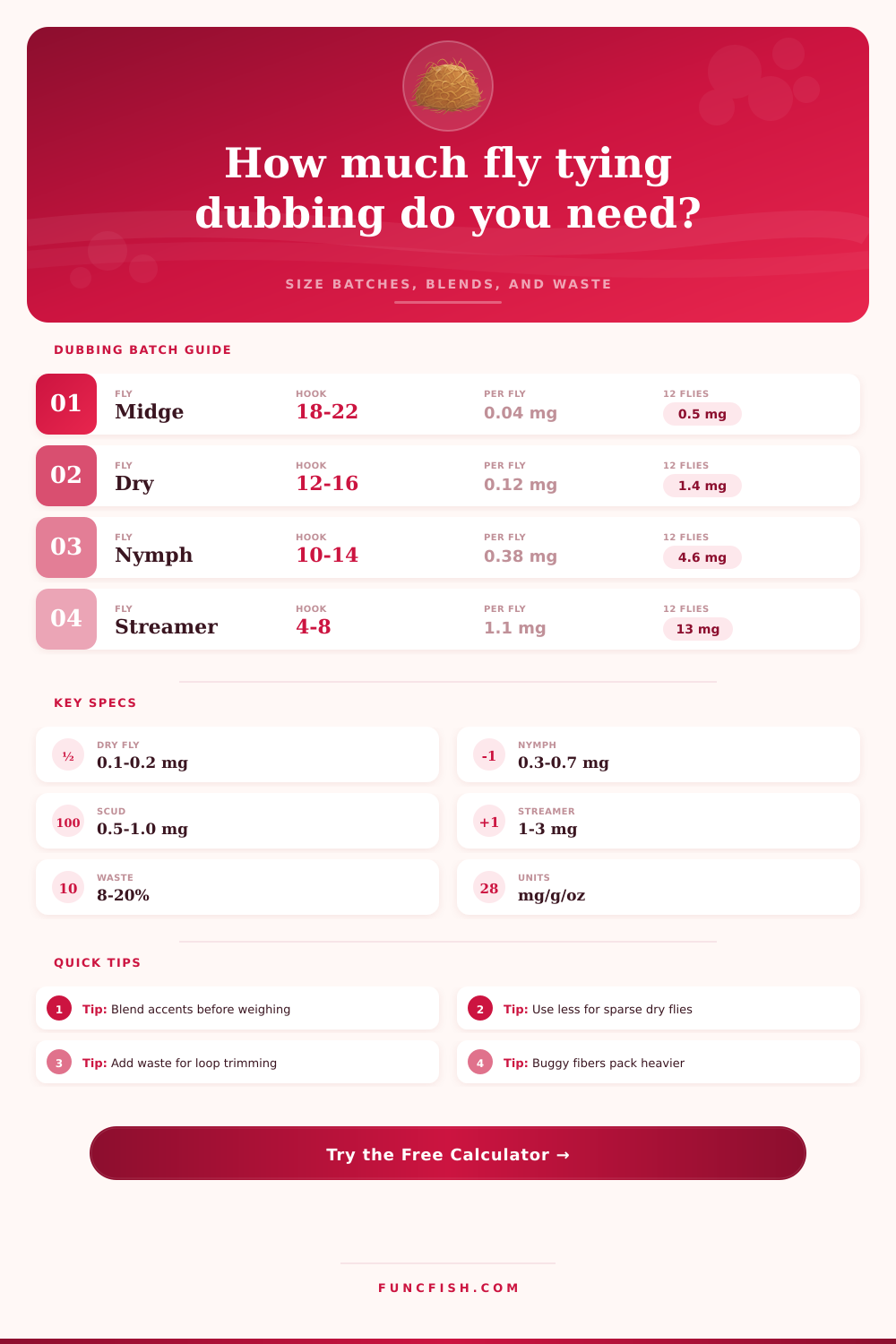
| 6 flies | 0.6 to 1.2 mg | 2 to 5 mg | 7 to 18 mg |
| 12 flies | 1 to 3 mg | 4 to 9 mg | 14 to 36 mg |
| 24 flies | 2 to 6 mg | 8 to 18 mg | 28 to 72 mg |
| 50 flies | 5 to 13 mg | 18 to 38 mg | 60 to 150 mg |
💡Tying quantity tips
When you see the bottom of a jar of dubbing and begin to panic because it appears only half full, that’s normaly just your perception of weight compared to volume. Because dubbing is primarily made of air contained within fibers, it cannot be estimated visually. What seems like a large pinch of loose synthetic may weigh nearly nothing, and a heavy wad of natural fur may wrap around the whole of a nymph body.
This is why most tiers runs out of some types of materials but are swimming in others: There is no correlation between what they think they’re taking (what it looks like) vs. What they actualy take (how much).
Why Dubbing Weight Matters More Than Size
The beauty of this is that all that math has been done for you by the calculator when you put in your dimensions. Instead of having to guess at units and coefficient conversions, it does the work for you. Because you’re not casting lead but rather wrapping threads around a bunch of fibers to fill up some space, it models the fly body as if it were a tapered cylinder instead of solid. So it asks for an average finished diameter and then a length of what’s dubbable.
Most people overestimate the diameter when they look at the initial wrap or gap between hook shank. But you want to think about how big the fly will appear once you brush out the fibers. Your slim dry fly abdomen may look really fat on the hook, but you need much fewer fiber to make it look airy and delicate.
And then there’s fiber type. Synthetics, especially blends with superfine fibers, trap air well. This means they can has significant volume with less weight. Natural fibers such as squirrel or hare’s ear is full of dense under fur and guard hairs. Those natural fibers also weigh more per millimeter of length. You’ll notice this most when comparing nymph dubbing masks. Many of them look similar in shape but use much more material than a synthetic dry fly blend of the same size.
The table on the page rates mass factors of various fibers. It’s not all about texture and color, it’s about density. That big, bulky head collar on that streamer requires heavy materials that sink a lot of weight right at the tie-in zone. In contrast, the thorax of a midge need very little material. This is because every milligram matters for keeping the fly up out of the water.
Anytime we talk about tying, waste becomes a major cost driver. Expensive flash dubbing can be sent flying to the floor based off your tying bench thanks to static electricity. Then there’s looping, more loss. That’s why the calculator has an input for allowing for waste. If you use a higher percentage here, you’re creating more loops or using a pre-made dubbing brush. Either way, you’re paying for the fiber that makes it into the trash bin next to your vise. Not considering waste means you’ll buy smaller packets far too frequently, which typically costs more per gram than bulk blends.
The other twist is mixing. Accenting a base color with some flash or UV fibers adds yet more variables to consider. You’re going to mix 90/10 main/accent and hope it turns out right? It would of been better to have that fiber in your hand before you start tying, rather than halfway through when you realize you have run out. By using the tool you can split the total weight of a batch into two parts: one for accent and one for main body fibers. That way you know you’ll end up with a consistent mix throughout a dozen flies. You won’t get a vibrant first three followed by a dull finish on the last few because the accent ran out.
Moving from thinking in terms of visual pinches to thinking in terms of grams shifts the way you organize your shop. From then on out, you buy according to your project’s need as opposed to impulse. Your expensive CDC jar doesn’t magically empty itself down to just a few emergers anymore. You learn that it wasn’t some kind of defect; instead, it’s an airy fiber being used little by little.
Trusting the eye versus trusting the geometry is the trick. After measuring the body size you intend, let the density factors do the work for you and poof! The mystery clears up. You get control over your inventory level, and most importantly, your material cost. It doesn’t have to be gone in the second week either. If it’s measured out properly at the start, it won’t be.
Just as measuring twice and tying once works for hook size, it also works for the amount of dubbing. Once you realize weight is what matters and volume is an illusion, then your ties will come consistently and your supply lasts for as long as it should.