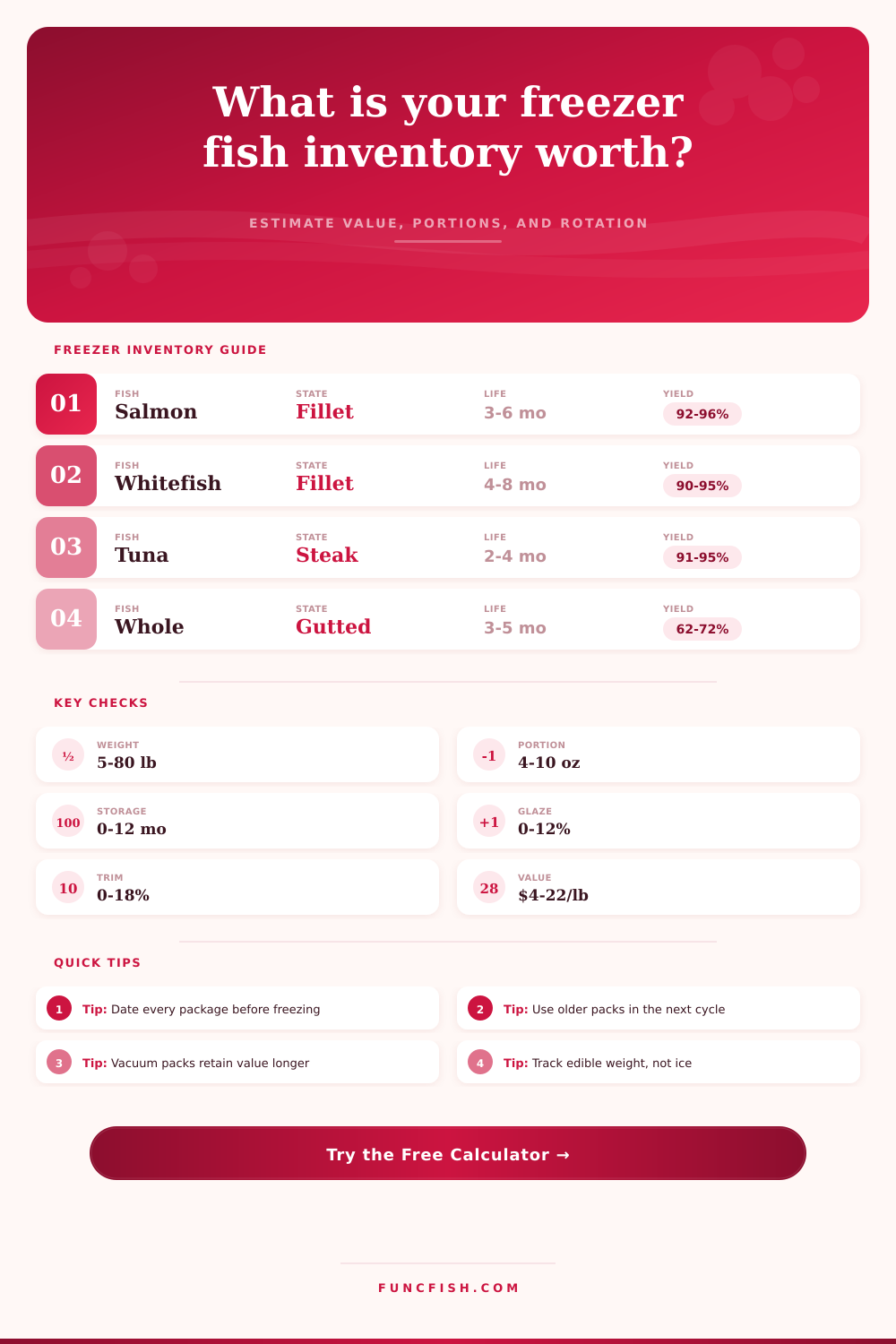
Freezer Fish Inventory Value Calculator
Estimate the retained value, edible weight, meal portions, and rotation priority of frozen fish by species group, package condition, and time in storage.
📌Inventory presets
⚙Freezer inventory inputs
Inventory estimate
Formula breakdown
🧊Package protection comparison
Vacuum sealed
Water glazed
Freezer bag
Paper wrap
📋Reference tables
| Fish group | Typical edible factor | Baseline freezer life | Common package style |
|---|---|---|---|
| Salmon / steelhead | 0.94 fillet factor | 5 months | Vacuum bag or glaze |
| Whitefish / walleye | 0.93 fillet factor | 7 months | Vacuum bag or paper |
| Halibut / firm white fillets | 0.95 steak factor | 6 months | Vacuum bag or container |
| Tuna / pelagic steaks | 0.93 steak factor | 4 months | Vacuum bag |
| Whole gutted fish | 0.68 edible factor | 5 months | Glazed wrap or container |
| Package type | Retention effect | Extra handling loss | Inventory note |
|---|---|---|---|
| Vacuum sealed | Highest retention | 2% | Best for longer storage |
| Water glazed | High retention | 4% | Subtract glaze from edible weight |
| Freezer bag | Moderate retention | 6% | Works when air is pressed out |
| Freezer paper wrap | Moderate retention | 8% | Rotate before premium packs |
| Loose or thin wrap | Lowest retention | 14% | Use early or downgrade value |
| Storage ratio | Retention band | Rotation priority | Suggested label action |
|---|---|---|---|
| 0% to 35% of life | 92% to 100% | Low | Keep in normal order |
| 36% to 70% of life | 76% to 92% | Medium | Move ahead of new packs |
| 71% to 100% of life | 55% to 76% | High | Plan next meals around it |
| Over 100% of life | 35% to 55% | Urgent | Inspect and use first |
| Portion target | Imperial size | Metric size | Best inventory use |
|---|---|---|---|
| Light serving | 4 oz | 113 g | Lunch bowls and panfish |
| Standard serving | 6 oz | 170 g | Most fillet meals |
| Large serving | 8 oz | 227 g | Steaks and grilled portions |
| Family pack basis | 24 oz | 680 g | Four standard servings |
💡Inventory checks
Tip: Separate ice glaze from fish weight when the package is heavily frosted; otherwise the inventory looks larger than the edible supply.
Tip: Run older freezer paper and loose-wrap packs before vacuum packs, even when the total weight is smaller.
When you open the freezer door, you find frost-encrusted blocks and opaque bags. They contains a big chunk of your protein supply, but you don’t know what’s in there, exactly, or how much it is worth. Frozen weight are not the same as edible weight, and here’s where math becomes interesting.
That unknown inventory becomes a clear picture: What’s usable? How much it is worth? The calculator above does all this math for you so that you can strip out the guesswork, the ice, the trim and get to numbers that matter for your meal plan.
How to Know What Is in Your Freezer
Packaging matters. And here’s where things gets interesting: How you package makes all the difference. Why do vacuum sealers exist if not for their ability to remove that culprit air. The air responsible for freezer burn? The resulting flavor stays fresh; texture remains firm. So when you opt for this route, the tool recognize it’ll retain more of that freshness by adding an increased retention factor.
Now, paper wraps and those flimsy plastic bags… Those suckers is super permeable. Moisture escapes through pores, leaving dry edges you must eventually hack off. This trim loss mean lost weight that vanishes down the drain. And that’s precisely why calculator prompts you to consider this cost. This ensures whatever you’re estimating captures what ends up on your plate, not what goes in the trash.
And what about ice? In world of glazes, a layer of ice is sprayed on top of fish to prevent dehydration. You’re right; it’s an industry practice. And it sounds like something that should of helped. Except that it also inflates weight. A ten pound bag of glazed fish may in fact only weigh eight pounds of actual protein.
That’s why the calculator allow you to enter the glaze percentage, so that it can deduct this frozen water from the final total. Because again, the ice isn’t something you’re paying for; its the fish. Fail to account for glaze factor, and you’ll end up overstating value of your inventory and miscalculating your portion counts. What you thought was going to stretch into six dinners turns out to last only four.
Another thing is age. Old fish isn’t good fish. In other words, old frozen fish gets worse over time. Each species type have a baseline freezer life. For example, a fatty fish like salmon or mackerel will go bad sooner than lean whitefish, but even then the quality still goes downhill slowly.
So if some of your fish has been languishing for a few months, it’s still got high retention. If it’s been hanging around for nine, even though it’s still “safe”, value is much lower. This is where rotation order really comes into play. You’ll be able to visualize it easily. Which bags should come forward to the front of line? Which ones can remain all the way at the back? This provide a quick visual clue to avoid wasting fish.
Most folks is thrown by portion size. Generally speaking, a fillet is six ounces while steaks tend to be heavier. You can adjust that in the calculator and see what impact it has on the final number of meals without altering total weight. That helps when planning out how much you want to make.
If you have a big chunk of halibut, for instance, you’ll know exactly how many dinners comes from it and if you should just cook the whole thing now or freeze some for later. It makes abstractions like weight more concrete, like “oh, I could make 4 meals with one of these fillet.”
Scroll down the page and see the reference tables laying out basic expectations of each group of fish. Why does a loose wrap around an entire fish spoil sooner than a tightly vacuum-sealed tuna steak? Because of surface area exposed to air, it’s not just how it’s packaged but also that. A whole gutted fish has less edible value because of its organs and bones, which all affect how fast it spoils. So understanding this will help inform your strategy: what do I consume first? You don’t want those things going bad before you get to them. Cook the vulnerable stuff first!
But in the end, this is all about control: Control over that precious resource called your freezer inventory. It’s easy to forget what you have in there, but with this you don’t guess anymore; you plan. You’ll know what’s on hand, how much it’s worth, and when it should be used up. Nothing will go to waste; every meal will be accounted for, and that clarity turns a chaotic freezer into a pantry stocked with everything you need.