Girth to Weight Ratio Calculator
Estimate fish weight from length and maximum girth, compare the girth-to-length ratio, and calibrate the formula when a real scale weight is available.
📌Scenario presets
⚙Fish measurement inputs
Use total length from closed mouth to tail tip.
Measure the fullest body circumference.
Leave blank to estimate only.
Girth-to-weight forecast
Full breakdown
📋Measurement equipment grid
Soft seam tape
Bump board + tape
Fish cradle
Retractable tape
Digital scale check
Lip-grip scale
Photo measure app
Rod or line marks
📊Formula comparison grid
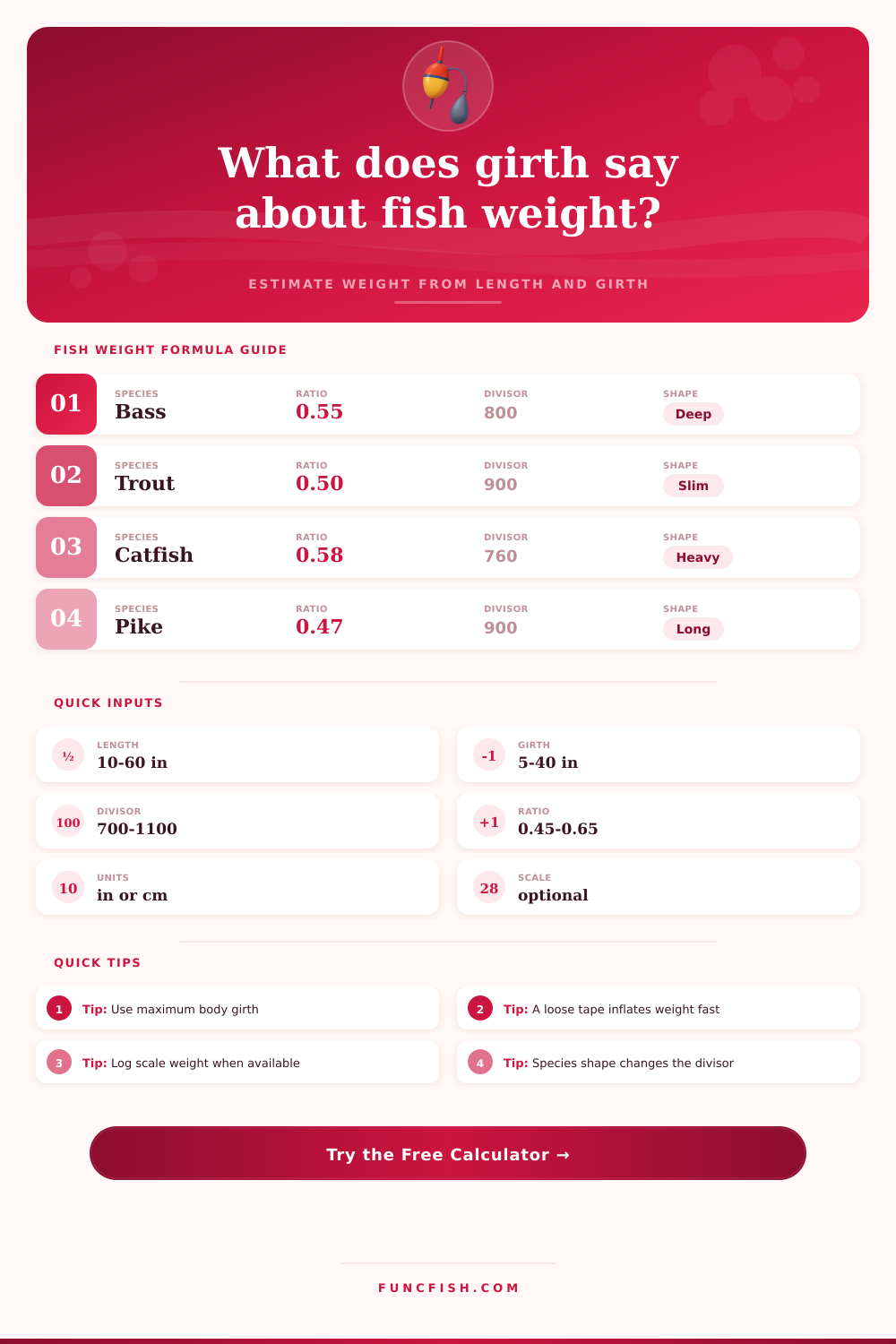
Standard formula
800Common all-around divisor for length x girth x girth when both measurements are in inches and weight is in pounds.
Deep body
700Raises the estimate for unusually thick fish with a tall, rounded profile such as heavy pre-spawn fish.
Slender body
900Lowers the estimate for long-bodied species where length adds less weight than girth.
Scale calibration
L/G²When you enter a true scale weight, the calculator reports the divisor that best matches that catch.
📘Reference tables
| Species profile | Typical divisor | Expected ratio | Shape note |
|---|---|---|---|
| Largemouth bass | 800 | 0.54-0.62 | Deep body, girth-sensitive |
| Smallmouth bass | 850 | 0.50-0.58 | Compact but less round |
| Rainbow / brown trout | 900 | 0.46-0.54 | Slender to moderate body |
| Walleye | 900 | 0.45-0.53 | Long body, lower girth ratio |
| Catfish | 760 | 0.55-0.66 | Heavy head and deep belly |
| Northern pike | 900 | 0.42-0.50 | Long and cylindrical |
| Striped bass | 800 | 0.50-0.58 | Strong shoulders |
| Redfish / drum | 850 | 0.49-0.57 | Thick mid-body |
| Salmon | 800 | 0.48-0.58 | Seasonal body depth varies |
| Panfish | 1100 | 0.50-0.62 | Shorter fish need a higher divisor |
| Girth / length ratio | Condition class | Weight effect | Field meaning |
|---|---|---|---|
| Under 0.44 | Very slim | Light for length | Long-bodied or spent fish |
| 0.44-0.50 | Slim | Below average | Common for pike, walleye, trout |
| 0.50-0.56 | Normal | Baseline | Good all-around condition |
| 0.56-0.62 | Heavy | Strong weight gain | Deep-bodied bass, catfish, drum |
| Over 0.62 | Exceptional | Very girth-driven | Pre-spawn or unusually thick fish |
| Length and girth pair | Divisor 700 | Divisor 800 | Divisor 900 |
|---|---|---|---|
| 16 in x 10 in | 2.3 lb | 2.0 lb | 1.8 lb |
| 20 in x 14 in | 5.6 lb | 4.9 lb | 4.4 lb |
| 24 in x 16 in | 8.8 lb | 7.7 lb | 6.8 lb |
| 30 in x 18 in | 13.9 lb | 12.2 lb | 10.8 lb |
| 36 in x 22 in | 24.9 lb | 21.8 lb | 19.4 lb |
| Measurement issue | Likely bias | Calculator adjustment | Best correction |
|---|---|---|---|
| Behind pectoral fins | Girth too low | Adds 3% | Find maximum body girth |
| Mid-body estimate | Girth slightly low | Adds 2% | Slide tape to widest point |
| Loose tape loop | Girth too high | Subtracts 2% | Keep tape snug, not angled |
| Tight compression | Girth too low | Adds 1% | Avoid denting the body |
| Photo estimate | Mixed error | Wider range | Use scale object in frame |
💡Practical checks
Tip: Girth affects the estimate twice because the formula squares girth. A small tape error can move the final weight much more than the same length error.
Tip: When you have a reliable scale weight, record the calculated divisor. Over several catches, that divisor becomes a better local profile for the species and season.
Being able to estimates the weight of an fish is a useful practice for many peoples. One of the reasons for being able to estimate the weight of a fish is to determine the size of the catch without using a scale to measure the fish. For many peoples, scales is not carried when go fishing.
Additionally, in some case, the fish are gone before the scales can be retrieved from the fishing boat. Thus, using the girth and length measurement of the fish can help to providing an estimate of the weight of the fish.
How to Estimate Fish Weight Without a Scale