Groundbait Ball Size Calculator
Size groundbait balls from diameter, wet mix density, binder, water, particles, swim depth, casting distance, and feed rhythm for pole, feeder, river, carp, and natural venue work.
📌Scenario presets
⚙Ball sizing inputs
Groundbait ball calculation
Full calculation breakdown
🧪Mix density and water grid
Fine Canal Crumb
Fishmeal Method
River Heavy Mix
Leam and Soil
📏Reference ball size table
| Ball diameter | Sphere volume | Typical wet weight | Best use |
|---|---|---|---|
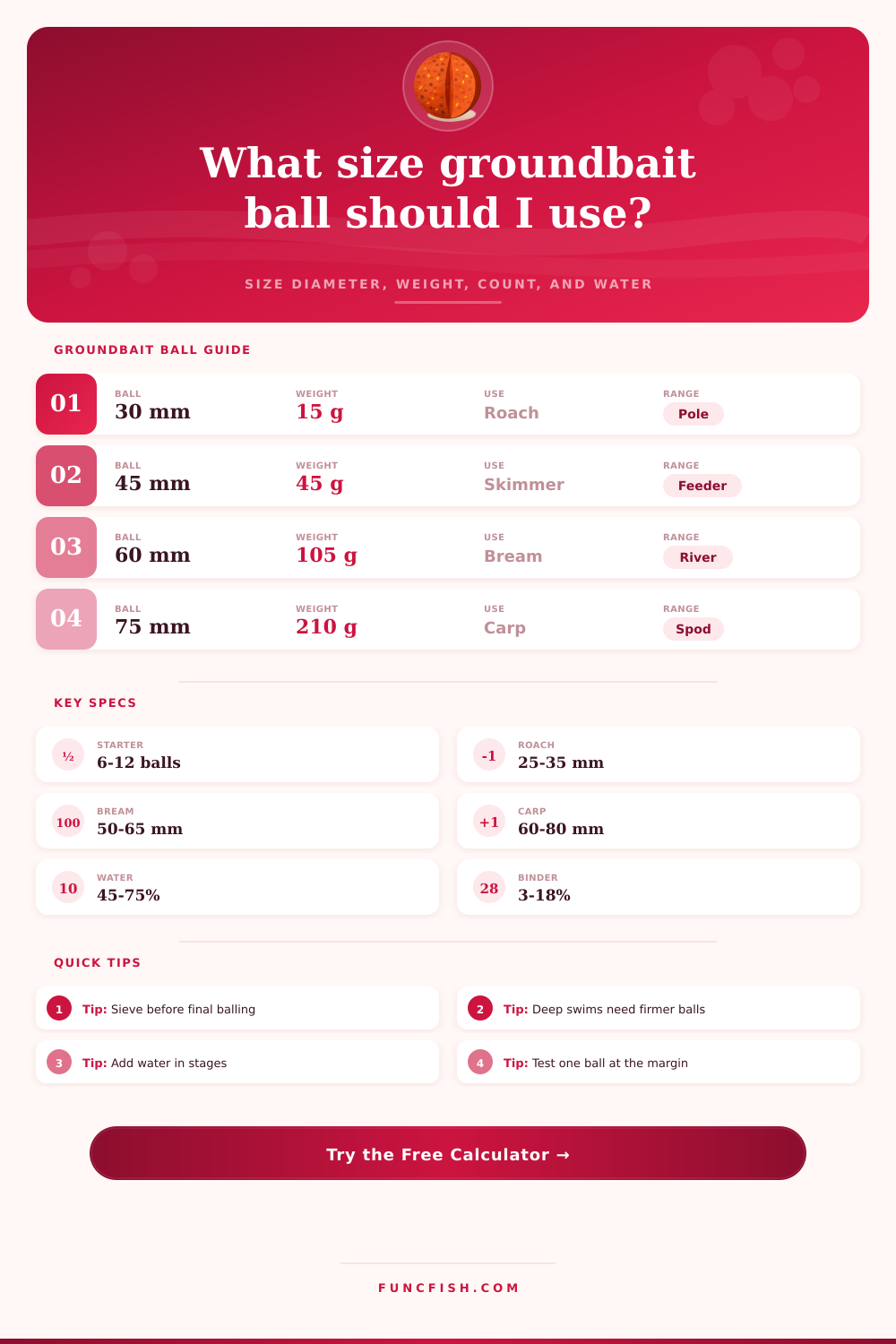
| 25 mm / 1.0 in | 8.2 ml | 8-12 g / 0.3-0.4 oz | Winter roach, punch crumb, cautious pole feed |
| 35 mm / 1.4 in | 22.4 ml | 22-34 g / 0.8-1.2 oz | Canal silvers, soft cloud feed, close cup work |
| 45 mm / 1.8 in | 47.7 ml | 45-70 g / 1.6-2.5 oz | Skimmers, open feeder mix, commercial lake top-up |
| 55 mm / 2.2 in | 87.1 ml | 85-130 g / 3.0-4.6 oz | Bream, tench, hand-thrown stillwater feed |
| 65 mm / 2.6 in | 143.8 ml | 145-215 g / 5.1-7.6 oz | Deep water, river glides, positive bream feed |
| 75 mm / 3.0 in | 220.9 ml | 220-335 g / 7.8-11.8 oz | Carp, barbel, strong tow, spod binder balls |
💧Mix water and binder reference
| Mix type | Wet density estimate | Water range by dry weight | Binder guidance |
|---|---|---|---|
| Canal fine crumb | 0.96-1.08 g/ml | 48-58% | 3-7% binder keeps a cloud but stops dusting |
| Fishmeal method mix | 1.06-1.18 g/ml | 58-68% | 8-14% sticky binder helps mould release cleanly |
| Breadcrumb cloud mix | 0.86-0.98 g/ml | 62-78% | Low binder for fast lift and visual cloud |
| River heavy groundbait | 1.25-1.45 g/ml | 42-55% | 12-20% leam, clay, or PV1 for bottom hold |
| Crushed pellet crumb | 1.00-1.14 g/ml | 65-82% | 10-16% binder after pellets finish drinking |
| Leam and soil blend | 1.35-1.55 g/ml | 36-48% | Binder often comes from the soil itself |
🐟Species and venue comparison grid
| Target | Common ball size | Feed rhythm | Mix and break-open target |
|---|---|---|---|
| Roach and small silvers | 25-38 mm / 1.0-1.5 in | 8-20 small balls per hour | Fine cloud, 1-4 minute breakdown |
| Skimmers and small bream | 40-52 mm / 1.6-2.0 in | 5-12 balls per hour | Medium squeeze, 4-8 minute breakdown |
| Bream and hybrids | 50-68 mm / 2.0-2.7 in | 3-8 balls per hour | Sweet or fishmeal, 6-12 minute breakdown |
| Carp and F1s | 55-80 mm / 2.2-3.1 in | 2-8 balls per hour | Pellet or fishmeal, particles held inside |
| Tench and crucians | 45-62 mm / 1.8-2.4 in | 2-6 balls per hour | Sweet dark mix, slow fizz and carpet feed |
| Barbel and chub in flow | 60-85 mm / 2.4-3.3 in | 1-5 balls per hour | Heavy river mix, 10-20 minute hold |
🎯Delivery gear comparison
Pole Cup
20-45 mmBest for quiet starter feed, tiny winter balls, and precise silvers work at close range.
Catapult
28-55 mmNeeds round, even balls with medium firmness so they leave the pouch without splitting.
Hand Throw
45-75 mmUses firm squeeze balls for bream, tench, and carp lines at reachable stillwater distances.
Spod or Spomb
55-85 mmAccepts heavier particle binders where compacted balls break down after the dump.
📋Application tables
| Use case | Diameter adjustment | Firmness adjustment | Calculation note |
|---|---|---|---|
| Shallow canal | Subtract 4-8 mm | Soft to medium | Less splash and faster scent release |
| Deep lake | Add 6-12 mm | Medium to firm | Ball must survive the fall before opening |
| Strong river | Add 10-18 mm | Firm to hard | More mass and leam resists tow and rolling |
| Long catapult | Subtract 3-6 mm | Firm | Smaller round balls fly straighter |
| Method feeder | Match mould cavity | Sticky | Weight is governed by mould volume and density |
| Particle heavy | Add 5-10 mm | Medium to firm | Particles increase voids and reduce cohesion |
💡Calculation tips
Two-stage wetting: Mix to about 80% of the calculated water, rest it, then add the reserve slowly. Pellet crumb and fishmeal often keep absorbing water after the first squeeze test.
Ball test: Drop one finished ball in the edge before feeding. If it breaks before bottom, raise binder or firmness; if it sits solid too long, reduce compaction or water.
Groundbait performance in the water can be a major factor for day’s success. Color? Nope. Flavor? Nope. Dissolution rate, mass, and density is all physical factors that affect whether fish see the hookbait or inhale nothing but dust.
When you roll a ball of bait around in your hand, you’re making some very small engineering choices. Understanding the factors that control its breakdown will help you get it right rather than going with gut feel. But it’s not just about the ball diameter; that’s typically where you start, but it’s just one part of this equation.
How to Make Better Groundbait Balls
For instance, a 25-millimeter ball sounds like plenty for a day of roaching when you’re up close and personal, but if the mix have too much water or doesn’t has enough binder, then you could end up with bunch of powder by the time it hits bottom. Likewise, if you’ve got a monster carp-sized ball that you’re chucking in some shallow water in a canal, then you’ll probably generate a huge cloud of smoke that scatter instead of attracting fish.
So after you enter the ball size and density of your mix, the calculator will do the rest. That way you don’t have to guess at what percentage of your bait makes it to the swim and what percentage gets torn apart by the current as it floats downstream. If you know what to expect from those results, then you can tweak on the fly while sitting on the bank not wasting an hour experimenting with varying consistency.
Perhaps the least understood of all the variables in preparing groundbaits is amount of water used. Most anglers adds enough water so the mixture appears damp without considering that some components soak up more water than others. To achieve the same degree of firmness, a breadcrumb cloud mix will take considerably less water than method mix based off fish meal. This means the balls will end up being either so wet they adhere to feeder hooklink or so dry they fall apart when they hit the water.
The table in the back of the tool sets out realistic water targets according to type of mix. These show why a fine canal crumb needs a lot less water than a leam-and-soil mix, for example. This isn’t just about sticking the bait together, instead you’re building a structure that will remain intact right through until fish disrupt it.
Similarly, the release window is managed by Binder percentage. The greater the amount of clay, soil or specialist binder added to the mix, the higher will be wet density. In turn, this causes the ball to sink quicker. It also maintains its shape for longer under stronger river flows or in deeper bed lakes. This level of control is critical when fishing for wary species such as tench or bream who tends to feed very cautiously along the bottom. Here you do not want the bait to vanish straight away but rather to spread out across the bottom.
Conversely, too much binder can also choke the scent trail, preventing attraction radius you need to draw fish in from a distance. Understanding your venue conditions and how to adjust accordingly is key here to finding the right balance.
Size and firmness The right size and firmness depend on delivery method as well. For example, when delivering soft, small balls into a pole cup, they can be very soft and quickly break down. They make an exact column of bait straight underneath the float. When hand throwing or spodding, you want a heavier and more firm ball because it has to come through the air without breaking apart mid-flight. This is where the tool helps you see what final mix should look like based off swim depth and casting distance.
If you’re fishing in deeper water you’ll want something denser so that it doesn’t breaks apart on impact with the bottom. In shallower water, you’ll want something lighter that breaks off quickly to keep it fresher and moving around.
Perfection isn’t as important than consistency. Once you have determined a profile that fits a certain situation, use small changes to adjust based off how the fish react. A quick tip that pays off big, test one ball at the margin before you feed your swim. If there’s something wrong with your binder or water level, this will tell you instantly.
The calculator gives you the theoretical baseline, but the lake always has the final word. Adjusting for reality is what separates good anglers from great ones. Understanding why your bait behaves that way takes the guesswork out of it and lets you fish with intention.