Groundbait Water Ratio Calculator
Estimate staged water additions for groundbait, method mix, pellet crumb, leam blends, and river mixes using dry weight, consistency, additives, weather, and rest time.
📌Scenario presets
⚙Batch settings
Groundbait wetting plan
Calculation breakdown
📊Groundbait hydration data
Canal Fine
Fishmeal Method
Pellet Crumb
River Heavy
📘Ratio reference table
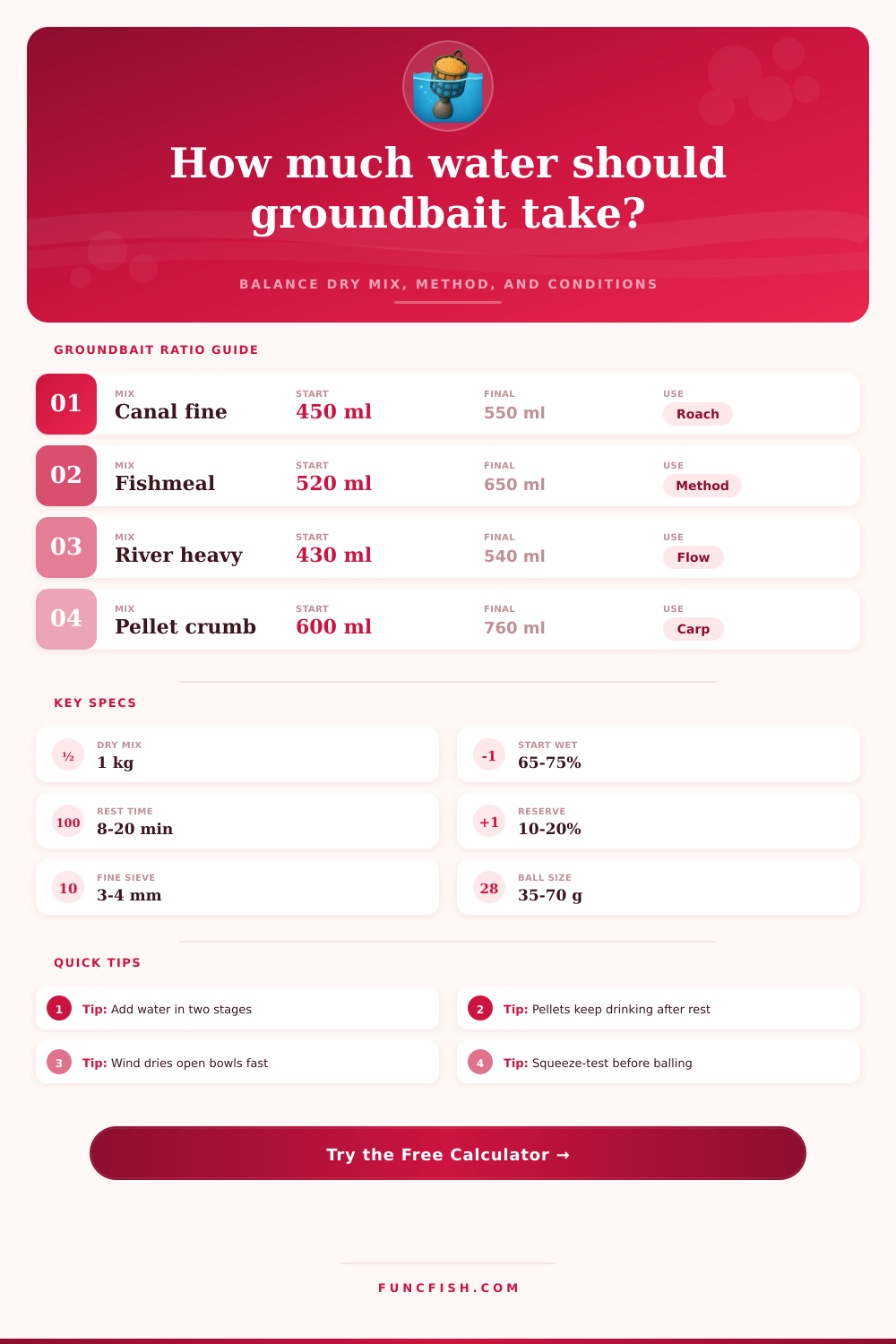
| Mix family | Starting water | Final water | Best texture check | Common use |
|---|---|---|---|---|
| Fine canal crumb | 330-390 ml per kg | 470-570 ml per kg | Breaks open with finger pressure | Roach, skimmers, punch, short pole |
| Fishmeal method mix | 420-500 ml per kg | 580-700 ml per kg | Compresses cleanly in a method mould | Carp, F1s, bream, commercial lakes |
| Crushed pellet crumb | 480-570 ml per kg | 680-820 ml per kg | No dry cores after sieving | Carp, pellet waggler, method feeder |
| River heavy binder | 350-430 ml per kg | 500-620 ml per kg | Firm ball reaches bottom before opening | Bream, chub, deep pole, steady flow |
| Leam and soil blend | 260-340 ml per kg | 380-500 ml per kg | Holds joker, caster, or chopped worm gently | Canals, clear water, deep stillwaters |
| Particle spod binder | 300-410 ml per kg | 450-620 ml per kg | Coats particles without turning to paste | Carp spod mix, hemp, corn, crumb bind |
🎣Method and consistency guide
| Method | Ratio adjustment | Reserve target | Feed size | Practical check |
|---|---|---|---|---|
| Pole cup balls | Neutral | 10-15% | 25-60 g / 0.9-2.1 oz | Ball drops cleanly from cup |
| Open-end feeder | Less 4% | 15-20% | 20-50 g / 0.7-1.8 oz | Plug releases after the feeder lands |
| Method feeder mould | Add 8% | 10-15% | 30-70 g / 1.1-2.5 oz | Moulded bait peels out in one piece |
| Cage feeder | Less 2% | 15-20% | 15-45 g / 0.5-1.6 oz | Mix grips the ribs but still leaks scent |
| Hand-thrown balls | Add 3% | 10-15% | 50-100 g / 1.8-3.5 oz | Survives the cast without splintering |
| Spod or spomb binder | Less 6% | 10-18% | 80-180 g / 2.8-6.3 oz | Binder coats particles, not the lid |
💡Practical ratio notes
Two-stage wetting: Most mixes behave better when 65-75% of the calculated liquid is added first, then the batch rests, is rubbed or sieved, and receives the final reserve slowly.
Absorption drift: Fishmeal, crushed pellets, biscuit, and sweet coarse mixes often feel wet at first and dry out after ten minutes. Leam and soil blends usually need less water but more careful mixing.
Achieving an correct water ratio to groundbait is a necessary skill because the water ratio determines how the groundbait will behave in the water. If there is too little water to the groundbait, the balls will fall apart in the air. If there is too much water to the groundbait, the balls will either explode on the water’s surface or settle on the bottom of the water body like clay.
Because the water ratio influences the behavior of the fish towards the groundbait, it is necessary to carefully control the water ratio to ensure that the fish continues to exhibit feeding behaviors towards the groundbait. Groundbait of different types require different amount of water to achieve the proper ratio. Fine canal crumb groundbait requires a light touch to the water because the crumb particles will release quick into the water.
How to Add the Right Amount of Water to Groundbait
Fishmeal blends require more water than other type of groundbait because the biscuit and protein components continue to absorb water after the blend has been mixed. Pellet crumb groundbait is the thirstiest type of groundbait because the pellets may be ready when added to the groundbait mix, but the interior of the pellets may still be dry. A calculator will help to determine the amount of water that should be used in the groundbait mix because the calculator considers the type of groundbait mix, the fishing method, the particle load of the groundbait, and the weather conditions.
The behavior that is desired from the groundbait will dictate the amount of water to the groundbait mix. For instance, if the goal is to fish for roach in a canal, the groundbait should be formulated to open quick so that it creates a column of groundbait that hold the fish at a specific depth. In a method mould used in a commercial lake, the groundbait should remain together until the feeder lands on the water, at which time the groundbait should break apart.
For locations like rivers, the water flow must be accounted for in the amount of water to the groundbait because the flow could strip the outer layer of the groundbait before it reach the fish. Thus, the fishing environment will change the amount of water that is added to the groundbait and the amount of time that the groundbait is allowed to rest after it is mixed with the water. Groundbait particles will continue to absorb water even after the groundbait has been mixed with the water.
Thus, even if the groundbait appears to be the proper ratio after mixing with water, it may take a few minutes for the groundbait to dry out and for the particles to absorb all of the water. It is better to use a water ratio calculator that includes an adjustment for the amount of time that the groundbait will need to rest after mixing. Another factor that will influence how much water to add to the groundbait is the weather.
If the weather is hot or the wind is strong, water will be lost from the surface of the groundbait. Thus, you should make an adjustment to the reserve percentage of water to the groundbait to account for the weather conditions. Another factor that will influence the amount of water required to mix with the groundbait is the particle load of the groundbait.
If hemp, corn or pellets are added to the groundbait mix, the total surface area of the particles will increase. Thus, the groundbait may appear to be wet when mixed with water, but the added particles may be absorbing the water from the groundbait mix. To account for this additional water absorption, the calculator will increase the base water ratio when a medium or heavy particle load is selected.
Additionally, the amount of water that is added to groundbait that contains heavy particle loads should not be considered a waste of that water because the extra water will provide insurance that the particles will be fully soak in water once the addition of water to the groundbait mix is complete. The moisture level in the groundbait can be tested using a squeeze test. When performed correctly, the groundbait should be able to be formed into a firm ball that maintains its shape for a few seconds before it cracks when pressure is placed upon it.
If the groundbait remains solid when pressure is applied, there is too much water in the mix. If the groundbait falls apart when pressure is placed upon the ball, there is too little water to the groundbait. Finally, a small amount of water should be reserved to allow for the adjustment of the texture of the groundbait.
Different methods of fishing will require different textures in the groundbait. Pole cup balls require the groundbait to be slightly looser than others because it will break upon entering the water. Method feeder moulds require the groundbait to have a tacky skin so that it will remain within the mould.
Cage feeders require the groundbait to have a texture that is between a loose and tacky groundbait so that the groundbait can grip the ribs of the cage while releasing its scent. The calculator can adjust the amount of water to the groundbait to account for these different fishing methods. Many individuals make the same type of groundbait each fishing trip.
The volume of water that is added to the groundbait each trip is the same. The amount of water is added to the groundbait all at once. Adding water to groundbait all at once allows for no time for the groundbait to absorb the water.
Thus, the best method for adding water to the groundbait is to use a two stage approach in which the groundbait is wetted and the remainder of the water is added after the groundbait has rested and been sieved with a sieve. This two-stage method provides the groundbait time to absorb water and to reveal the texture of the groundbait. The use of these methods will ultimately provide repeatability in the groundbait that is created.
While the calculator will allow for an individual to accurately determine how much water to add to groundbait, the individual is still responsible for monitoring the weather, performing the squeeze test, and adjusting the amount of water that is reserved for the bank. Thus, the calculator removes the guesswork that is involved in adding water to groundbait.