
Off the coast of Alaska, you’re hooked up on a big halibut. The reel screams, the rod bow down, your mind races with the worst case scenario. Is this going to be a 30-pound dinner? Is it a 200-pound monster? Time will tell but now reality meets readiness.
Knowing what size halibut are in relation to their length isn’t just fun trivia for anglers. It’s the difference between landing the fish of a lifetime and losing it to a broken line as you miscalculate weight of that flat body.
Why Halibut Weight Matters for Fishing Success
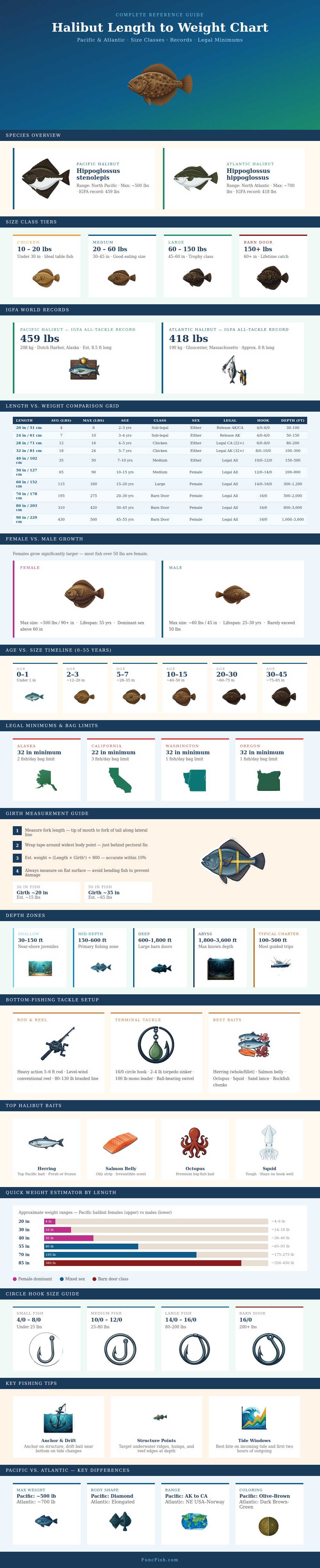
Many people believe that halibut follow linear growth patterns, so a forty inch fish equals half the weight of an eighty inch fish. This isn’t true. As halibut get older, their dimension grow much faster in both depth and width. An eight foot long fish doesn’t only weigh twice as much as a four footer…it holds far more muscle and water volume than you would guess from looking at its ruler size alone. The chart do a good job of illustrating this point visually. After about a 50 inch fish, the weight increase quickly. You’ll notice that a few inches of additional length result in a huge leap in weight.
Veteran captains won’t let anyone go into deep water without beefy tackle. It is not because they want to catch bigger fish, but because they know what those fish weigh when caught. The way nature works forces you to adjust your mindset on the fight.
Male halibut do not get anywhere near as large or heavy than females. Even if they lived another several decades they would never approach the size of the average female. Female halibut often dwarf her male companion in size at any given time. She can reach upwards of five hundred pounds and live well past fifty years old. A male will rarely ever surpass sixty pounds no matter his age. So anytime you’re floating around in deep water and targeting big fish it’s safe to assume that it’s nearly always going to be a female. That means she’s going to have a body structure built for endurance and massive weight capacity. This explains the difference in the two sexes very well based off the chart. It states that most trophy class halibut is female. That knowledge alone gives you more respect for what’s on the other end of line. You’re tangling with an ancient beast who has spent decades accumulating mass on bottom of the sea.
If you grasp weight classes, gear selection makes sense. You wouldn’t use the same setup for a four-hundred-pound barn door at two thousand feet deep as you would for a twenty-pound halibut in shallow water. It require special fishing equipment like heavy braid and specialized circle hooks, along with serious patience.
New anglers frequently try to use light line because they are going after small fish and end up getting their lines broken by a thirty pounder who just decided to take a deep run. There is a lot more drag from the water pressure. Depth give the fish power to shake a hook. Protecting yourself from losing those fish happens by matching your leader strength and hook size with the likely weight class. This helps you set up your terminal tackle properly before casting. It’s also why this is good information to keep handy, a handy chart matches hook sizes with approximate weights.
But there’s also the layer of strategy created by the law. Different states has different minimum length requirements. Many times, this means an angler must measure any fish they would of kept. For instance, a 24 inch fish may be legal in one place and not in another. Knowing how heavy that minimum length is will tell you if you should cut the fish loose quickly or really lay into it and fight them out. That way you can save some line and bait for a keeper. It’s as much about being efficient as it is being compliant. After all, you don’t want to burn yourself out on catching marginal fish that aren’t going to legaly fit the bill anyhow.
Respect the power and the scale of halibut. Playing the fight with an awareness of what’s under there makes a difference. So when it gets tight again you’ll know what’s on the other side of that line. You’ll see the fish… its size, its age, maybe even its sex. And then that transforms the panic into strategy. And so you bring more fish home.