
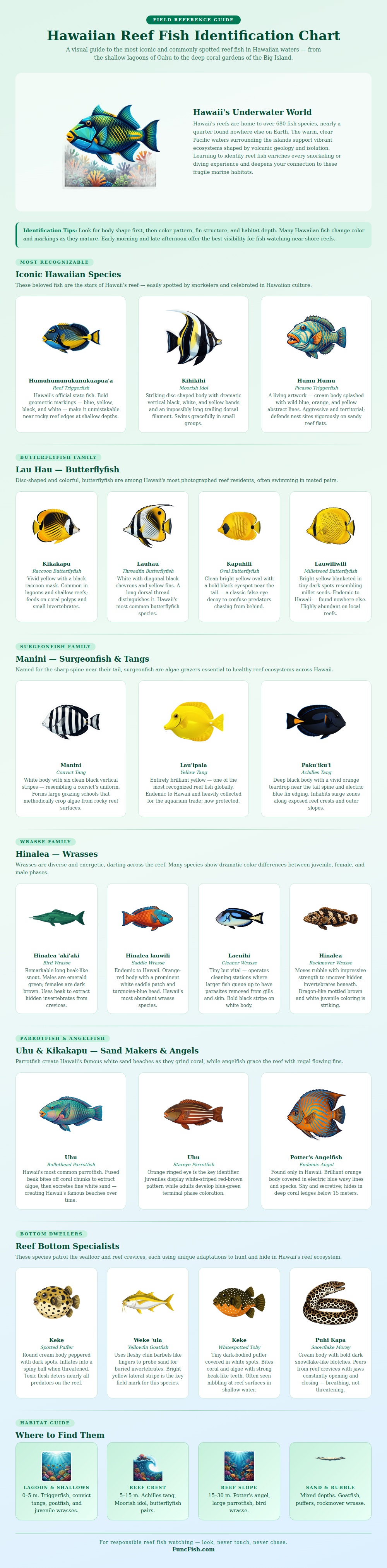
You slip into the water off the coast of Oahu, and for a moment the world is just blue noise and light. There is a shape, a splash of yellow, and a series of black and blue markings. For most people, they’re just watching fish on mute until it dissapears again. But if you know the reef fish around you, then suddenly shapes becomes named things with stories, and you are no longer passively observing, but actively discovering.
The most commonly seen are depicted in the infographic above. All that confusion make it easy to see them as a familiar group of characters. First things first: Consider the shapes. While there’s no need to learn all of the scales pattern immediately, experts begins with the shape. For example, the Hawaiian State Fish, the Humuhumunukunukuapuaa (that’s right, that’s how you pronounce it), is shaped anguluarly with bold markings around the edge of rocky outcroppings. Its unique design make it appear more like something manufactured.
Meet the Reef Fish of Hawaii
Beside it, the Picasso Triggerfish features what appears to be paint spilling from the canvas. These territorial triggerfish guards their nests strongly in shallow sandy habitats. They may be small, but those teeth can cause painful encounters if you snorkel too close. Best to give them space.
Moving smoothly through coral branches, butterflyfish also swim around in pairs (usually for life). In these photos you can see that the Threadfin Butterflyfish has a long filament at its dorsal fin’s end, whereas the Raccoon Butterflyfish have a black mask across his face. Those identifying features come into play: If you spot a fish with a thread hanging from him or her and then some diagonals, that’s a Threadfin. And there you have it, common species, which may make them look ordinary. But don’t let that fool you; they’re indicators of healthy reefs. When you see lots of them, it means that the corals’ structures remains intact so they can eat as they normaly do.
Tangs, or surgeonfish, have surgical-looking tools at the end of their tails. Turns out that’s just a defense mechanism. That spine has helped save its life numerous times. It has also spared others from becoming dinner for bigger predator. Striped in color, the Convict Tang also lives in large groups and grazes algal growth. If not for these guys, reefs would of been carpeted with seaweeds since they’re the ones who eat what chokes the corals.
Completely yellow in color, the Yellow Tang is endemic to Hawaii. Decades ago, they were almost wiped out due to overcollection but thanks to conservation efforts, they’re now protected and you see the fruits of this labor today when you look at them. Respect that by not chasing them.
The wrasse adds some color and activity to the picture. They change colors and dart about. They even act as a bit of a spa for other bigger fish who cue up to get parasites removed (Cleaner Wrasse). It is a small fish with a big job. If you’ve seen a big parrotfish sitting still while a small striped fish flits around its mouth, it’s the mutualistic relationship between a parrotfish and cleaner wrasse. This gets rid of parasite, keeping the reef free from diseases.
And then there’s another reason why parrotfish are important, they grind coral with their beaks to extract algae. The result? This results in fine white sand, meaning all the beaches you walk on were created by fish like the Bullethead Parrotfish. Strange, right? But when you consider the volume of sediment each population produce in a single year…
What fish you will see depends on depth in each area. Goatsfish and juvenile wrasse is up shallower probing the sand with their barbels in the shallow lagoons. Moorish Idols and Achilles Tangs handles the stronger current better as you move out towards the reef crest. Knowing what to expect where is aided by the chart above. A little knowledge helps you appreciate the beauty of shallow water too; you don’t have to dive deep to see it.
The next time you’re in the water, pick one species and slow down. Notice its movement and its neighbors. Pay attention to everything until the reef isn’t a blur anymore. You’ll start to see the scene for what it is. It will make sense, and you’ll connect with it in a way photographs never can.