Hemp Seed Prep Ratio Calculator
Calculate dry hemp seed, soak water, simmer top-up, cooked bait yield, pot batches, and feed pacing for particle-bait fishing sessions.
📌Scenario presets
⚙Hemp seed prep inputs
Hemp prep results
Calculation breakdown
🧪Hemp seed prep data
Whole black hemp
Mini hemp
Large carp hemp
Crushed hemp
🎣Gear and species matching grid
Pole cup roach
25-80 gFine whole or mini hemp, well drained, fed little and often for canal silverfish.
Method feeder bream
80-180 gSoft split hemp blended into groundbait, damp enough to bind without flooding the mix.
Spod or spomb carp
250-600 gNormal split hemp with liquor kept for attraction and bulked with other particles if needed.
River dropper barbel
150-400 gFirm whole hemp, drained enough to sink quickly and resist washing out of the bait dropper.
📊Reference tables
| Hemp form | Typical dry bulk | Soak water ratio | Soak window | Simmer window | Finished texture |
|---|---|---|---|---|---|
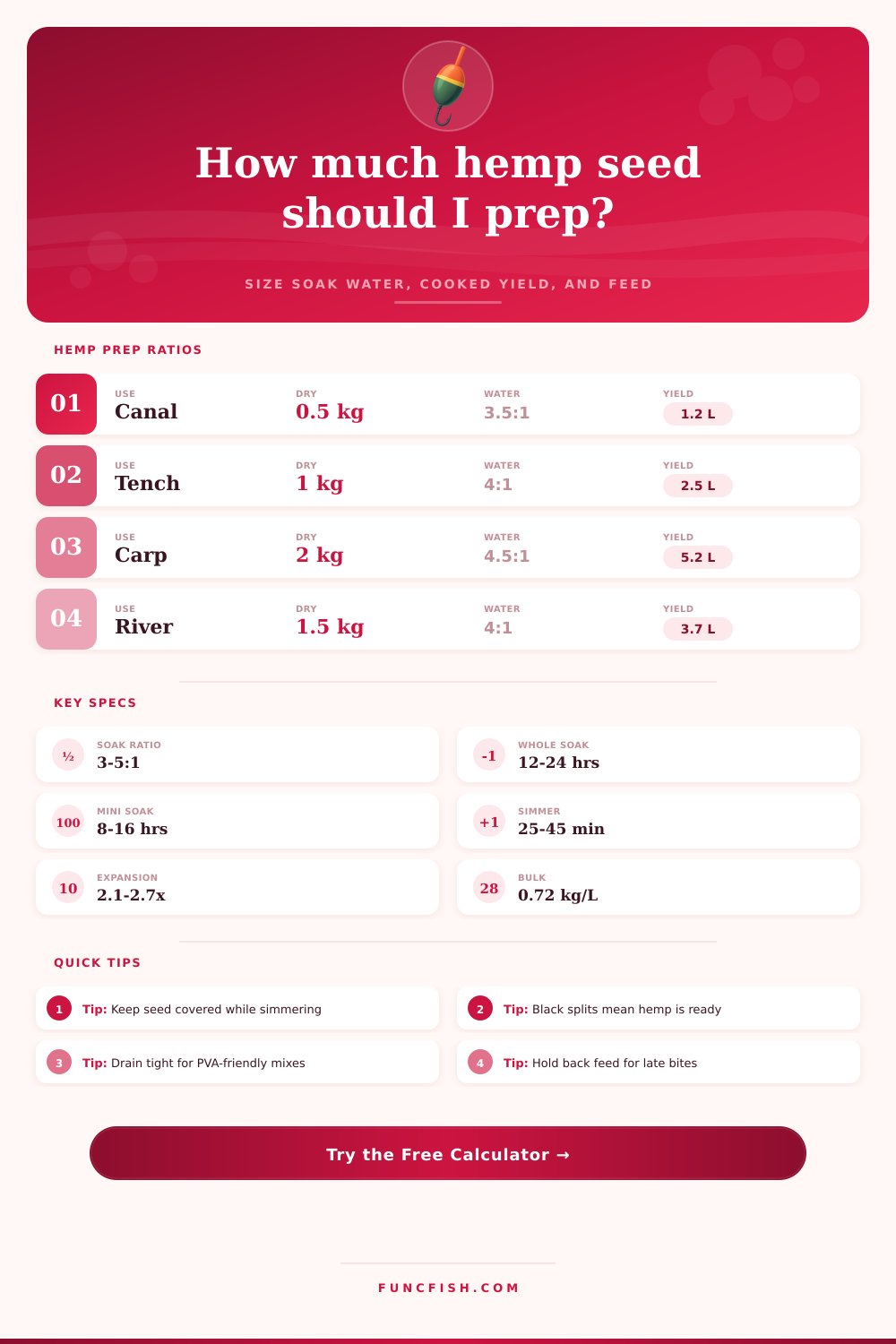
| Whole black hemp | 0.72 kg per L | 3.5:1 to 4.5:1 | 12 to 24 hours | 30 to 45 minutes | White shoots showing, seed still firm |
| Mini hemp | 0.70 kg per L | 3:1 to 4:1 | 8 to 16 hours | 22 to 35 minutes | Small split seed for pole or feeder work |
| Large carp hemp | 0.74 kg per L | 4:1 to 5:1 | 18 to 24 hours | 35 to 55 minutes | Bulky, high-visibility particle feed |
| Crushed hemp | 0.52 kg per L | 2.5:1 to 3:1 | 1 to 3 hours | 0 to 12 minutes | Oily crumb for groundbait and method mixes |
| Hemp and tare mix | 0.76 kg per L | 4:1 to 5:1 | 18 to 24 hours | 30 to 45 minutes | Firm particles for roach, tench, and bream |
| Species or venue | Starting dry seed | Feed rate | Best finish | Prep note |
|---|---|---|---|---|
| Canal roach | 0.25 to 0.50 kg | 40 to 90 g per hour | Bare split, well drained | Small cups keep fish searching without overfeeding. |
| Lake tench | 0.75 to 1.50 kg | 120 to 250 g per hour | Normal split, damp loose | Some liquor helps the hemp cloud settle into silt. |
| Carp particle work | 1.50 to 3.00 kg | 250 to 600 g per hour | Normal split, liquor kept | Batch size usually depends on pot capacity first. |
| River barbel | 0.75 to 2.00 kg | 150 to 400 g per hour | Firm split, well drained | Dense seed sinks cleaner through flow. |
| Bream feeder | 0.50 to 1.25 kg | 100 to 250 g per hour | Soft split for binding | Soft hemp folds through groundbait more evenly. |
| Dry seed amount | Approx dry volume | Soak water at 4:1 | Typical cooked yield | Pot capacity guide |
|---|---|---|---|---|
| 0.25 kg | 0.35 L | 1.4 L | 0.55 to 0.65 kg | 2 L pot is comfortable |
| 0.50 kg | 0.69 L | 2.8 L | 1.1 to 1.3 kg | 3 L pot, watch boil-up |
| 1.00 kg | 1.39 L | 5.6 L | 2.2 to 2.5 kg | 6 L usable pot or split batch |
| 2.00 kg | 2.78 L | 11.1 L | 4.4 to 5.2 kg | Two or three home-pan batches |
| 3.00 kg | 4.17 L | 16.7 L | 6.6 to 7.8 kg | Large stock pot or outdoor boiler |
| Preparation choice | Expansion factor | Wet weight gain | Drain factor | Use when |
|---|---|---|---|---|
| Bare split | Lower end | About 2.1x dry weight | 0.98 to 1.02 | Seed must stay firm for loose feeding. |
| Normal split | Middle | About 2.3x dry weight | 1.00 to 1.08 | Most general coarse fishing particle mixes. |
| Soft split | Upper end | About 2.5x dry weight | 1.03 to 1.12 | Groundbait, method feeder, and cloudier mixes. |
| PVA tight drain | Middle | About 2.2x dry weight | 0.90 to 0.96 | When excess liquor would weaken a bag or stick mix. |
💡Prep ratio tips
Soak coverage: For whole hemp, calculate water from dry seed volume rather than dry weight. The seed swells before the pan heats, so a taller water column prevents dry patches.
Batch control: If the simmer load is close to the safe pot limit, split the cook. Hemp foams and rolls as it opens, and crowded seed cooks unevenly.
Liquor choice: Keeping hemp liquor increases finished bait weight and attraction, while tight draining gives a cleaner feed for catapults, cups, and PVA-friendly mixes.
Session pacing: Compare the feed coverage result with your session length. A short coverage number means reduce the starting feed or prep a larger dry batch.
There’s nothing worse then standing there with your pot full of hot hemp seed, dreading the fact that you just made half the amount of bait necessary. It happens. It happens to all of us because we didn’t calculate for seed expansion. We merely estimated it based off its appearance as a dry product. How much of that stuff do you think is going to soak up into a thick mass before the cook?
That’s right; it’s math. And math determines if you’ll be catching fish or coming home empty handed. So now, rather than needing to guess at conversions and coefficients, simply enter the capacity of your pot (above) and desired target species into the calculator and it does all the math for you.
How to Cook Hemp Seed Bait
We begin with dry weight since that’s how it comes packaged in bags. One kilo of dried whole black hemp seems like a lot, till you see it swell up and then some. Soaking and simmering causes seed to expand 2-3 times its dry state. No wonder folks end up stuck, they think about how much water fits in the bag (not the finished product), and before long they’re behind on feeding schedule and the pot is boiling over.
The quantity is equally important but so too is your choice of finish, you wouldn’t use canal roach feed made from hemp to catch carp on the lake, for example. For roach you need small amounts regularly pinched out of the cup. It needs good drainage, and seed should remain fairly solid to hold its shape. If it’s too mushy it’ll dissolve in the cup and form a muddy sludgy mess that more confuses the roach than attracts them. Carp feeding are different when the seed splits and becomes softer, as more oil is released into the water to provide a scent trail. To accommodate this the tool adjust the yield estimate and drain factor to suit a soft mix intended for making ground bait or firmer loose feed.
The key, however, is soaking: You’re jump-starting the germination process, getting the seed to open up properly once it’s heated. To do that, soak whole seeds for at least 12 hours (up to 24) in cold water. This gives moisture time to get through the hard hull. Mini hemp take less time, maybe half that amount. Again, the bigger the surface area compared to the volume, the quicker you go. Rush this step and your mix will have mushy outsides and hard centers.
This is not good when you want something easy to feed. Besides, sticking, sinking, or floating also makes feeding hard. But don’t worry about going over the top; the hemp foam expands like crazy when seeds crack and swell, which is where the pot capacity input comes in. Fill up a six-liter container full of dry seed and add the water to the max and…yikes! You’ll be cleaning the stovetop while you’re waiting for timer. The calculator will break down your entire batch into smaller safe loads for simmering. It will let you know exactly how many times you need to cook again until you have enough bait prepared.
Do yourself a favor and just do three little batches rather than one giant messy one. That way, all your bait turn out the same. The last variable linking prep to performance, however, is the feed rate. Make sure you have enough cooked hemp to last through your session so you do not run out when the magic hour hits, but do not have so much that you end up rationing it bit by bit. Hold back 15 percent as a buffer in case fish quit biting or you want to sort some hookbaits. How long will your prepped bait last at the hourly feed rate you’ve selected? The tool calculate that for you.
When I say prep, I don’t necessarily mean chemistry. I mean preparation, which is planning and knowing what goes into a bucket, when it goes in, and how much you need. Knowing that a certain texture works for certain fish, another doesn’t and that a foam expands while a seed doesn’t. Knowing all of this means less guesswork and more predictability instead of chaos. You stop throwing things against the wall to see what sticks and instead plan out your attack. Your feed will become consistent, your buckets will be filled and you’ll find yourself spending more time fishing than cooking the next time you’re on the bank.