Hook Gap to Wire Diameter Calculator
Compare a measured hook gap against wire diameter, bait thickness, line pressure, and cover so the hook has enough bite without becoming harder to drive home.
📌Scenario presets
⚙Hook geometry inputs
Hook geometry result
Formula breakdown
🧰Hook wire material grid
Fine carbon
Bronze bait
Standard carbon
Black nickel
Tinned salt
Stainless salt
Fine treble
Heavy forged
📋Ratio and hook pattern references
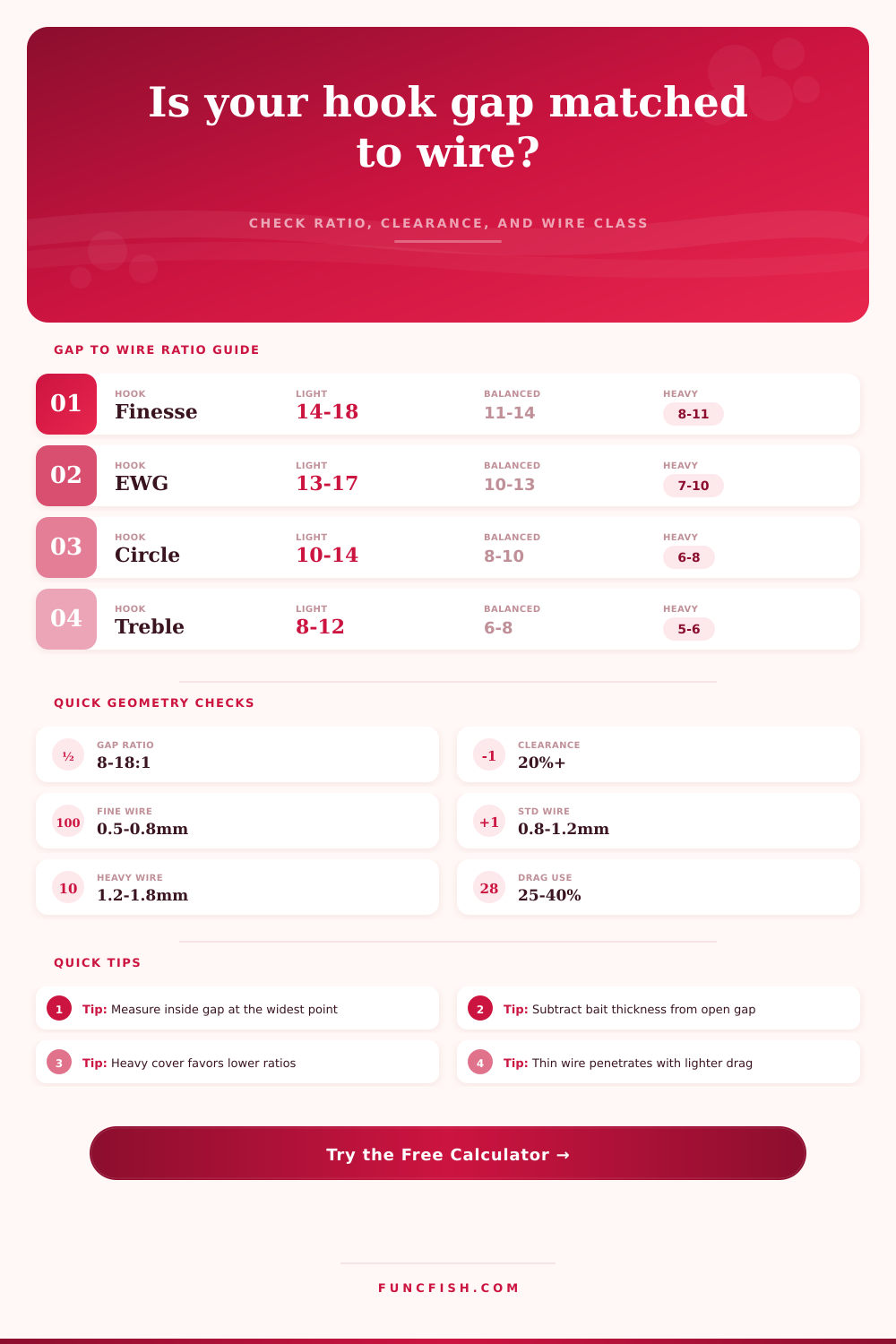
| Hook pattern | Light wire ratio | Balanced ratio | Heavy wire ratio |
|---|---|---|---|
| Finesse J | 14:1 to 18:1 | 11:1 to 14:1 | 8:1 to 11:1 |
| Aberdeen long shank | 15:1 to 20:1 | 12:1 to 15:1 | 9:1 to 12:1 |
| Standard J | 13:1 to 17:1 | 10:1 to 13:1 | 8:1 to 10:1 |
| Extra wide gap | 13:1 to 17:1 | 10:1 to 13:1 | 7:1 to 10:1 |
| Circle hook | 10:1 to 14:1 | 8:1 to 10:1 | 6:1 to 8:1 |
| Treble hook | 8:1 to 12:1 | 6:1 to 8:1 | 5:1 to 6:1 |
| Measured wire | Wire class | Best pressure range | Typical use |
|---|---|---|---|
| 0.45 to 0.65 mm | Fine | 2 to 6 lb line | Trout, panfish, finesse |
| 0.65 to 0.90 mm | Light | 4 to 10 lb line | Live bait, light jigs |
| 0.90 to 1.20 mm | Standard | 8 to 17 lb line | Bass, walleye, general bait |
| 1.20 to 1.55 mm | Heavy | 15 to 30 lb line | Circle hooks, surf, cover |
| 1.55 to 2.10 mm | Extra heavy | 25 lb plus line | Flipping, pike, saltwater |
| Scenario | Gap target | Wire target | Clearance priority |
|---|---|---|---|
| Small finesse bait | 8 to 14 mm | 0.45 to 0.75 mm | Easy penetration |
| Soft plastic worm | 12 to 20 mm | 0.85 to 1.25 mm | Bait compression room |
| Live minnow | 10 to 18 mm | 0.70 to 1.10 mm | Natural movement |
| Cut bait circle | 14 to 24 mm | 1.20 to 1.70 mm | Corner-set opening |
| Heavy cover jig | 14 to 22 mm | 1.30 to 1.90 mm | Strength before finesse |
| Comparison | High ratio | Middle ratio | Low ratio |
|---|---|---|---|
| Penetration | Easiest | Balanced | Needs more pressure |
| Bending resistance | Lowest | Moderate | Highest |
| Bait room | Most open | Usable | Can feel crowded |
| Best water | Clear, open | Mixed | Dirty, cover, surf |
| Common fix | Use thicker wire | Keep it | Use wider gap |
💡Measurement tips
Tip: Measure the inside gap from shank to point line at the widest usable opening. Outside gap measurements make the ratio look better than the hook really fishes.
Tip: For thick soft plastics, compare open bite clearance after the bait is rigged. A strong hook can still miss bites if the body fills the gap.
Have you ever had one of those days fishing a plastic worm, where the bass opens his mouth, snatches on it and then… Nothing happens? Line goes slack. Fish gone. It is not always a miss. Occasinally, it’s bad geometry. The hook are too big for its own good. No matter how much you yank on it, there’s no way a thick hook will penetrate the lip. It go from being a needle to being a blunt instrument made of wire.
That’s what this calculator solves; that particular problem. It compares size of the inside gap to the diameter of the wire. Does it pierce? Or does it break? So what’s that number? That is core metric we’re talking about. It’s the ratio between the gap and the wire thickness.
How to Choose the Right Fishing Hook
If it has a high ratio then it has a skinny wire with a big wide open gap, ideal for clear-water finesse fishing where fish are spooky. If it has a low ratio, then it’s got a tighter fit and thicker wire, ideal for dragging a jig across rocky bottoms or through gnarly wood cover. Once you plug your measurements into the calculator above, it’ll do the math for you. But the real value is knowing why those numbers matter.
Most folks reach into the tackle box, grab whatever size hook they have laying around and go to work. They rarely measure the gap of the hook, and they absolutely never measure the actual wire diameter with calipers. This thing make you put down the hook and look at physical reality of what you’re looking at… not the size on the packet.
The wire makes all of the difference For example, a thin, fine high carbon wire bends easily but pierces easy. A heavy forged wire resists bending and stays straight but takes a lot of drag pressure to get it home. This chart on the page group the wire into classes and lays it out.
For instance, you may be tempted to use a heavy wire hook when fishing for smallmouth in rocky creeks because they don’t break off. But then your hook has a low gap-to-wire ratio and it bounces off of their mouths. There must be enough gap clearance for the point to reach bone.
The other variable nobody seems to consider is the bait thickness. You can thread a wide gap but if you’re threading a fat creature bait through there, then what’s the use? There’s no gap left because the hook is filled up with plastic. That’s where the tool comes in and allows you to select the thickness of the lure’s body. Then it measure how much space is left over once the bait is threaded onto the hook.
Once you get below a certain amount, the hook is choked off. Fish can nip at it all they want. They can even do it just inches from the point and not touch the point itself. It’s a very subtle thing. And it appears as though it’s rigged right. Feels good in the water. But in terms of how it works, it blocks the bite zone.
This also ties into drag settings. Because the hooks are thin wire, they has to be handled delicately. Setting the drag at forty pounds isn’t going to keep a light wire hook bent. That thing is going to pull right back out. To reach a decision regarding balance the calculator take into account your cover type and line test. So if it’s telling you that the setup is heavy, it means you’re probably overbuilding the rig for the conditions. You’re sacrificing penetration for strength you don’t necessarily need.
Finesse wins in open water every time. Strength is king in heavy cover. The trick is finding that middle ground where the hook is thin enough to get into the fish but strong enough to hold them.
The trickiest thing to measure is that gap. On most hooks, it is the distance from the point line to the shank on the inside at the widest part of the bend. Don’t measure on the outside. That will give you a false measurement. If possible get some digital calipers for this. If not then try to just get out a ruler and eyeball it the best you can. But again accuracy is important cause even a 1/16th of an inch will change the whole ratio more.
Sometimes a slightly different wire gauge will turn a finesse hook into a power hook. Ultimately, this is all about mechanics and intuition. Knowing how your bait relates to your hook, how that hook relates to its wire, and how that wire relates to that gap makes guessing a thing of the past. Those final three fish goes from being a mystery to becoming a matter of understanding. It is a matter of knowing exactly why.
The next time you tie on a hook, consider the ratio. Consider the clearance. Let the math do the work for you rather than against you.