Ice Fishing Spring Bobber Tension Calculator
Estimate spring bobber tip load, bend percentage, bite force threshold, jig balance, and trim length from spring geometry, line drag, and hardwater presentation style.
📌Spring bobber presets
⚙Tension inputs
Spring bobber tension estimate
Load and sensitivity results will appear here.
Calculation breakdown
🔧Spring material reference
📊Reference tables
| Spring style | Best use | Typical thickness | Target bend | Notes |
|---|---|---|---|---|
| Fine round wire | Bluegill, crappie | 0.008-0.016 in / 0.20-0.41 mm | 35-55% | Shows tiny down-bites and lift-bites. |
| Medium round wire | Perch, small walleye | 0.014-0.024 in / 0.36-0.61 mm | 25-45% | Good all-around tungsten range. |
| Flat strip | High visibility | 0.006-0.014 in / 0.15-0.36 mm | 25-50% | Width raises side stability and visibility. |
| Coil spring | Adjustable sensitivity | 0.010-0.024 in / 0.25-0.61 mm | 20-45% | Coils soften the visible tip response. |
| Carbon bristle | Micro jigging | 0.012-0.030 in / 0.30-0.76 mm | 30-60% | Very light mass, less crisp in slush. |
| Target fish | Common jig load | Bite signal | Suggested visible bend | Tuning move |
|---|---|---|---|---|
| Bluegill | 0.02-0.08 oz / 0.6-2.3 g | Small tick or lift | 40-55% | Longer, softer spring. |
| Crappie | 0.03-0.12 oz / 0.9-3.4 g | Up-bite or slow load | 35-50% | Preload slightly down. |
| Perch | 0.05-0.18 oz / 1.4-5.1 g | Repeated pecks | 25-45% | Stiffen if bottom pounding. |
| Walleye | 0.10-0.35 oz / 2.8-9.9 g | Firm tap | 15-35% | Shorten spring or use medium wire. |
| Whitefish | 0.06-0.20 oz / 1.7-5.7 g | Lift and slack | 30-50% | Keep bend away from bottomed out. |
🎯Tension tuning notes
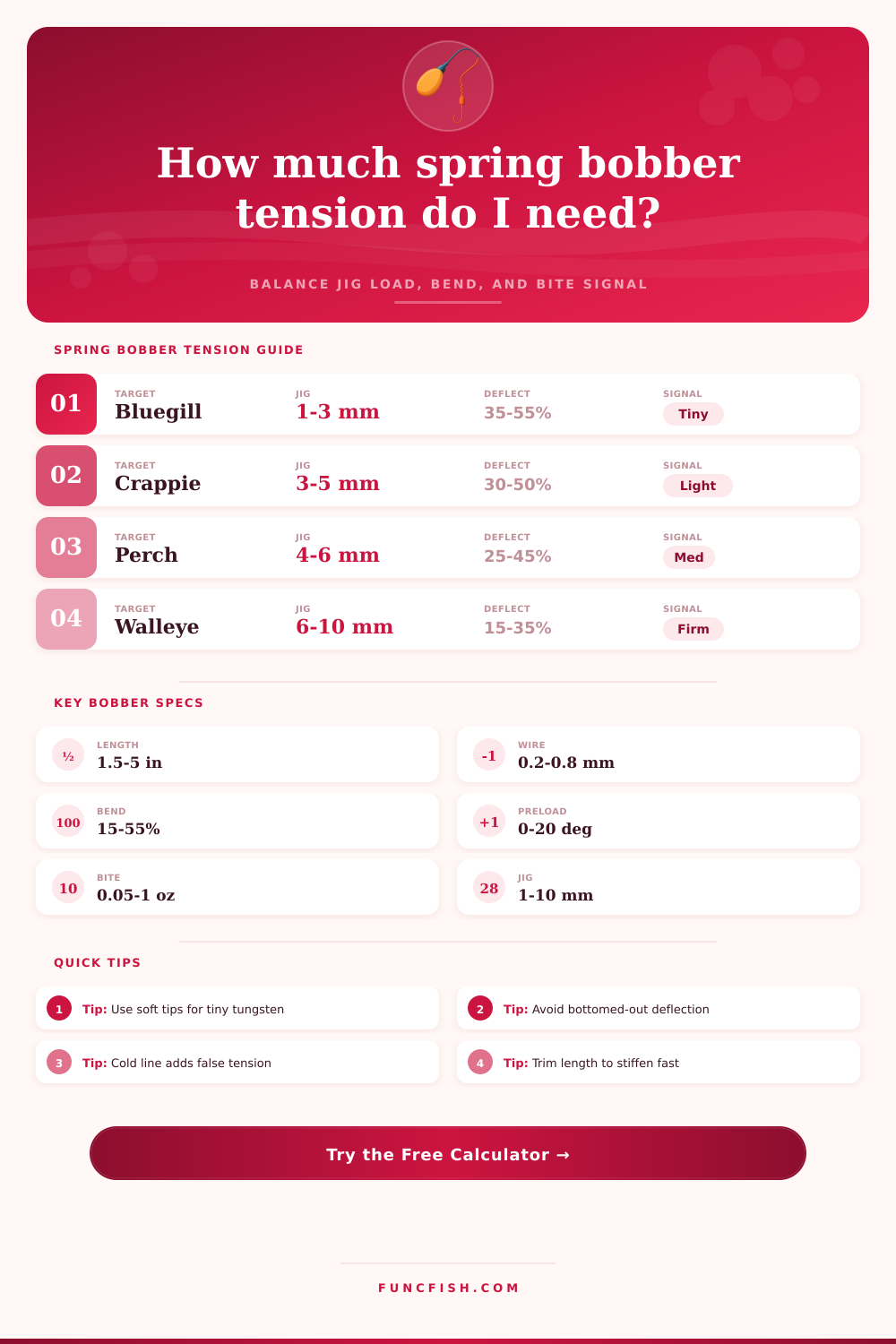
Deflection window: A spring bobber that rests around one-third to one-half of its length bent down usually leaves room for both down-bites and lift-bites.
Geometry tuning: Shortening the exposed spring is the fastest way to stiffen the signal; adding length softens it sharply because tip stiffness changes with length cubed.
When you see an angler catching fish regularly while your own bobber looks completely dead, you know they’ve got it dialed in right. It’s often just a little tension that makes all the differense. Sensitivity is key when ice fishing with these thing. You need something that lets you feel the little bite but won’t spook to easily from the little vibration in the water. If your balance isn’t right, you will miss bites and have empty hook sets.
Matching jig weight to spring stiffness are the primary challenge. Too much weight in a tungsten jig and the bobber lay across the ice surface, taking away any bite indicators. By inputting line type and jig dimensions, this tool’s calculator provide an estimate of both working bend and tip load. You won’t have to guess what added weight of lead will do. You convert spring physics into a practical pre-drilling hole strategy.
How to Get Better Sensitivity from Ice Fishing Bobbers
The first consideration is what kind of spring it is made out of. A stainless steel tip will have predictable return and hold up well to abuse, preferred by many angler targeting panfish. For cold water, titanium tips will snap back fast with a softer feel. Carbon bristles are light weight but sometimes lack responsiveness in current or slush. The reference table links materials to the best application for that material.
Generally speaking, walleye fishermen wants something stiffer to help them weed through false signals where bluegill guys tend to get more mileage from the softer springs. This formula takes into account line drag. Because monofilament floats, creating greater friction within the guide ring and sinking fluorocarbon does not create as much drag. That friction also effectively weighs down the bobber tip. To counteract that drag, the calculator increase the threshold with each line choice. In colder water where monofilament is harder to move, a stiffer spring will hold the bobber upright. Many fishermen go to fluorocarbon leaders to get a clearer signal. Not taking into account this variable will make rig feel too loose while fighting resistance.
Sensitivity depends on geometry. Shortening the exposed tip by half an inch have a huge impact on how much force bends it back. Force required goes up cubed, not linear with length. Pros keep files or cutters handy to trim their springs on the spot. Often your first few bites won’t be as apparent. Trim a couple of millimeters and your signals will show twice as easy. You can set the exposed length input and instantly see what bending it does to deflection percent.
The other frequently ignored variable is preload. Most guys use bobbers that have some downward pull, either because of how they look or because they sits lower in the water. But this causes positive preload where spring starts pulling against itself prior to the fish making contact with the bait. It increases your bite threshold a lot. When fishing for suspended crappie, you want to use as little preload as possible so that the tip stay neutral for those more subtle up-bites. Too much initial pull will hide the first sign that a fish might be interested.
You want as much sensitivity as you can get, but you also want some sort of reserve with which you can set hook on a committed fish. If your bobber bends at 90 degrees too easily, it’s coming off on the hookset. Ideally, there should of be a sweet spot in the center range (typically around 30-50% of total length) that gives you ample room to fit both lift and down-bites, yet doesn’t overwhelm the mechanism. The idea is to have just the right combination of visibility and reliability.
Metal gets stiffer and lines get more friction as water cools. When ice locks down on a lake, a working rig in late ice might not cut the mustard. Softer tension are better early in the year. Trimming up a bobber will stiffen its tension. Removing wire is permanent. You can’t put it back on. Start light so you can watch your tip closely. Tweak only when the signals overwhelm you, little mechanical things make a big difference.