Ice Fishing Tip-Up Line Length Calculator
Estimate how much line to strip from a tip-up spool, where the bait will sit, how many spool wraps that equals, and how much total line should stay on the reel for fish runs, reties, ice thickness, and depth uncertainty.
📌Tip-up presets
⚙Depth, line, and spool inputs
Tip-up line length result
Set the line, mark the depth, and keep enough reserve on the spool.
Calculation breakdown
🧵Tip-up line material data
Braided Dacron
Coated Tip-Up
Ice Braid
Cold Mono
Fluorocarbon
Wire Base
Handline
Leader Add
📊Ice tip-up reference tables
| Target fish | Common tip-up zone | Starting line class | Run reserve | Leader note |
|---|---|---|---|---|
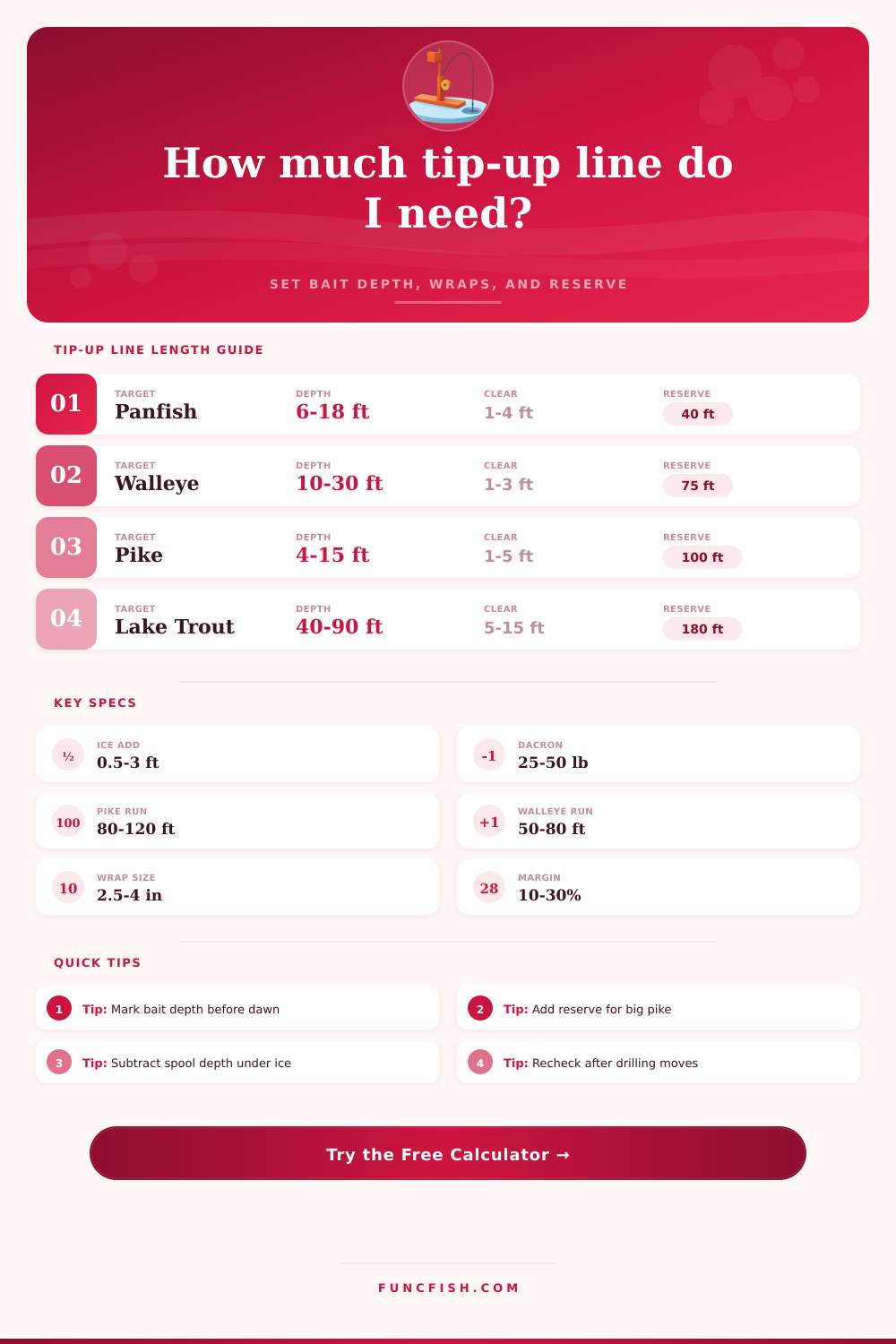
| Walleye | 1-3 ft above bottom, weed edge, or breakline | 20-30 lb Dacron with 8-12 lb leader | 50-80 ft / 15-24 m | Fluoro leader keeps the minnow natural. |
| Northern pike | 1-5 ft above weeds or shallow flat | 30-50 lb Dacron or coated line | 80-120 ft / 24-37 m | Wire or heavy fluoro for teeth. |
| Lake trout | 5-15 ft off bottom or near suspended marks | 30-50 lb Dacron or braid | 120-220 ft / 37-67 m | Longer leader helps in clear basins. |
| Crappie | Suspended at school height, often above basin bottom | 8-15 lb mono, fluoro, or braid | 30-55 ft / 9-17 m | Small bait and light leader improve flags. |
| Yellow perch | 0.5-2 ft above bottom on flats | 8-20 lb tip-up line | 30-50 ft / 9-15 m | Short leader reduces tangles near bottom. |
| Burbot | Close to bottom on night humps or channels | 20-40 lb Dacron | 60-100 ft / 18-30 m | Abrasion allowance matters around rock. |
| Scenario | Line-to-bait adjustment | Depth uncertainty | Reserve habit | Best use |
|---|---|---|---|---|
| Weed edge | Subtract clearance from bottom, add small drift | 1-2 ft / 0.3-0.6 m | Moderate | Walleye, pike, perch |
| Shallow bay | Short drop, higher run reserve | 0.5-1.5 ft / 0.2-0.5 m | High | Pike and bass-sized live bait |
| Deep basin | Long vertical drop, extra spool load | 2-5 ft / 0.6-1.5 m | Very high | Lake trout and deep whitefish |
| Suspended | Use target depth, not bottom minus clearance | 1-3 ft / 0.3-0.9 m | Low-medium | Crappie, trout, roaming walleye |
| Channel current | Add diagonal line angle and drift belly | 2-4 ft / 0.6-1.2 m | High | Burbot, walleye, river ice |
| Spool diameter | Approx circumference | 10 wraps | 50 wraps | Marking note |
|---|---|---|---|---|
| 2.5 in / 6.4 cm | 7.9 in / 20 cm | 6.5 ft / 2.0 m | 32.7 ft / 10.0 m | Common on compact rail-style tip-ups. |
| 3.0 in / 7.6 cm | 9.4 in / 24 cm | 7.9 ft / 2.4 m | 39.3 ft / 12.0 m | Easy to count for shallow sets. |
| 3.5 in / 8.9 cm | 11.0 in / 28 cm | 9.2 ft / 2.8 m | 45.8 ft / 14.0 m | Good all-around loaded spool estimate. |
| 4.0 in / 10.2 cm | 12.6 in / 32 cm | 10.5 ft / 3.2 m | 52.4 ft / 16.0 m | Large pike or laker spools. |
✅Practical line-setting checks
Measure from the ice surface if you are sounding through the same hole. If the spool sits several inches under water, subtract that submerged distance when estimating line actually leaving the spool.
The calculator separates line-to-bait from total line on the spool. A short shallow set can still need a large reserve when pike, lake trout, or current can take line before the angler reaches the flag.
Fishing through the ice, do you know how much line to leave on your tip-up spool? I’ve seen most guys guess at that number. Hoping for the best. That’s where our calculator comes into play; it takes math out of it for you; it will account for type of fish and their depth. Not only does that save you from guessing in the middle of the night, but it’ll ensure you have enough line for a big one to bite.
Consider what remains on the reel and what rests on bottom of the lake. Consider the water column itself. Then consider ice thickness and where your spool reside beneath the surface. That submerged space impacts length of line exiting the reel before it hits the water’s surface. It doesn’t seem like much, but this can cause your bait to ride up too high or drag across mud if fishing for suspended fish.
How to Calculate the Right Amount of Line for Ice Fishing
The other part of that equation are how the fish behave. A few inches to a few feet of space between bottom and your lure may be all it takes to get bit on walleye around weed edges. In deep basins, lake trout frequentely suspend 15 feet off the bottom. To compensate for this, you can adjust tool to deliver your bait at a predetermined distance from floor instead of simply dropping it to the bottom.
That makes a huge difference as fish move and don’t stay stationary. They relocate with feeding opportunities and temperature changes during the day. By adjusting your depth, you’ll be targeting where the fish are versus merely crossing your fingers that one will swim past to find your bait.
The most overlooked component of the set-up is reserve line. When a lake trout or pike gets it, they runs hard. And if you burn through all of your spooled line getting that bait to the bottom twenty feet, you’ve got nothing but a cut-off leader when they makes a sixty-foot run. Based off the species you choose, the calculator factors in a safety buffer.
For slow panfish, there’s less need for reserve; whereas for aggressive runners (pike), there’s a much higher recommendation of reserve. You’re not lugging around extra weight for nothing. You’re lugging around insurance in case those fish puts on a burst of energy in the first ten seconds of their hookup.
And current is tricky as well. Your line will sink vertically in still water. It’ll angle outward in wind or a river. More line means same vertical depth, but you have to account for that angled path. Because input fields do this, your bait goes where you want. What used to be an educated guess becomes a physically precise location below the ice.
The line you use also influences its behavior on the spool. Monofilament is fairly bulky compared too braided dacron. So using monos means you need a larger spool to hold same amount of reserve without compromising drag. You’ll see this in the line type / species reference table on page. This helps you match job with gear.
Sometimes a light fluoro leader works great at keeping walleye interested. But it won’t stand up to meeting a set of pike teeth. So knowing what needs longer or shorter to achieve same strength helps you make most of your spool capacity.
Logistics is just as important in ice fishing as patience is. Once the bait’s down and the hole’s done, you can’t correct a poor line management plan. Spending a few minutes figuring out exactly how much line you want to have on spool makes it a strategy instead of a gamble. When that flag pops up, all you’re worried about is holding the fish. The cold only respects preparation; intentions don’t matter. You should of prepared sooner.