🧊 Ice Thickness Safety Calculator
Determine if ice is safe for walking, fishing, snowmobiling, or driving — in imperial & metric
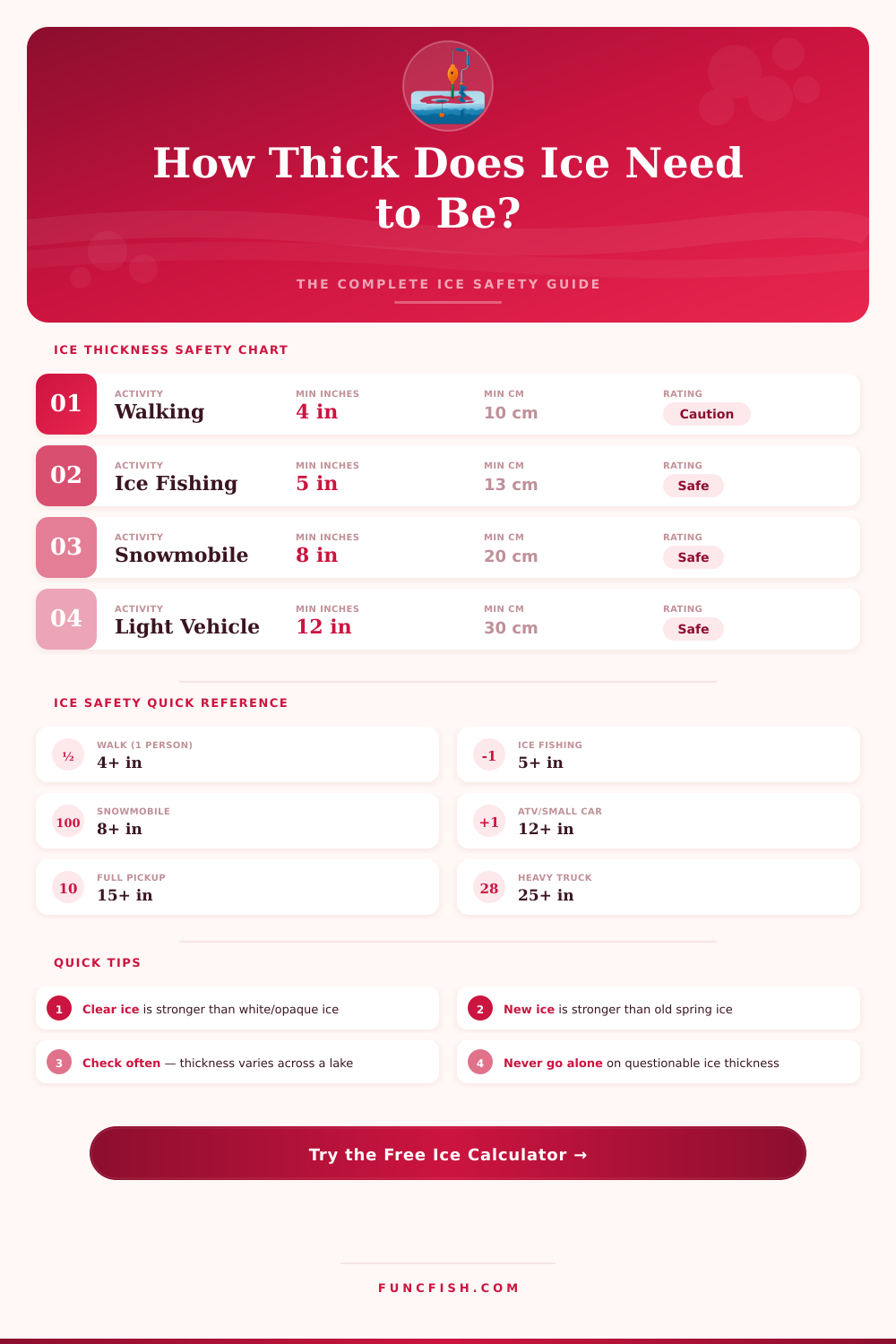
| Activity | Min. Thickness (in) | Min. Thickness (cm) | Safe Thickness (in) | Safe Thickness (cm) |
|---|---|---|---|---|
| Walking (1 person) | 4 in | 10 cm | 5+ in | 13+ cm |
| Walking Group | 5 in | 13 cm | 7+ in | 18+ cm |
| Ice Fishing (1 angler) | 5 in | 13 cm | 7+ in | 18+ cm |
| Ice Fishing Group | 7 in | 18 cm | 9+ in | 23+ cm |
| Snowmobile | 8 in | 20 cm | 10+ in | 25+ cm |
| ATV / Small Vehicle | 10 in | 25 cm | 12+ in | 30+ cm |
| Light Car / SUV | 12 in | 30 cm | 15+ in | 38+ cm |
| Pickup Truck | 15 in | 38 cm | 18+ in | 46+ cm |
| Heavy Truck / Equipment | 25 in | 64 cm | 30+ in | 76+ cm |
| Ice Type | Strength Factor | Appearance | Typical Formation | Notes |
|---|---|---|---|---|
| Clear Blue/Black Ice | 100% (Full Strength) | Transparent / dark | Slow freeze, cold nights | Strongest; use standard tables |
| New Clear Ice | 90% | Clear, slightly thin | Recent rapid freeze | Very strong, check thickness carefully |
| White / Milky Ice | 50% | Opaque white | Slushy snow freeze | Double required thickness |
| Layered Ice | 70% | Banded layers | Multiple freeze/thaw cycles | Unpredictable; test frequently |
| Slushy / Wet Ice | 30% | Wet, soft surface | Near 0°C / 32°F | Very dangerous; avoid if possible |
| Spring Deteriorated | 15% | Honeycombed, porous | Warming temperatures | Extremely dangerous — stay off |
| Person / Vehicle | Typical Weight (lbs) | Typical Weight (kg) | Min. Clear Ice (in) | Min. Clear Ice (cm) |
|---|---|---|---|---|
| Average Adult | 150–200 lbs | 68–91 kg | 4 in | 10 cm |
| Adult with Ice Fishing Gear | 250–350 lbs | 113–159 kg | 5 in | 13 cm |
| Snowmobile | 400–600 lbs | 181–272 kg | 8 in | 20 cm |
| ATV / 4-Wheeler | 600–900 lbs | 272–408 kg | 10 in | 25 cm |
| Compact Car | 2,500–3,500 lbs | 1,134–1,587 kg | 12 in | 30 cm |
| Full-Size Pickup Truck | 4,000–6,000 lbs | 1,814–2,722 kg | 15 in | 38 cm |
| Heavy Truck / Bus | 20,000+ lbs | 9,072+ kg | 25+ in | 64+ cm |
The thickness of the ice is cause that necessarily must consider before go fishing on it. Each person bear the responsibility about his safety. Although the DNR does not control the ice check on lakes of Minnesota, superbly know as estimate the ice are inherent.
Many factors affect the safety of the ice for instance temperature snow covering flows sources and even sharp fishes. Even if the ice seems firm that impression can cheat. So matter to know the precise check so that you do not fall through the cold water.
How Thick Should Ice Be for Safety
For estimate the real check bear holes by means of ice drill. You can also employ spud bar or ice chisel. Ice probe with marks on the handle answers instead of tape measure.
If you use tape measure enter it in the hole and hook the bottom edge of the ice anksau later read the value. Do not judge the check according to the easliy with that the chisel or drill breaks the surface. The thickness ranges through the whole lake so control several spots.
Maybe you find clear ice that occasionally calls black ice or white ice because of air bubbles occasionally called snow ice. Measure both kinds. A bit of ice are like this clear that you sees the check before walk on it.
Solid thunk show thick ice during hollow sound signal thin ice.
The involved thickness ranges according to the activity. For stand and fishing either skating at least four inches answer. Clear black ice of four inches suffice but more inches are more well if it is not like this clear.
For group in one line sept inches and half is the recomendatio. Walking or skating require widely four until six inches. Snowmobile either ATV require at least seven until eight inches.
For passenger car eight inches can suffice but dozen is safe. Little truck minimumume require dozen so more well fifteen. Clear ice of dozen until fifteen inches carry full-sized van.
One metre thick ice backs truck entirely loaded by means of more than 40 tons of fuel.