Jetty Fishing Line Length Calculator
Estimate the line length needed from rod tip to rig when fishing from a jetty, including deck height, target depth, cast distance, current belly, tide change, leader length, rock abrasion allowance, and reel reserve.
📌Jetty presets
⚙Line length inputs
Jetty line length result
Calculation breakdown
🧵Line material data grid
Nylon Mono
Fluorocarbon
4-Carrier Braid
8-Carrier Braid
📊Jetty height and depth reference
| Jetty position | Rod tip height | Common target depth | Typical line angle | Reserve note |
|---|---|---|---|---|
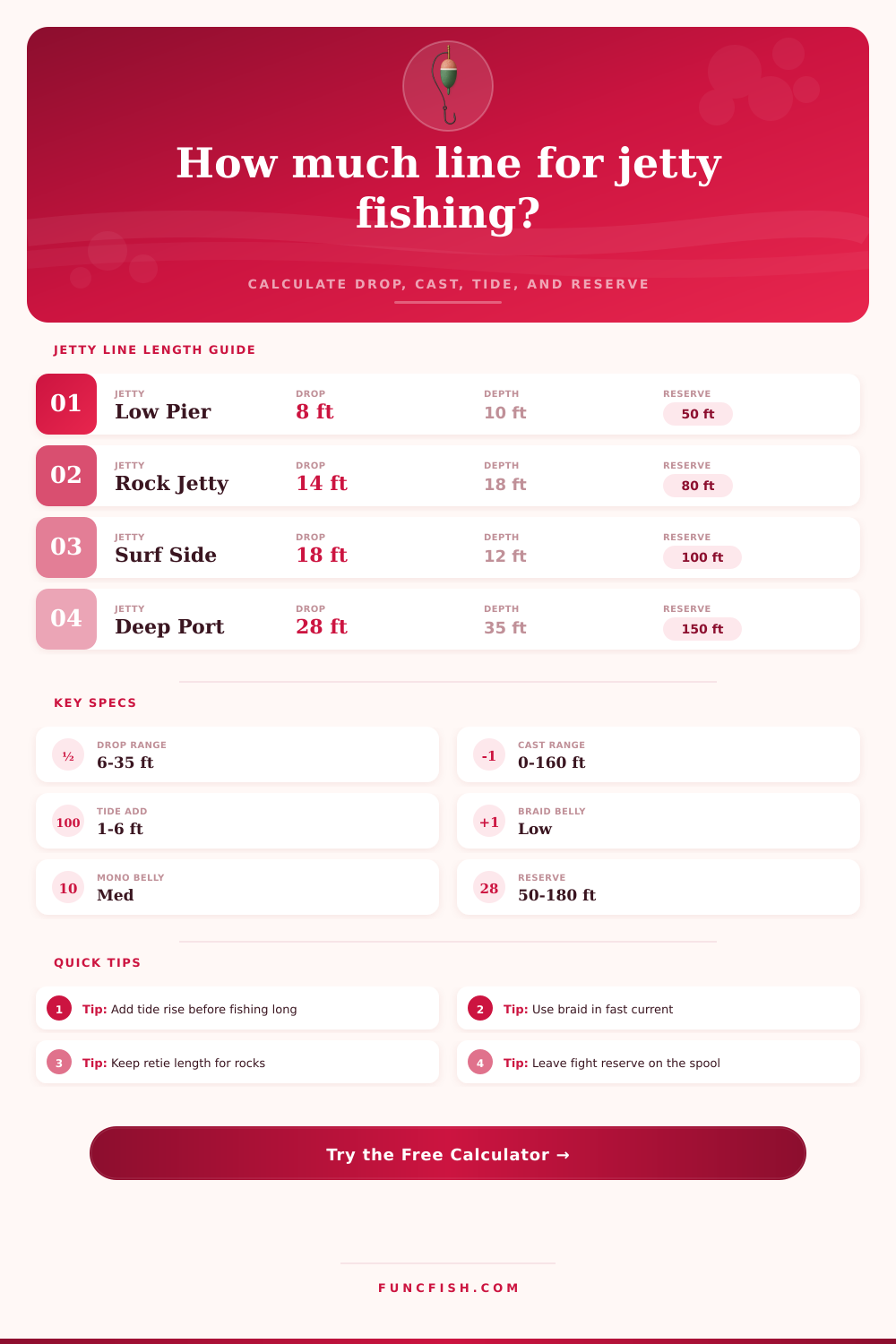
| Low bay pier or inner jetty | 6-10 ft / 1.8-3.0 m | 6-14 ft / 1.8-4.3 m | Steep, short belly | 50-75 ft is usually enough for small fish. |
| Rock jetty near mouth | 10-18 ft / 3.0-5.5 m | 12-24 ft / 3.7-7.3 m | Mixed drop and sweep | Keep extra for rocks, surge, and reties. |
| Channel end or shipping wall | 18-30 ft / 5.5-9.1 m | 25-45 ft / 7.6-13.7 m | Long diagonal line | Large fish and current need added spool reserve. |
| Surf-side jetty face | 12-24 ft / 3.7-7.3 m | 8-18 ft / 2.4-5.5 m | Low angle after cast | Wave sweep can use line even when depth is shallow. |
| Inlet pass or bridge-jetty blend | 20-35 ft / 6.1-10.7 m | 20-55 ft / 6.1-16.8 m | Strong line belly | Use a larger reserve for fast drifts. |
⚓Line material comparison
| Line material | Best jetty use | Calculator effect | Approx 30 lb diameter | Abrasion allowance |
|---|---|---|---|---|
| Nylon monofilament | Live bait, shock absorption | Adds more current belly | 0.022 in / 0.56 mm | Moderate, 4 ft per retie |
| Copolymer mono | All-around bait rigs | Slightly less belly than mono | 0.020 in / 0.51 mm | Moderate, 4 ft per retie |
| Fluorocarbon main line | Clear water, short casts | Sinks, trims belly slightly | 0.021 in / 0.53 mm | Good, 3 ft per retie |
| 4-carrier braid | Rocks, bottom contact | Thin line cuts current belly | 0.011 in / 0.28 mm | Fair, 5 ft per retie |
| 8-carrier braid | Long casts, light sinkers | Lowest belly in current | 0.009 in / 0.23 mm | Fair, 6 ft per retie |
| Hollow-core braid | Heavy live bait and topshots | Low belly with splice reserve | 0.013 in / 0.33 mm | Good with leader, 6 ft per retie |
| Dacron handline | Hand drops, crab or bait lines | Thicker line adds belly | 0.026 in / 0.66 mm | Good, 4 ft per retie |
🎣Species and rig comparison grid
Sheepshead / Blackfish
20-40 lbShort vertical line, high abrasion, small retie allowance repeated often around rocks and pilings.
Striper / Snook
30-50 lbDiagonal casts to current seams need extra belly and enough spool reserve for a first run.
Mackerel / Bluefish
12-30 lbFloat or lure drifts use more horizontal line than their shallow target depth suggests.
Tarpon / Big Drum
50-80 lbFast passes and heavy fish need a larger spool load beyond the actual fishing line length.
📏Adjustment reference table
| Condition | Length effect | Calculator field | Practical range | Why it matters |
|---|---|---|---|---|
| Rising or falling tide | Adds vertical buffer | Tide change | 1-6 ft / 0.3-1.8 m | A rig set near bottom may need more line before reset. |
| Fast inlet current | Adds line belly | Current and soak time | 0.8-2.5 knots | Belly builds faster than the straight geometry suggests. |
| Rock abrasion | Adds retie length | Abrasion passes | 1-5 reties | Nick checks shorten leaders and main line during a session. |
| Long surf-side cast | Adds horizontal path | Cast distance | 60-180 ft / 18-55 m | Low line angles create a longer diagonal from rod to rig. |
| Big fish near structure | Adds spool load | Scenario reserve | 80-220 ft / 24-67 m | Reserve prevents the spool from running too low after hookup. |
🧭Scenario defaults table
| Scenario | Slack factor | Current factor | Fight reserve | Best matching line |
|---|---|---|---|---|
| Straight-down drop | 3 percent | 0.60 | 50 ft / 15 m | Mono or braid with short leader |
| Piling bait | 5 percent | 0.75 | 65 ft / 20 m | Fluoro or mono leader |
| Channel cast | 8 percent | 1.00 | 120 ft / 37 m | Braid main line |
| Float drift | 12 percent | 1.20 | 90 ft / 27 m | Mono or braid main line |
| Fast pass drift | 15 percent | 1.45 | 200 ft / 61 m | Heavy braid with leader |
💡Calculation tips
Measure from the rod tip, not only the deck. A high rail, raised rod angle, or standing several feet back from the edge makes the diagonal path longer than a simple water-depth number.
Treat current belly as a session allowance. Even anchored bottom rigs develop a bow in the line; reset the bait sooner or add reserve when the tide begins to move hard.
Think of the line length as depth plus slack. When most people measure line length, they thinks about how deep it goes down to the bottom and call it good. What happens when you’re trying to chase a snook on the rising tide or pull out a sheepshead through a piling? Suddenly the length of your line matters because jetty fishing isn’t about two dimensions; it’s three.
There’s the depth but there’s also distance between where your rod tip hits the water and the edge of the structure itself. Then add in surge and current drift and now the real amount of line coming off your spool can be quite different than what your depth finder reads. The key is knowing how much is really getting thrown overboard every time you make a cast into the surf.
How to Calculate Line Length for Jetty Fishing
Standing on a high rail with a long rod immediately change the geometry. Your bait may be sitting ten feet beneath the surface, but now your rod is six feet over the water. There are another few feet of diagonal line before the bait gets in the target zone. Add a few more feet because you’re also standing three feet back from the edge. That little bit makes all the difference in the world for accuracy.
Input your setback and height into the calculator and it does the math for you. You will no longer have to guess at conversions or coefficients. It is easy to forget this but many people do which causes them to run their spool dangerously low when fighting a fish.
Consider line belly as well. When lying in still water, the line will lie straight. In current, however, it will be tight like a bow string. It is pulled by the current instead of your reel. The tail-end object determine how much the line bellies out. Mono floats higher and has greater bulk (thickness), which creates a lot of drag and drapes excess slack over time. Leave a mono rig knotted for 20 minutes and you might need 30 feet of line to keep bottom contact. By contrast, braids are thin and cut through water cleanly. They minimize resistance to create a small belly.
Because most folks don’t account for dynamic drift, this dynamic is missed. The tide makes that issue worse. Your bait will run deeper when the tide is coming in. This requires a little extra line length from the top of the jetty to allow for rising water level. This prevents snatching up the leader as you try to reset or pulling your rig off the bottom.
Use the table to understand how height of each jetty usually relates to water depth change, which lets you work through planning your day around the lunar cycle instead of simply responding to changing conditions.
A lesser known way your line gets killed is from abrasion. Sharp-edged rocks, oyster shells, or even concrete will take there toll. The line rips across these surfaces when a fish makes an unexpected run for cover. Often, though the fish is hooked well, it’ll take micro cuts in the line which drasticly compromise its strength in a matter of seconds.
Always leave some excess line on the reel so you can cut it off and re-tie after a hard fight. The issue is that you don’t know how many times you’re going to have to set the hook again, so you can’t budget that in terms of feet. Depending based off what type of fishing you do, if you’re fishing blackfish along rough rock walls, you may have to allow yourself 5-feet of slack line for every possible occurrence. Those incremental losses quickly compound into a whole spool of lost line by day’s end.
The last thing you want to think about is your fight reserve. By that I mean keeping from hitting the drag brake against bare spool. A big striper hooked off some piece of structure will rip out sixty or one-hundred feet of line in three seconds. If that means you had twenty feet of safety margin based off the above math, you’re sunk.
With the total load visualized with the tool, you know exactly how much main line and backing you’ll need for the first burst. That’s abstract anxiety turned into concrete, something you can rely on before casting.
Space management and tension control, these are the keys to jetty fishing. Knowing precisely how much line is out there allows you to play the fish as aggressively as possible whether you’re dropping live bait directly to bottom or drifting a float across the rock field. Leave lots of slack for those surprising runs, plan for that diagonal and give some respect to the current. The current does not care what you estimate, and your reel will benefit from those early calculations.