Kayak Anchor Trolley Scope Calculator
Estimate kayak anchor line length, trolley ring position, swing radius, pull angle, holding load, and quick-release allowance from depth, tide, wind, current, bottom, and fishing orientation.
📌Kayak anchoring presets
⚙Trolley and scope inputs
Enter the clear radius from the anchor drop to docks, banks, bridge pilings, oyster bars, brush, other boats, or shallow water.
Kayak trolley scope results
Full calculation breakdown
🔗Anchor and trolley equipment comparison
Grapple Anchor
Mini Claw
Mushroom
Stake-Out
⚓Kayak scope reference table
| Condition | Starting scope | Trolley point | Line behavior | Use case |
|---|---|---|---|---|
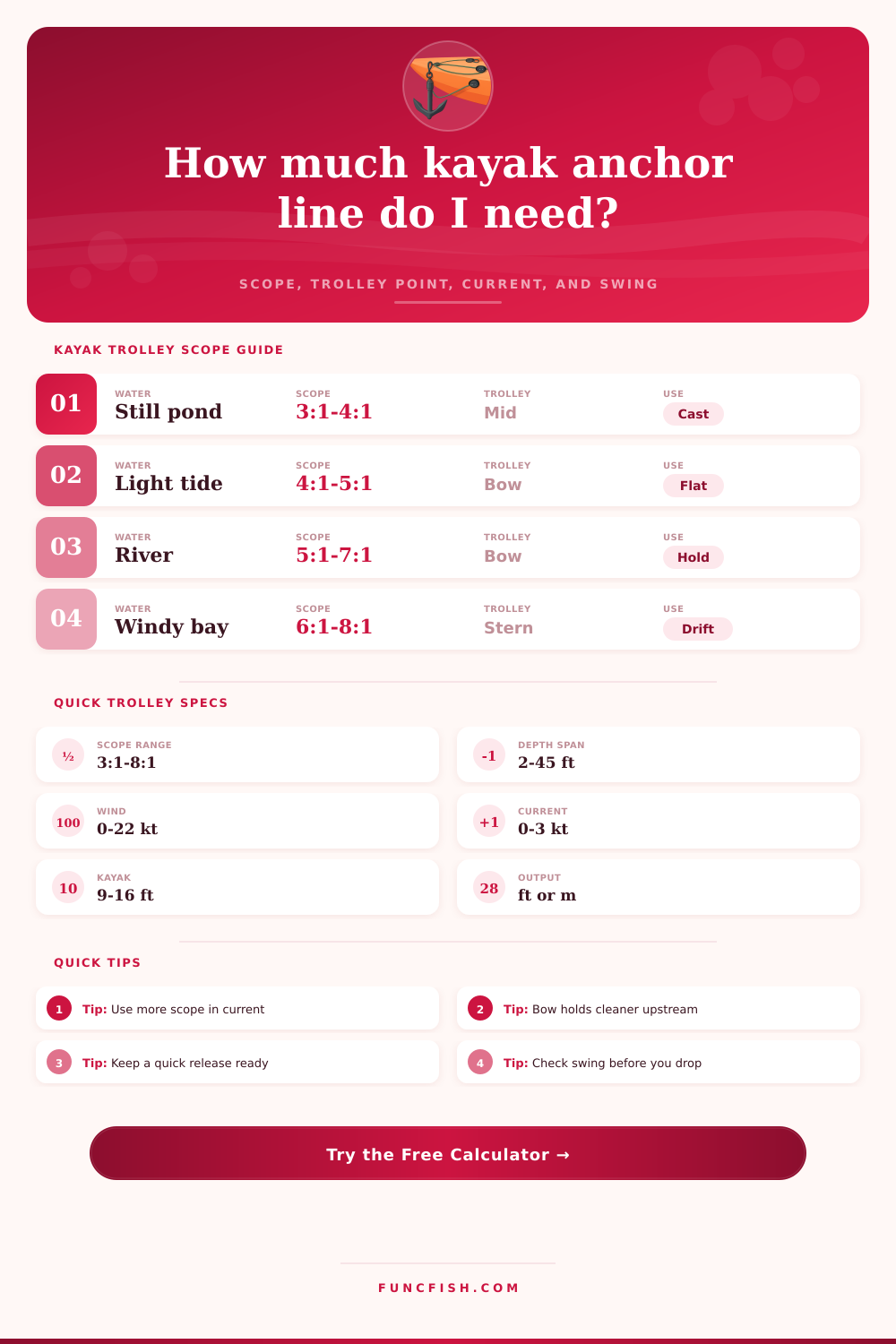
| Calm pond or protected cove | 3:1 to 4:1 | Midship or quarter | Short line and small swing | Bass, panfish, sight casting |
| Light tidal flat | 4:1 to 5:1 | Bow or forward quarter | Cleaner pull into current | Redfish, trout, flounder |
| River ledge or bridge eddy | 5:1 to 7:1 | Bow | Current drives the scope | Catfish, smallmouth, stripers |
| Windy bay or open lake | 6:1 to 8:1 | Stern or forward quarter | Wind yaw adds swing | Walleye, crappie, bay fishing |
| Tight dock pocket | 3:1 to 4.5:1 | Quarter or midship | Shorter scope trades holding | Snook, bass, sheepshead |
| Deep vertical presentation | 5:1 to 7.5:1 | Bow | Long line needs clear room | Crappie, lake trout, reef edges |
📍Trolley position comparison grid
| Trolley position | Percent from bow | Best force direction | Stability tradeoff | Calculator trigger |
|---|---|---|---|---|
| Bow ring | 5% | Strong current or upstream hold | Most stable in flow | Current above wind or deep water |
| Forward quarter | 25% | Current with casting offset | Good control and visibility | Moderate yaw request |
| Midship hold | 50% | Calm short-scope positioning | Least forgiving in current | Tight swing with low loads |
| Rear quarter | 75% | Wind-driven downwind casting | Can yaw in reversing tide | Wind greater than current |
| Stern ring | 95% | Downwind bait soak or drift stop | Use care in current | Wind-heavy, low current |
🌊Bottom adjustment table
| Bottom type | Scope adjustment | Holding behavior | Snag risk | Kayak treatment |
|---|---|---|---|---|
| Clean sand | 0.0 | Predictable set | Low | Baseline scope |
| Soft mud | +0.3 | Needs time to bury | Low | Small scope increase |
| Grass over sand | +0.5 | Can foul anchor flukes | Medium | Moderate scope increase |
| Shell or gravel | +0.4 | May skate before biting | Medium | More line and more release margin |
| Rock or riprap | +0.2 | Often wedges rather than buries | High | Lower load but high release concern |
| Brush or timber | +0.6 | Unpredictable grab points | Very high | Conservative quick-release allowance |
🐟Fishing target setup table
| Target or technique | Typical depth | Anchor style | Trolley setting | Scope note |
|---|---|---|---|---|
| Bass on weed edges | 3 to 8 ft | Stake or mini claw | Quarter or midship | Short scope keeps casts accurate |
| River catfish ledges | 8 to 18 ft | Claw or grapple | Bow | Current usually sets the ratio |
| Redfish and trout flats | 2 to 6 ft | Stake or grapple | Forward quarter | Add tide rise before multiplying |
| Bridge sheepshead | 10 to 25 ft | Grapple with release | Bow or quarter | Keep swing away from pilings |
| Lake walleye points | 12 to 30 ft | Claw or mushroom | Bow in chop | Wind adds line and swing room |
| Crappie over brush | 15 to 40 ft | Mushroom or claw | Bow | Allow release tail for snags |
💡Kayak trolley calculation tips
Scope tip: Kayak scope uses total vertical distance from the trolley ring to the bottom. Add tide rise and ring height before multiplying by the scope ratio.
Trolley tip: A bow or stern ring is usually safer than a side pull in current. Keep the quick-release float reachable before anchoring in flow.
For those of us who fish from kayaks with rope and plastic shells, we all know that familiar sinking feeling. You pull up onto a nice quiet cove, drop the anchor, and then see your kayak slowly sliding over some submerged limbs. The issue isn’t normally the anchor. I bet it would hold if you had enough weight there to sink a small car. No, the issue is nearly always related to the geometry of where that line exit the boat. Most folks tie their anchors on as they would a line tied off to a dock…pull it tight and hope it stays. And for good reason it does…until the first time current or wind enter the equation.
Plugging in your conditions and depth into the calculator above does all the heavy lifting so you don’t have to guess if you’re swinging into trouble or simply too short on line. But how do you put it to good use? That’s where understanding why these inputs matter becomes important.
How to Anchor Your Kayak Safely
Let’s start with depth. Depth is the foundation here. When we talk about depth we’re not talking about distance between your hull and the water below. You also must factor in tidal rise beneath you and the height your trolley ring sits above the water. So one foot rise in an hour or two feet of freeboard on your deck mean nothing if you don’t account for them. Your effective depth will be wrong. This means your scope ratio doesn’t mean squat. It is a small thing, but it makes a world of difference when trying to keep yourself over a fish ledge.
That’s just one example; scope is defined as the ratio of line out to vertical depth. So if you had a three-to-one ratio in calm water, you’re probably not moving much. Now put a little current, or even a knot of wind against you and that same line are a slingshot. That’s because there has to be leverage. A longer line doesn’t get pulled straight up (which would rip the anchor), but instead gets a shallower pull angle on the anchor fluke so it digs deeper. Your kayak gets some room to swing around, too. Without dragging the anchor. Water physics says you fight that every time the breeze changes, unless you have that slack. And that’s where the reference table on the page clearly shows how scope jumps from three-to-one to six-to-one or higher in windy bays.
A common newbie error is trolley position. If you’re facing up river, it’s tempting to place line in the bow ring. But this makes your boat a weather vane, pointing straight toward any imminent danger. Better to attach on the stern or quarter so the current or wind can push the bow side-to-side naturaly, stabilizing your cast angle. Here, the calculator predicts how to position one of the rings to ensure your kayak faces down on your target spot instead of spinning you out toward the rocks. That involves considering current flow and wind direction, which frequently oppose each other in actualy bays and rivers.
Don’t neglect the bottom composition. Grass, rock and mud all affect behavior of anchors. Timber may allow a great grip while smooth sand sees a grapple slide uselessly along. The tool takes this into account with an increased line suggestion when the bottom is soft and requires a little longer to get a good set. It also accounts for a quick release allowance. That is the safety margin that will save your butt if you get hung on an oyster bar or bridge piling. All those extra six feet won’t be wasted space. They’ll be the difference between getting free and losing the stuff.
At the end of the day, anchoring a kayak is all about countering invisible forces: the currents, the tides, and the wind against a simple piece of string at the bottom of the water. The key to getting the scope correct lies in trusting the equations rather than relying on instinct. Slack is stability. If you feel as if there’s too much line out, keep in mind that slack is stability. Find your numbers with the tool. Go catch something while the rest of the lake is still floating away from their spots.