🛶 Kayak Hull Speed Calculator
Calculate theoretical maximum hull speed, paddling efficiency, and speed ratings for any kayak
| Kayak Type | Typical Length | Hull Speed (mph) | Hull Speed (km/h) | L/B Ratio | Best Use |
|---|---|---|---|---|---|
| Recreational | 9–12 ft (2.7–3.7 m) | 3.9–4.3 mph | 6.3–7.0 km/h | 4:1–6:1 | Lakes, slow rivers |
| Touring | 13–16 ft (4.0–4.9 m) | 4.5–5.0 mph | 7.2–8.0 km/h | 7:1–9:1 | Open water, coast |
| Sea / Expedition | 16–18 ft (4.9–5.5 m) | 5.0–5.5 mph | 8.0–8.9 km/h | 9:1–12:1 | Open sea, multi-day |
| Fishing Kayak | 10–14 ft (3.0–4.3 m) | 4.1–4.6 mph | 6.6–7.5 km/h | 4:1–6:1 | Lakes, inshore |
| Whitewater | 7–11 ft (2.1–3.4 m) | 3.4–4.1 mph | 5.5–6.6 km/h | 3:1–5:1 | Rivers, rapids |
| Racing / Sprint | 17–22 ft (5.2–6.7 m) | 5.4–6.2 mph | 8.7–9.9 km/h | 10:1–14:1 | Flatwater racing |
| Tandem | 14–18 ft (4.3–5.5 m) | 4.6–5.5 mph | 7.5–8.9 km/h | 6:1–8:1 | Pairs, families |
| Length (ft) | Length (m) | Hull Speed (mph) | Hull Speed (knots) | Hull Speed (km/h) | Effort to Reach |
|---|---|---|---|---|---|
| 8 ft | 2.44 m | 3.79 mph | 3.30 kts | 6.10 km/h | Very High |
| 9 ft | 2.74 m | 4.02 mph | 3.49 kts | 6.47 km/h | Very High |
| 10 ft | 3.05 m | 4.24 mph | 3.68 kts | 6.82 km/h | High |
| 11 ft | 3.35 m | 4.44 mph | 3.86 kts | 7.15 km/h | High |
| 12 ft | 3.66 m | 4.64 mph | 4.03 kts | 7.47 km/h | High |
| 13 ft | 3.96 m | 4.83 mph | 4.20 kts | 7.77 km/h | Moderate-High |
| 14 ft | 4.27 m | 5.01 mph | 4.35 kts | 8.06 km/h | Moderate-High |
| 15 ft | 4.57 m | 5.19 mph | 4.51 kts | 8.35 km/h | Moderate |
| 16 ft | 4.88 m | 5.36 mph | 4.66 kts | 8.63 km/h | Moderate |
| 17 ft | 5.18 m | 5.52 mph | 4.80 kts | 8.89 km/h | Moderate |
| 18 ft | 5.49 m | 5.68 mph | 4.94 kts | 9.14 km/h | Moderate |
| Condition | Speed Factor | Effective Cruising Speed | Notes |
|---|---|---|---|
| Calm / Flat Water | 100% | Full theoretical speed | Best conditions for speed |
| River / Moving Water | 85–115% | Depends on current direction | Downstream adds speed |
| Open Water / Lake | 90–100% | Near theoretical | Wind is main variable |
| Coastal / Tidal | 75–95% | Tidal flow major factor | Time with tides |
| Rough / Choppy | 60–80% | Significant reduction | Energy lost to stability |
| L/B Ratio | Speed Potential | Stability | Typical Kayak Type | Paddler Rating |
|---|---|---|---|---|
| 3:1 – 4:1 | Low | Very High | Sit-on-top, WW Play boat | Beginner |
| 5:1 – 6:1 | Moderate | High | Recreational, Fishing | Beginner–Intermediate |
| 7:1 – 8:1 | Good | Moderate | Day touring | Intermediate |
| 9:1 – 10:1 | High | Low–Moderate | Sea / Expedition | Advanced |
| 11:1 – 14:1 | Very High | Low | Racing K1, Sprint | Expert |
Hull speed is the speed where the kayak waves sync to minimize resistance. After that limit, the drag goes up quickly. A displacement hull kayak cannot easily pass this bar.
It is like a wall that becomes harder to break
What Is Hull Speed and Why Longer Kayaks Are Faster
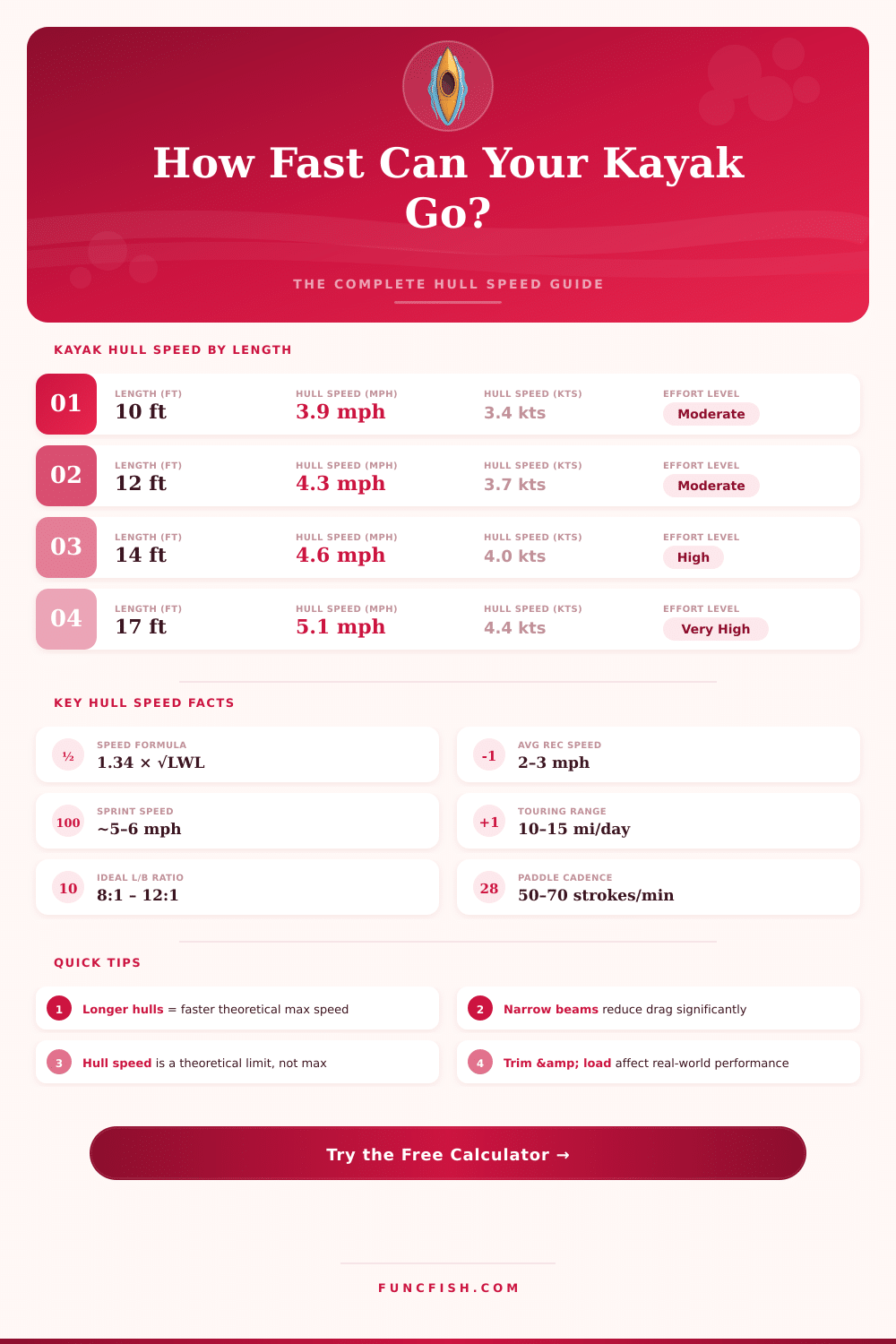
The formula to find hull speed is very simple. It is 1.34 times the square root of the waterline length in feet. A 14-foot boat has hull speed of around 5.01 knots.
For 18.5-foot boat it reaches about 5.76 knots, or around 6.63 mph. The lnoger the boat, the higher the hull speed.
In hull speed the wavelength of the wake matches the length of the boat. Here the boat starts to slip upward on its own waves. Long and narrow kayaks however make little wake.
Wave resistance for displacement hull goes up dramatically after passing hull speed, which depends on the square root of the hull length.
Speed is proportional to length. Long boats beat shorter, at least for displacement hulls. 17-foot kayak will go much more quickly than shorter.
Many paddlers believe that longer kayak helps to go more quickly, and that mostly must. The main factor is the waterline length, because the natural speed of kayak is proportional to it. Minimum 15 feet is good for long ways.
Narrow kayaks around 24 inches are fast, but broader gives more stability.
Most kayaks cruise from 5 to 7 km/h and reach around 10 km/h when strongly pushed. With moderate effort, 3 to 4 mph are usual for fun kayaks. In touring kayak you can keep 6.25 mph for more than hour.
Sprinting at around 8 mph in short pause costs too much force for more than 20 to 30 seconds.
Most kayaks do not reach their theoretical maximum, or not long, because paddlers are not Olympians. Actual speed depends on the resistance of the kayak form and the power of the paddler. You can push tubby 13-foot boat at 4 knots reasonably, but it always will feel heavy on the paddle.
Sleek kayak slips well and slows less between pauses, so the next stroke costs less effort. Very broad hull pushes a lot of water and goes more slowly. You must choose: fast kayak or more stable but less fast kayak.
Most kayaks can’t reach their theoretical top speed, or if they can, not for long, because most paddlers aren’t Olympic athletes. Actual speed comes down to how much resistance the kayak shape produces and how much power the paddler supplies. You can push a tubby 13-foot boat at 4 knots reasonably but it will always feel heavy on the paddle.
A sleek boat will glide more and slow down less between strokes, so the next stroke needs less effort. Very wide super stable hulls push a lot of water and are slower. You have to pick one, a fast kayak or a slow kayak that is more stable.