
When you purchase your initial koi, you expect them to be able to live in a little back yard pond. After all, it’s just a fish, right? Turns out that fish is carp and have big growth potential. Before long you’re surprised to find that instead of staying compact, the fish become bigger then expected. It’s a normal response for novice keeper who don’t understand that koi are more than just decorations.
To save yourself some aggravation, you should of known that growth isn’t linear. That means you’ll have to know how these creatures evolve from diminutive fry to full-blown adults. But the numbers on chart will only get you part way there. To understand what’s driving biology you’ll have to know why things grow like they do.
Why Koi Fish Grow So Big
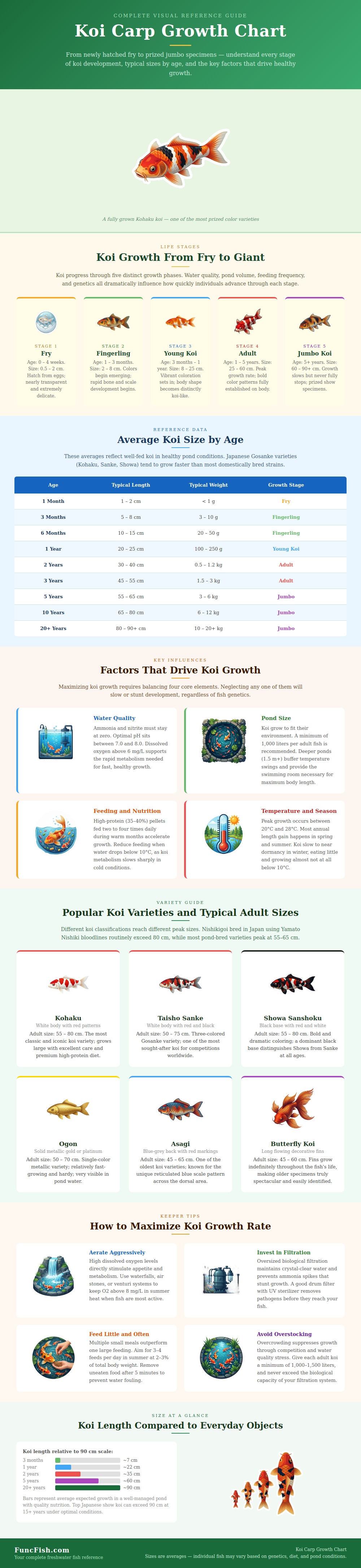
Koi are carp with delusions of grandeur. They start out very fragile. When hatched from an egg, the baby koi (fry) depends upon its yolk sac for nutrition for several days and is therefore tiny and prone to attack. At about 3-months, the fish are called fingerlings, and they’ve doubled or tripled in size. However, how large they’ll grow isn’t yet known. Their colors start flashing then, making them look full grown. Nope. Not even close.
Year one through year five is when most of bulk is added. This is why keeping your koi in a shallow pond or small tub will stunt them before they’ve reached their genetic limit. There’s only so much space to swim, and physics dictates that there must be enough. More room means more swimming, stimulating a larger appetite while building muscle mass.
Everything about growth are dependent on water quality. Premium pellets fed become waste not meat if the water quality is bad (e.g., high ammonia). Metabolism rises in warm weather causing koi to excrete lots of waste. Because of this, filtration must be oversized to accommodate the load. Good water helps feeding since lack of good conditions causes stress and reduces appetite.
Dissolved oxygen is critical for growth too. A fish won’t grow well when breathing isn’t efficient. Warm water requires additional aeration as koi eat high protein meals. Absence of enough oxygen will cause growth to stall no matter how much you feed.
Metabolic activity depends on temperature. In spring, as water hits twenty degrees C, koi awaken and gorge themselves. It’s the time of year that they grow most length. When it gets too cold (below ten degrees), their metabolism basically shuts off. They can’t digest their food very well at all if you try to feed them during winter. So, in cold weather smart people either change to maintenance feeds or quit feeding altogether. That doesn’t mean the fish get no attention, but it does follow biological rules instead of being neglectful.
Winter is not a good time to try to make your fish grow since their internal systems are turned off. Wait until things warm back up and let them grow normaly.
Variety influences size, but not as much as the environment do. An Ogon might not be as good of a show fish as a Kohaku but if you give either one the space they will also get big. Because of selective breeding over decades, the Japanese Gosanke varieties tend to gets larger. If you place even a common koi into the right environment they too can become giant. So don’t worry about selecting a certain strain just based off size because pond conditions are far more important.
Deep water buffers temperature swings and allows for more freedom of movement. Also, overstocking creates competition for oxygen and food. This slows the growth of all fish in the pond and makes them stay small and unhappy.
Keeping big koi is more than a hobby; it’s a responsibility. It takes time, attention, and knowledge about how to manage them in order for you to raise healthy, happy fish. Keeping them involves maintaining an ecosystem that meets the fishes’ needs. It’s not simply about feeding them. A big fish gliding through lily pads proves that all your efforts have been worth it.
How big they grow shows your decisions over the years. You decided what and when to feed them, where to keep them, and how much water they need.