
There’s a flash of color, white with some red. And there they are. You’ve walked up to a pond and seen them: a carp (technically), but realy what you’re witnessing is living art. The selective breeding over hundreds of years has gave rise to certain colors and patterns.
And there’s a language in those fish; a slight visual language that poses challenges to new owner. One little dot can show one kind of fish but another of a completely different kind if it appears on its head versus its body. Buying the wrong fish is more than getting a fish that doesn’t look as good. It means you will also not be able to tell what kind of fish it is or what it is worth later on when you try to sell it.
How to Tell Different Koi Fish
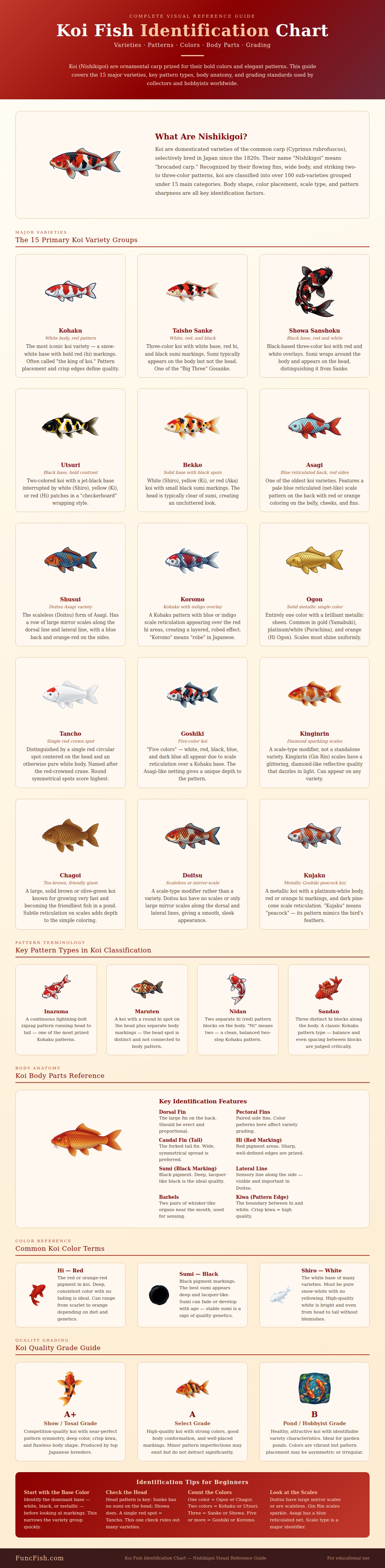
What matters isnt so much choosing pretty colors but knowing the rules that all those who breed the fish has used for well over a hundred years. This is the base color. This is where your first clue of identification begins. What is the main background color? Is it white with some red? Then you are probably dealing with a Kohaku. Why is it often referred to as the king of koi? Because it’s simple. It just lets the pattern speak without distraction from other elements. You can see how this plays out in the hierarchy shown in the infographic above.
Same white background but now there are black dots but only on the body (not the head). Now we have a Taisho Sanke. Make the base color black with white and red wrapping around the fish, now we have a Showa Sanshoku. Three varieties make up what are known as the Gosanke or big three kinds. Being able to know which category you’re in immediately reduces the options. Most newbies will attempt to learn all patterns simultaneousy. That doesn’t work because they is missing the logical structure behind breeding.
After that comes the quality. That’s when you should of pay attention to things like sumi and kiwa. Kiwa refers to the line between one color and another. Sharp, clear division between white and red mean higher grade. Lower grades are characterized by fuzzy color lines (meaning poor development or less than great genetics). Sumi: The pigmentation found on the black parts of the koi. For the best-grade Showa koi, this sumi should be very dark, almost like lacquer, and stable. It shouldn’t fade easy or appear to be washed out. Such a fish would never hold its value.
The chart above shows how each of these grading categories break down into levels. Shows is closest to perfect, with both depth of color and proper symmetry. Selects are still outstanding for avid koi collectors. Minor variations in patterns distinguishes them from their show-grade counterparts. Pond grade fish are vibrant and healthy, perfect for decorating a garden without the pretension of competition judging. And don’t worry about needing show quality just to have a good looking pond. Many hobbyists like those slight imperfections on a pattern that make each one unique and more full of character.
There’s also pattern placement. Called Tancho (for its resemblance to the red-crowned crane), it has one central red spot on the head. But this needs to be precise; an off-center spot changes the classification or reduces the aesthetic score. In Kohaku, lightning bolts (zigzag stripes) that extend from head-to-tail is prized for their dynamic energy. Two-step or three-step patterns are areas of different colors divided by white spaces. And again, balance is key. Your eye should flow smoothly down the fishs body without getting hung up on cluttered spots.
There are other factors to consider: scale type and body shape as well. Mirror scaled doitsu koi appear armored and sleek; some is completely without scales. Some varieties, such as Asagi, present a reticulated net pattern of blue on their backs contrasting red colored sides. They link the history of koi to today’s varieties.
With knowledge comes recognition. What once was a blur of color in the water takes form, and suddenly you can read each individual fish. You begin to appreciate the beauty behind carefully crafted designs versus luck of the draw mutations. Staring at the water evolves into appreciating it. It turns seeing a flash of color underwater from something you just notice into something you stop and truly observe.
Look at the base. Look at the head. Let the pattern unfold. That’s when the hobby realy starts.