
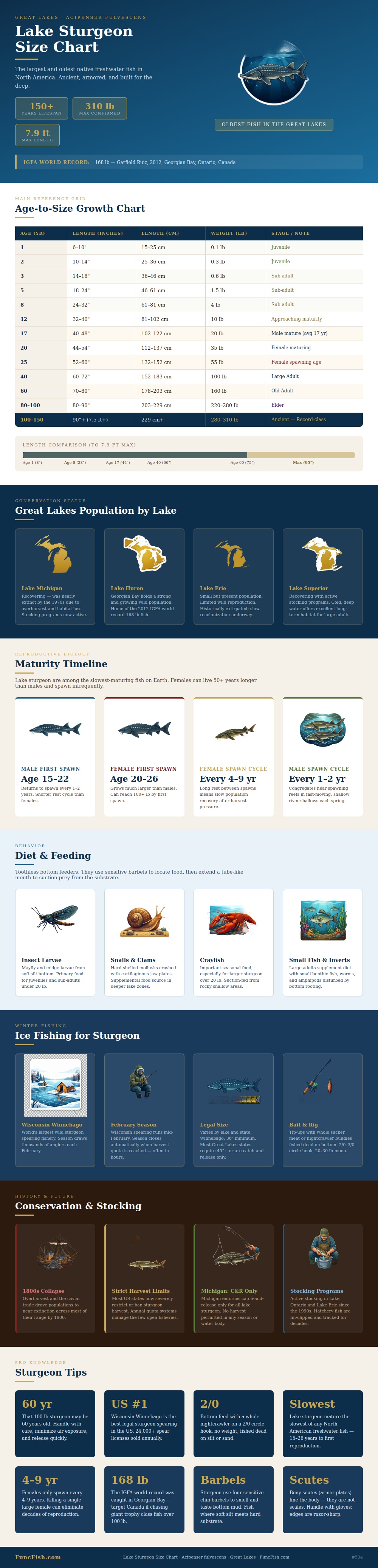
And there it sits; a creature so old your great-great-grandparents’ grandparents weren’t even born yet. It is an ancient and massive fish that couldn’t be more different than any other freshwater species. You’re holding an artifact of days past when sharks swam in the inland lakes. It makes for a very different understanding of this animal.
And it’s why conservation is such a pressing matter, even though the fish seems to look indestructible. But unlike today’s fish, these fish grows slowly by moddern standards. Sturgeon do not look for instant gratification; they run on a geological clock. They’ll grow maybe an inch or two a year during their first decade as juveniles (hunkered down on muddy river bottoms where no one can find them). And if you don’t protect that young fish from predation until it grows big enough to be noticed, it won’t make it.
Why We Must Protect Sturgeon
Afterward things speed up, though never linearly. An infographic depicts the trajectory, depicting that a ten-year-old fish might only weigh ounces but then shoot into adulthood like a rocket. It’s all about exponential patience. The male’s smaller size is due to biological differences between males and females. Those that are biologically able does mature rapidly, spawning by the time they’re teenagers or early twenties.
Females require more time to mature, with some not spawning until their 25th year or later. While a female may spawn multiple times she also returns to shallow waters every four to nine years, making her a crucial link to gene pool as well. If you kill off a big female, you lose several decades of potential offspring at once. A chart illustrates the divide; while males level out in size, females keeps on growing.
Sturgeon fishing requires a mindset adjustment because you cannot chase them like bass or trout. Sturgeon are bottom-feeding fish that suck up insect larvae, crayfish, and clams off the bottom. They use feeler-like structures called barbels, and they sense food by tasting mud with their toothless tongues. Presentation is more important than speed. Patience is rewarded.
Using dead bait, fished on the bottom in areas around hard structure is better than flashier baits as it mimics natural foraging habit. The right hook is crucial. Their mouths are toothless, tough and rely on cartilage plates to crush shells. Use a circle hook so you don’t hook them too deep and gill the fish. Most regulations makes this a catch-and-release fishery.
Depending on where you live, the conservation status ranges from good to fair. In some places, populations is recovering because of harvest bans and stocking programs. In other areas, the status is poor, with only a few survivors hanging on. But we should of never forget how badly the sturgeon fishery collapsed back in the 19th century because of overharvest for both meat and caviar. Now, many states has adopted catch-and-release regulations so we won’t repeat past errors.
It’s a balancing act that provides angling opportunities but guarantees the continued presence of these ancient creatures. The age and size of that sturgeon help you understand what it is you’re looking at. If it was a hundred pounds in the boat, it probably lived through quite a bit during its six decades of life. And we want to treat these fish well and avoid stressing them out; treating them right respects their age.
It isn’t about catching a big one. It’s also about doing our part to care for this incredible animal. They are an ancient neighbor and deserve to be treated as such. When they’re released back into the water, they can continue livig on for another day or a decade in the wild.