
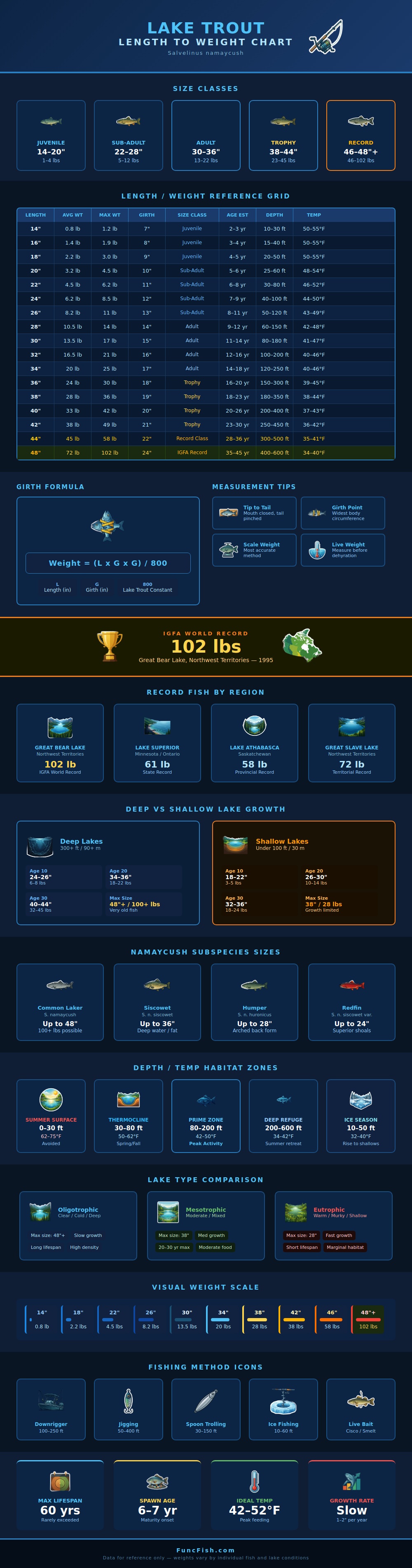
I was fighting a big lake trout from deep water and hooked into something realy heavy. I fought it to surface and got it on the deck, but there was no scale nearby. You need to measure it quickly once it’s on the deck before dehydration set in. If you don’t have a scale handy or the fish is too big for your device, you can estimate how much it weigh. And that’s where knowing fish length to weight matter. How long does this mean? Use this chart (above) and you’ll know what you’ve got pretty close. Being able to estimate accurately allow you to figure out if you’re within limits and learn more about biology of the fish.”
As seen in the visual guide, lake trout are grouped by size class to show life stages. Fourteen- to twenty-inch juveniles has a very slow growth rate in nutrient poor waters and seldom exceed four pounds. Twenty-two- to twenty-eight inch sub-adults keeps getting heavier until they reach about twelve pound. It’s the transition times of year when most angler find themselves catching these fish. Crossing the thirty-inch mark puts lake trout into trophy status. Once past this benchmark, trophies achieve massive weights through exponential body mass gains different than linear increases in length.
How to Measure Lake Trout Length and Weight
The presence or absence of big lake trout has more to do with habitat zones than a given lake. Lake trout need specific temperatures; that is, they prefers temperatures in a tight band of 42 to 52 degrees Fahrenheit. They stays in cooler, deeper water during the summer months when surface waters become warmer. Deep, clean water and ample depth support this vertical movement and can help them live beyond age sixty. Although nutrient-rich shallow waters may have better food resources, their quicker warming rates limits growth potential. It’s less about what’s being eaten and more about being able to consistantly enjoy thermal comfort.
Measure the lake trout’s length (snout to tail) with its mouth closed and lobes pinched together always. Girth should of been measured around broadest part behind gill area with a flexible tape measure. Never attempt to guestimate based off eye level comparison. For estimated weight, use the standard cubic formula: length x girth squared divided by 800. If you can verify the weight on scales that’s best. Minimize stress through quick handling. This has a direct effect on how many lives after being released.
But the outliers, the record holders, are always interesting. They challenge biology, pushing it to extremes. A hundred and two pound fish was caught decades ago in northern waters of Canada. Those regions hold extreme depths where cold water remains stable and allows these fish a chance to reach ages unseen elsewhere. They demonstrates that under the right circumstances, with stable cold water, food, and time, the lake trout can surpass what we might expect. The reality is most regional records falls into that 60-75 pound range indicating some sort of cap on maximum potential even under ideal conditions.
Seasonal shifts in water temperatures change depths, which alter how they are fished. Trolling with downriggers effectively presents bait at consistent depths where fish will be actively feeding outside the range of direct sun reach. Jigging patterns is most effective during low light periods like twilight. This puts a lure in front of the fish at a height off the bottom that make them easier to target. Live bait such as cisco or smelt often create strike triggers based on instinct rather than how well an artificial mimic looks. Winter layers break down and the ice opens up new ways to reach fish schools in and around mid-depth water.
Equipment complexity isn’t as important as patience. Lake trout are slow moving creatures in their environment. They takes years to build muscle. They don’t suddenly explode like a bass might during the spawn of springtime. Honor their time frame, learn their rising air and be patient and precise when naturaly occurring land falls occur. Whether it’s to help with science and conservation or just to add to your personal bests, being accurate with the pinched tail end is key.