Line Elongation Under Load Calculator
Estimate how much fishing line stretches under steady drag and sudden surges, then compare hook-set travel, strain percent, and safety margin.
📌Scenario presets
⚙Line load inputs
Line elongation analysis
Full breakdown
🧵Line material stretch grid
Nylon Mono
Fluorocarbon
8 Carrier Braid
Wire Leader
📋Reference tables
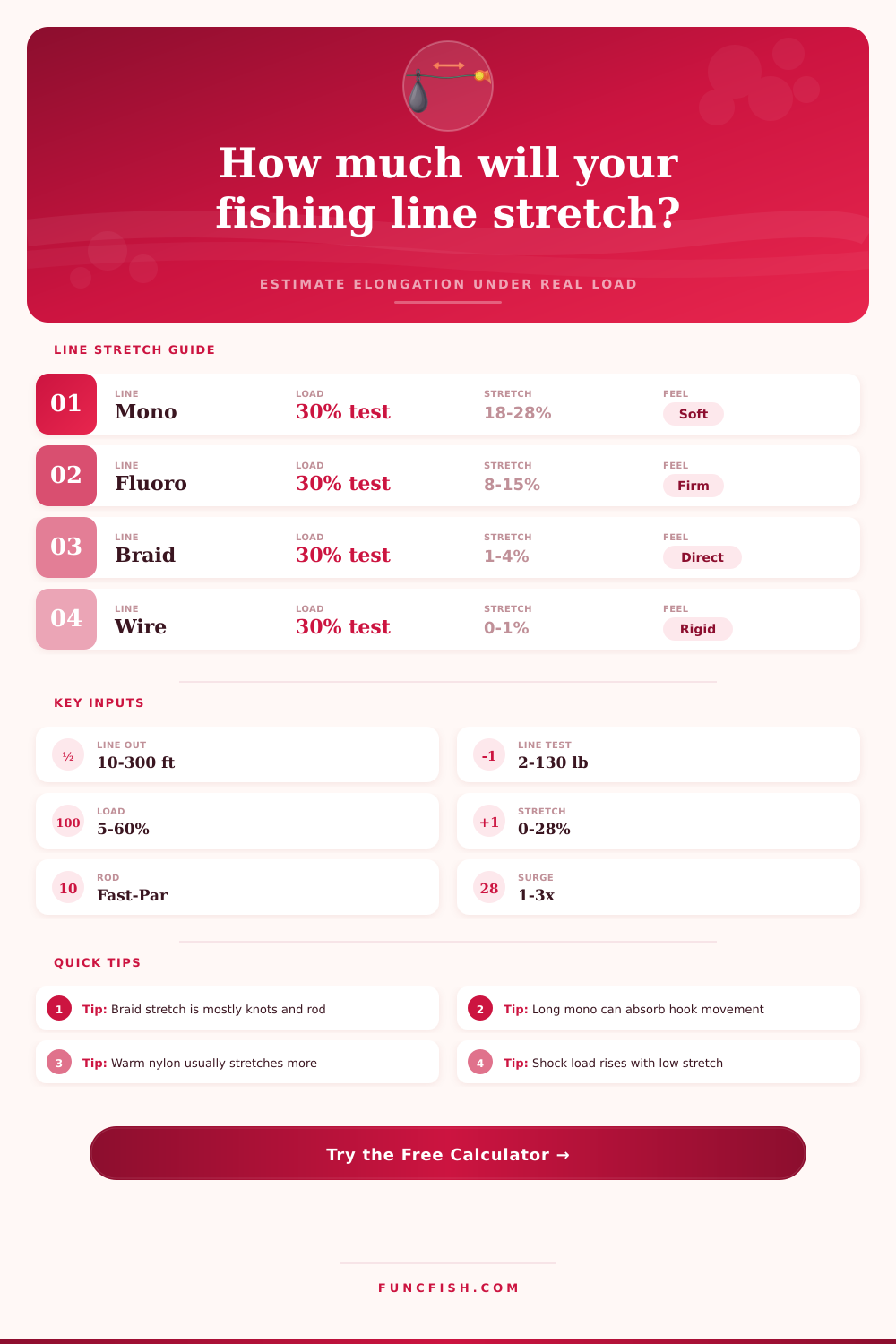
| Line family | Typical stretch at 30% test | Shock cushion | Common fishing use |
|---|---|---|---|
| Nylon monofilament | 18-28% | High | Crankbaits, trolling, surf shock |
| Copolymer | 13-21% | Medium-high | All-around casting and trolling |
| Fluorocarbon | 8-15% | Medium | Jigs, leaders, clear water |
| Braided PE | 1-4% | Low | Grass, deep jigging, long casts |
| Lead core | 5-9% | Medium-low | Controlled depth trolling |
| Wire leader | 0-1% | Very low | Pike, musky, toothy fish |
| Load as percent of test | Mono behavior | Fluoro behavior | Braid behavior |
|---|---|---|---|
| 10% | Light working stretch | Small but visible give | Nearly direct |
| 25% | Strong cushion zone | Firm controlled stretch | Knot and rod dominate |
| 33% | Typical drag ceiling | High working load | Watch shock spikes |
| 50% | Large elongation | Near hard pull zone | High break risk on surges |
| Technique | Line out | Useful stretch | Watch point |
|---|---|---|---|
| Close jigging | 10-40 ft | Low to medium | Hook penetration needs movement |
| Long crankbait cast | 60-120 ft | Medium to high | Too much mono can soften hook-set |
| Surf cast shock leader | 20-60 ft | High | Cast load can exceed steady drag |
| Offshore trolling | 100-300 ft | Medium | Long line stores a lot of energy |
| Heavy grass braid | 20-80 ft | Low | Rod and drag must supply cushion |
💡Practical checks
Tip: Long mono can stretch several feet under hard load, which helps protect light hooks but can absorb a short hook-set at distance.
Tip: Low-stretch braid gives cleaner contact, but sudden surges move more load into the knot, drag, rod, and terminal hardware.
Fishing line stretch is teh amount that a fishing line expand when a fishing line is under tension. The fishing line stretch can impact how a person feel a fish with the line, as well as the force that is transferred to a knot or hook. Lines that has alot of fishing line stretch will allow the fishing line to absorb the movement of the fish; however, the stretch can prevent the hook from making proper contact with the fish.
Lines that have very little stretch will allow the force of the fish to be transferred to the fishing line to the knot; however, the line may break more easy when the fish surge forward. The material of the fishing line will impact the amount of stretch that the line exhibit. Lines made of nylon will exhibit a high amount of stretch, since people select nylon as a material for its ability to absorb the shock of a fighting fish.
What Affects Fishing Line Stretch
Lines made of fluorocarbon will exhibit a moderate amount of stretch, as fluorocarbon lines are stiffer than nylon lines, yet not as rigid as braided line. Lines made of braided line will exhibit very little stretch, allowing anglers to feel the fish with the line as it fight. Finally, lines made of wire will exhibit almost no stretch at all due to the inherent rigidity of wire as a material.
A variety of variables can impact fishing line stretch. For instance, the length of the line can impact the amount of stretch that the line exhibits. Short lengths of line may only exhibit a few inch of stretch when under tension, while longer lengths of line will exhibit more stretch in the same amount of force.
Another variable that can impact fishing line stretch is the test rating of the line, the steady load on the line, and the surge factor that can act upon the line. For instance, a steady load will impact the amount of stretch that can occur on the line when the force being applied is constant. Surge loads are load that are suddenly applied to the line, such as the fish that begins to surge forward when it is hooked.
The temperature of the fishing line can also impact the amount of stretch that the line exhibit; warm nylon lines will stretch more then cold line. Other factors that impact the stretch of the fishing line includes the action of the fishing rod, the drag on the line, and the length of the fishing line. For instance, rods with a parabolic action will bend more deep into the line than fast-action rods, distributing the force of the fish to the line more evenly.
Fast-action rods will exhibit more direct transfer of force between the fish and the line. Drag on the line can exhibit different behavior; smooth drag will allow the line to surge forward more gradually, while sticky drag may cause an initial spike in the pressure that the line experience. Finally, the length of the fishing line is another factor; the stretch of the line is cumulative over the length of the line.
The type of knot that anglers use on the fishing line will alter the amount of stretch that the line exhibits. For instance, a loop knot will exhibit a small amount of additional stretch compared to a direct tie between the two component of the fishing line setup. Finally, the condition of the fishing line may also impact the amount of stretch that it exhibit.
Lines that have been exposed to the sun may exhibit less stretch due to the loss of elastic properties of the line when exposed to UV light. Similarly, lines that have become abraded along their path to the fish may lose some of their elastic properties. Thus, a line with lost elastic properties will exhibit less stretch when under load, and may break more easy.
In making a decision about the type of fishing line that anglers will use in a fishing scenario, anglers must balance the benefits of both high and low amount of stretch. Lines with high amounts of stretch will provide protection for the knot and hooks on the fishing line, but the stretch can contribute to a softer hook-set. Lines with low amounts of stretch will allow anglers to better feel the fish as it is caught, but they require the fishing rod and drag system to absorb some of the force of the fish.
Additionally, fishing line stretch calculator are available that allow anglers to test the effect that each of these line parameter can have on the fishing line. Thus, using such a calculator will allow anglers to decide whether they need a long line made of monofilament material, or if they need to use fluorocarbon of a shorter length. You’ll have to consider your gear, because its important to get it right.