Line Replacement Interval Calculator
Estimate when to replace or reverse fishing line using line material, age, trip load, abrasion, UV exposure, salt, storage heat, drag pressure, and visible wear.
📌Scenario presets
⚙Line wear inputs
Line replacement estimate
Full breakdown
📋Line material service grid
Monofilament
Fluorocarbon
Braided PE
Fly Line
📐Replacement interval reference tables
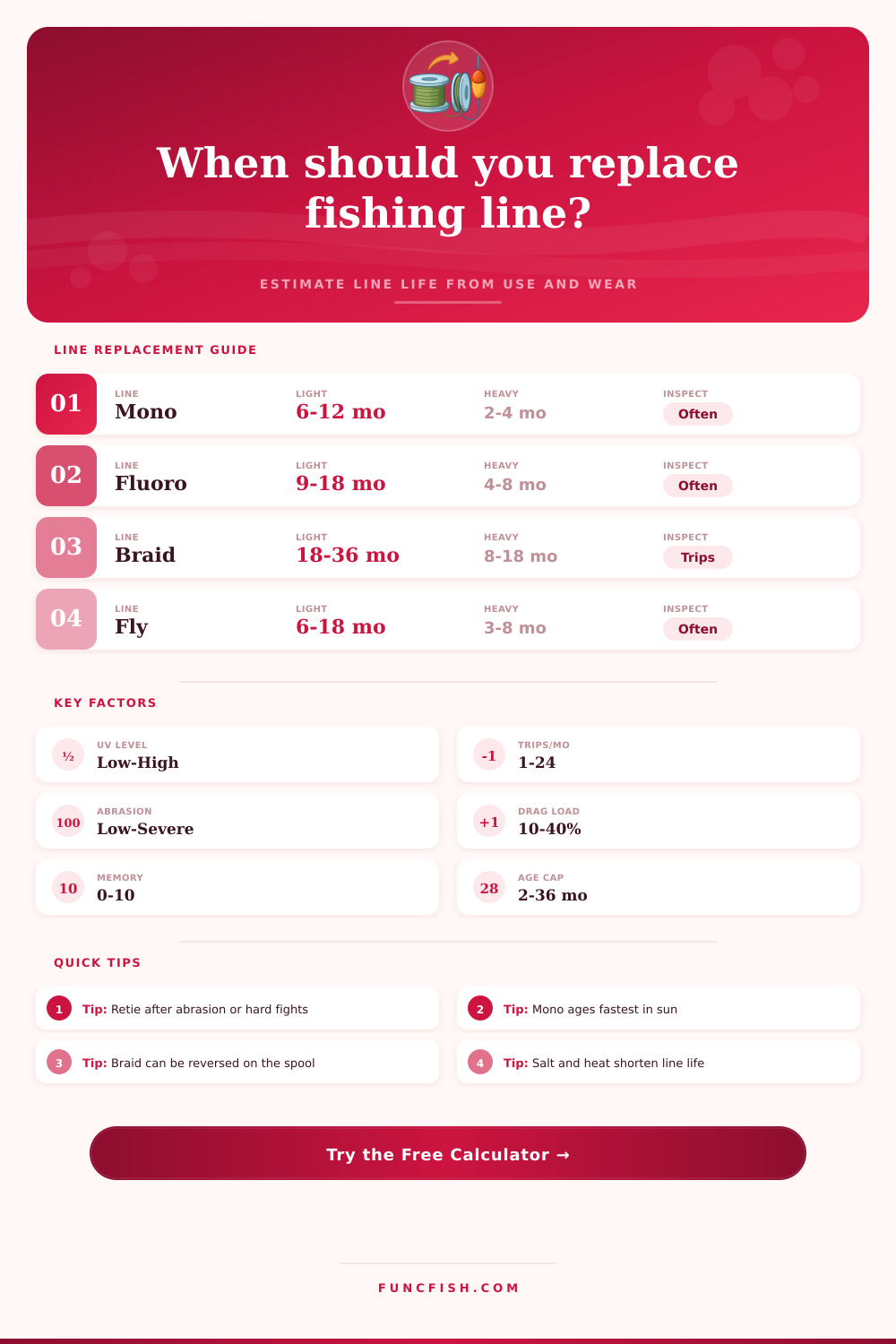
| Line material | Light freshwater use | Normal use | Hard salt or cover use |
|---|---|---|---|
| Monofilament nylon | 9-12 months | 4-8 months | 1-3 months |
| Fluorocarbon | 12-18 months | 6-12 months | 3-6 months |
| Copolymer | 9-15 months | 5-10 months | 2-5 months |
| 4-carrier braid | 18-30 months | 10-18 months | 5-10 months |
| 8-carrier braid | 24-36 months | 12-24 months | 6-14 months |
| Fly tippet | 8-12 months | 3-8 months | 1-3 months |
| Wear signal | What it means | Score impact | Recommended action |
|---|---|---|---|
| Milky or cloudy fluoro | Stress whitening | High | Replace affected section |
| Mono coils off spool | Memory and UV aging | Medium | Respool soon |
| Braid fuzz at guides | Abrasion or coating loss | Medium | Cut back or reverse |
| Flat spots after snag | Crushed or overheated line | High | Retie immediately |
| Fly line cracks | Coating failure | High | Replace or retire |
| Technique | Primary line stress | Inspection rhythm | Line to watch |
|---|---|---|---|
| Finesse casting | Twist and light nicks | Every 2-3 trips | Fluoro, tippet |
| Jigging | Rock contact and shock | Every trip | Fluoro, braid |
| Surf casting | Sand, salt, guide heat | Every trip | Mono, shock leader |
| Trolling | Long steady drag | Every outing | Braid, mono topshot |
| Fly casting | Coating cracks and grit | After cleaning | Fly line, tippet |
💡Practical checks
Tip: Run the last few feet through your fingers after rough cover, hard hooksets, snags, and fish that roll near the net.
Tip: Braid with good inner wraps can often be reversed on the spool, but replace it when fuzz, fading, or random breakoffs cluster near the working end.
Fishing line dont provide an signal for anglers when the line is worn out. Fishing line may become quiet or it may become stiffer when the fishing line is old. Because the fishing line is susceptible to failure, it is possible for the fish to bite on the fishing line and snap it.
Many peoples will replace their fishing line based on the date on the calendar. However, using the calendar to determine the life of the fishing line are not accurate. Likewise, many anglers will replace their fishing line based on a hunch.
When to Replace Your Fishing Line
However, the idea of a hunch is also an unreliable method for determining the life of the fishing line. The life of the fishing line depend on certain variables. Some of those variable include the material of the fishing line and the conditions in which the fishing line is used.
The material of the fishing line will set the limit of how long the fishing line will last. Monofilament fishing lines is known to absorb water and ultraviolet (UV) radiation. Additionally, fluorocarbon fishing lines are resistant to UV radiation.
However, the hardness of the fluorocarbon will hide damage within the line until the fishing line become cloudy. Braided fishing lines can last more longer in theory. However, the braided fishing line fibers will collect grit and the coating on the braided fishing line may wear down from friction against the fishing guides.
In these cases, the type of environments in which the fishing line is exposed will also affect the life of the braided fishing line. Fishing line life will also be affected by the way in which a person fish. For instance, a person who goes fishing four times each month will wear down the fishing line at a different rate then a person who jigs the fishing line over rocks every other day.
Fishing line that is braided may last a full season when trolling for fish in the open water. However, using the same braided fishing line for surf fishing every other week will cause the sand to wear at the braided line. The drag settings that anglers use when fishing will also impact the life of the fishing line.
For instance, if the angler uses high drag when they reel in each fish, the life of the fishing line will become shorter. Environmental factor that impact fishing line life include where fishing line is stored and the type of water in which the fishing line is used. Fishing line that is stored on a spool in a truck on a summer day will experience memory and coating fatigue.
The salt on the fishing line can remain in the line if it is not rinse out. Braided fishing line tends to hold moisture between the strands of the braided fishing line. People often thought fishing lines used in freshwater environments to not be damage by the water.
However, if the fishing line comes in contact with weeds or wood in the water, the fishing line can develop nicks along the fishing line. These nicks may not be visible while fishing, but may become visible if the fish begins to pull on the line. Anglers often ignore the signs of damage to the fishing line.
For instance, if there is fuzz on a braided fishing line or if there is a flat spot on a monofilament fishing line, it mean that that area of the fishing line has lost some of its strength. As the fishing line is coiled up repeatedly under tension, weak spot will form in the line. These weak spots are referred to as memory in the fishing line.
If fishing line is exposed to high abrasion and drag, the life of the fishing line will degrade at a faster rate than the number of days that the fishing line has been in use. The calculation of the life of the fishing line will include a percentage that indicate the health of the line and a recommendation regarding the fishing line. In most cases, when replacing fishing line, it is not necessary to replace the entire spool of fishing line.
The outer section of braided fishing line can be damaged; however, if the angler reverses the braided fishing line, the life of the braided fishing line can be extended. Fishing lines made of monofilament or fluorocarbon will not benefit from being reverse. The UV radiation will impact each spool of the fishing line.
In these cases, when the health of the fishing line reaches a point where it can no longer be used effective, monofilament and fluorocarbon fishing lines should be replaced. This measure will reveal how many times the fishing line can be retied before it is necessary to cut back on the amount of fishing line that are in use. The purpose of monitoring fishing line wear is to replace the fishing line when it is likely to fail.
Fishing line should be continued to be use when the calculations indicate that it is still reliable. Therefore, instead of thinking about the life of fishing line in terms of a calendar date, the life of fishing line should be thought of in terms of the conditions in which the fishing line is use.