Livewell Capacity for Limit Calculator
Estimate livewell gallons or liters for an entered fish limit, target species, hold time, temperature, water exchange, and aeration support.
📌Scenario presets
⚙Livewell settings
Livewell capacity forecast
Full breakdown
📋Holding profile reference grid
Live Release
Sorting Well
Transport
Short Hold
📐Species and livewell tables
| Species profile | Typical limit load | Stress factor | Comfort temp | Notes for capacity |
|---|---|---|---|---|
| Largemouth bass | 5 fish / 8-16 lb | 1.15 | 62-75 F | High live-release buffer |
| Smallmouth bass | 5 fish / 7-14 lb | 1.20 | 58-72 F | Sensitive in warm water |
| Walleye | 4-6 fish / 8-18 lb | 1.10 | 50-68 F | Needs cool oxygenated water |
| Trout | 5 fish / 3-10 lb | 1.35 | 45-62 F | Highest cool-water demand |
| Crappie | 10-25 fish / 6-18 lb | 1.05 | 55-72 F | Many small fish add waste load |
| Catfish | 5-10 fish / 15-45 lb | 0.90 | 60-80 F | Heavy biomass drives capacity |
| Redfish / inshore | 2-5 fish / 8-25 lb | 1.25 | 65-78 F | Large slot fish need room |
| Northern pike | 2-5 fish / 10-35 lb | 1.00 | 50-68 F | Long fish need surface room |
| Livewell style | Usable factor | Best capacity range | Exchange target | Capacity note |
|---|---|---|---|---|
| Built-in boat livewell | 0.94 | 20-45 gal / 76-170 L | 1-3x per hour | Good all-around shape |
| Portable aerated tank | 0.90 | 12-35 gal / 45-132 L | 1-2x per hour | Watch slosh and heat |
| Kayak livewell box | 0.82 | 5-18 gal / 19-68 L | 0.5-2x per hour | Best for small limits |
| Round tank | 0.96 | 20-80 gal / 76-303 L | 1-4x per hour | Efficient circulation |
| Cooler conversion | 0.86 | 15-60 gal / 57-227 L | 0.5-2x per hour | Check actual filled volume |
| Divided tournament well | 0.88 | 30-60 gal / 114-227 L | 2-4x per hour | Divider reduces usable water |
| Aeration level | Oxygen support factor | When it fits | Capacity effect |
|---|---|---|---|
| Low bubbler only | 1.18 | Short, cool holds | Needs more water volume |
| Standard recirculation | 1.00 | Most boat wells | Baseline capacity |
| Strong spray bar | 0.92 | Tournament or warm days | Small capacity credit |
| Supplemental oxygen | 0.84 | Heavy biomass loads | Still needs water room |
💡Capacity checks
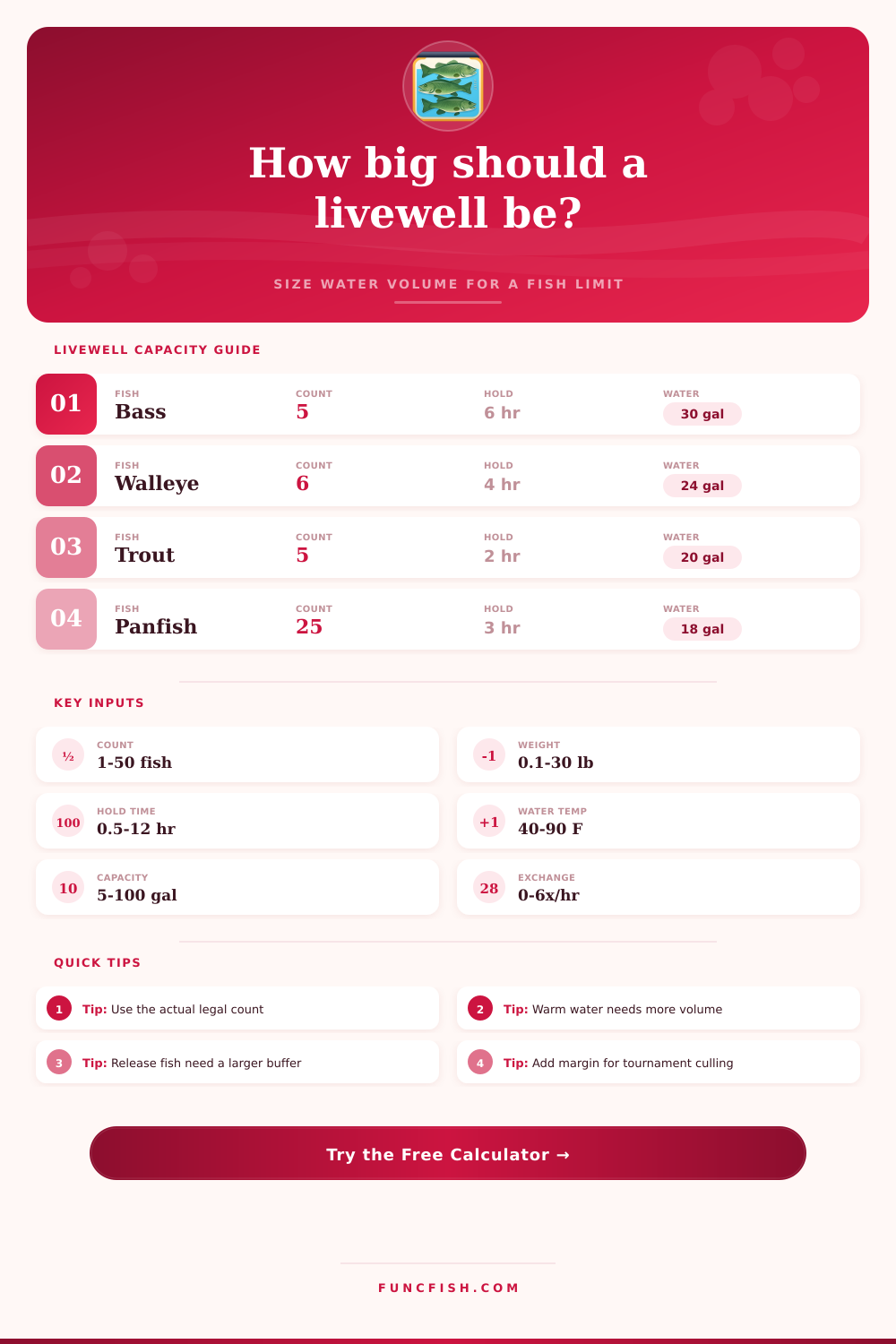
Tip: Enter the fish count you actually need to hold, then choose the stricter live-release setting when fish must stay in strong condition.
Tip: Warm water, long hold times, weak exchange, and divided wells all raise the required volume even when the fish count stays the same.
A livewell is a container that is used to hold fishes in water, and it must be sized correct in order to ensure that the fish remain healthy during the trip. If the livewell contain too little water, the fish will crowd one another, and the wastes from the fish will quickly build up in the livewell. Conversely, if the livewell contains too much water, the extra weight will be a burden on the boat.
Each of these factor must be considered when determining the appropriate size of the livewell, including the number of fish to be held, the water temperature to be contain within the livewell, the length of time that the fish must remain within the livewell, and the level of aeration provide to the livewell. Many people chooses the size of their livewell based off the legal limit of fish of that specific species. However, choosing the size of a livewell based upon legal limits may not provide for the fish the amount of oxygen that are required of them.
How to Choose the Right Livewell Size
For example, if an individual keeps five bass in their livewell at the same time that dawn arrives, it is possible that by the time it is late in the morning, the bass will no longer have enough oxygen within their livewell due to the increase in the temperature of the water. This calculator will help an angler to determine if their livewell is large enough to contain the fish that they plan to keep. Different species of fish requires different amounts of water to be contained within the livewell.
For instance, pike require more surface area within their livewell than catfish of the same weight due to the different body shapes of those two type of fish. Additionally, fish like trout often experience higher levels of stress than non-stress species like walleye at the same water temperatures, requiring more water per pound of fish than walleye require. These reference tables will allow an angler to determine how much water is required for each species of fish that they plan to keep.
The goal that an angler intends to use the livewell for may also impact the amount of water that is required within the livewell. For instance, if an angler is competing in a fish tournament, extra capacity are required for the livewell to ensure that the tournament fish have the strength to swim away from the fish livewell after they are released. However, if the goal of the livewell is to transport the fish to a cleaning table, a smaller volume of water is required.
An angler can select this goal on the calculator so that the calculator provides an appropriate output for this specific goal. Aeration and the exchange of water within the livewell also impact the amount of water that is required to be contained within the livewell. Water with a basic bubbler may be enough to provide the necessary oxygen for the fish when the water is cool, but not enough oxygen if the water is warm or if there is additional fish within the livewell.
If the livewell contains stronger spray bar or performs more water exchange through the livewell, less water is required to be contained within the livewell. The same amount of water may be adequate at one water exchange rate, but inadequately at a different rate. In addition to the factors mentioned above, there are also environmental factors that will impact the amount of oxygen that is provided within the livewell.
Factors like the wind, the amount of sun exposure that the livewell has while in the boat, and the opening of the lid to the livewell will reduce the amount of oxygen that is provided to the fish within the livewell. Anglers are often aware of these factors, and, therefore, account for them in their calculations for the size of the livewell; the margin settings on this tool will account for this extra variable for the angler. It is important for anglers to use this calculator to ensure that the livewell can hold the number of fish that they plan to keep.
By using this calculator, anglers will be aware whether they need to reduce the number of fish that they plan to keep in their livewell, increase the aeration within the livewell, or shorten the time in which the fish will remain within the livewell. By determining these factors before beginning to fish for the day, anglers can remove any guesswork in determining how many fish to keep in their livewell.