Loop Rig Length Calculator
Calculate loop rig cut length from finished hooklink length, bait hair loop, top loop, knot take-up, material stiffness, lead weight, bottom type, and trimming reserve.
📌Loop Rig Presets
⚙Rig Length Inputs
Your loop rig length result will appear here.
Length Breakdown
🧵Hooklink Material Data
📏Loop Rig Reference Tables
| Loop rig type | Typical finished length | Top loop inside length | Hair loop range | Best use |
|---|---|---|---|---|
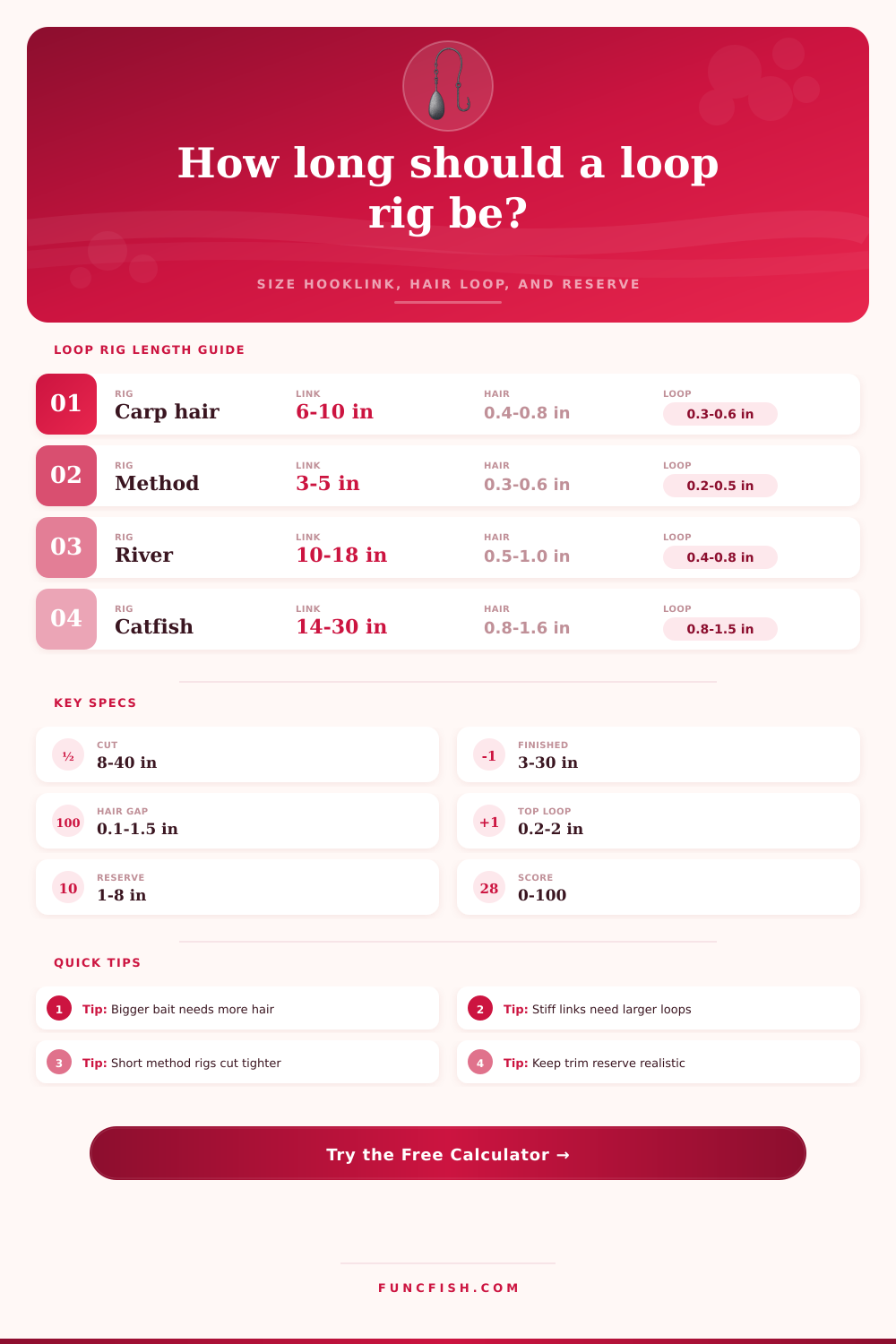
| Short method feeder | 3 to 5 in / 8 to 13 cm | 0.25 to 0.45 in / 0.6 to 1.1 cm | 0.2 to 0.5 in / 0.5 to 1.3 cm | Compact presentation, pellets, wafters, and method balls. |
| Standard carp hair loop | 6 to 10 in / 15 to 25 cm | 0.4 to 0.8 in / 1.0 to 2.0 cm | 0.3 to 0.7 in / 0.8 to 1.8 cm | Boilies, corn, balanced baits, and most stillwater rigs. |
| River loop hooklink | 10 to 18 in / 25 to 46 cm | 0.5 to 1.0 in / 1.3 to 2.5 cm | 0.4 to 0.9 in / 1.0 to 2.3 cm | Barbel, chub, current, and rolling leads. |
| Heavy bait loop trace | 14 to 30 in / 36 to 76 cm | 0.8 to 1.8 in / 2.0 to 4.6 cm | 0.7 to 1.8 in / 1.8 to 4.6 cm | Catfish, cut bait, surf bait, and larger hooks. |
| Knot or loop finish | Material take-up | Loop behavior | Useful range | Calculator adjustment |
|---|---|---|---|---|
| Figure-eight loop | Moderate | Strong, compact, easy to repeat | Braid, coated braid, mono | Adds balanced knot allowance and low bulk penalty. |
| Perfection loop | Moderate-high | Straight pull and neat top connection | Mono and fluorocarbon | Adds extra loop take-up for stiff material. |
| Surgeon's loop | High | Fast, reliable, slightly bulky | Mono, braid, light fluorocarbon | Raises cut length and bulk penalty. |
| Crimped loop sleeve | Fixed sleeve allowance | Clean loop radius for wire or heavy mono | Wire, heavy mono, surf traces | Adds sleeve length and improves score on wire. |
| Target group | Practical finished length | Common bait loop | Material tendency | Rig note |
|---|---|---|---|---|
| Carp and buffalo | 6 to 10 in / 15 to 25 cm | 0.3 to 0.7 in / 0.8 to 1.8 cm | Coated braid or combi | Keep the hair gap visible when using bottom baits. |
| Tench and bream | 4 to 8 in / 10 to 20 cm | 0.2 to 0.5 in / 0.5 to 1.3 cm | Supple braid or light mono | Short loops help tiny baits sit close to the hook. |
| Barbel and chub | 10 to 18 in / 25 to 46 cm | 0.4 to 0.9 in / 1.0 to 2.3 cm | Coated braid or mono | Current often rewards a longer, more settled hooklink. |
| Catfish and surf bait | 14 to 30 in / 36 to 76 cm | 0.7 to 1.8 in / 1.8 to 4.6 cm | Heavy mono, wire, or coated braid | Large bait stacks need reserve for knots and stop loops. |
💡Calculation Notes
Cut length: The calculator adds finished hooklink length, top loop fold, bait hair loop, hook knot allowance, main loop knot take-up, and trimming reserve.
Tangle margin: Short supple links and heavy bait stacks score lower unless the rig has enough stiffness, stripped section control, and loop clearance.
Measurements are rig-building estimates. Wet knots, line diameter, coating thickness, and how tightly each loop is dressed can shift final length slightly.
We all know hooklines are measured far less often then bait flavors are debated. But as usual, the length of the line typically make or breaks whether we get a bite or our line gets tangled. If your loop rig is too short, it acts like a stiff stick that keeps your bait stuck in place and makes it hard to feel subtle bites. Too-long, well, it turns into a bird’s nest in the lead clip. And wraps up on itself before reaching bottom.
Just enter the target species and material type, and the calculator does the math for you. So don’t just guess how much line dissapears into folds and knots. But really it’s all about how to measure something versus what you’re measuring. An eight inch hooklink means you visualize total length from hook eye to swivel once it is finished. However, that isn’t the actual amount of line you remove from spool. There’s that little bit extra for your knot at the hook. There is the length of the top loop connecting to your lead system. Then there’s that other loop holding the bait in the hair. Finally, there’s that additional bit you leave on in case you mess up a tie. It adds up quick.
How to Choose the Right Hooklink Length
This all comes down to material stiffness. A flexible braided line have great drape; it’s like silk. But with too much looseness/length in the loop it will wrap. And fluorocarbon is stiff and has memory; it wants to return to the shape it came off the spool in. Use too stiff of material, don’t compensate for its resistance and your hair loop won’t lie flat on hook shank; it’ll act like an antenna. The tool starts by asking for material type first as it then sets the minimum needed inside length of your loops to accommodate that material in order for them to lay naturaly vs. Fighting against the physics of the line.
Consider what the location is: On a clean silt bed, a short method rig keep the bait right under the fish’s nose. A long rig gives you room to get the bait off the lead while swinging it into position. This is helpful on a current-carrying river with rolling stone cover to prevent snags. This is why most barbel river rigs will be twice as long than regular carp rigs (as displayed well in the table on the page), so the bait has length to swing away from the lead and avoid snagging. That length doesn’t just keep lines apart but reduces tangles in heavy cover too. This gives the line more space to settle without wrapping around mainline.
Another quiet hook-up killer is hair gaps. Another quiet hook-up killer is hair gaps. When your bait is positioned too near the bottom of the hook bend (i.e. Big pellets or boilies), the fish can feel the obstruction and spit it out. Big pellets or boilies), it’s going to block the fish’s view of the food and cause them to spit. Ideally there should be a small gap between your bait and the hook bend, typically only a couple millimeters, giving the fish plenty of opportunity to engulf the bait before sensing the metal. By entering the loop length and bait diameter into the calculator, you’ll know precisely how much distance you’re leaving between the hook point and the food. It seems insignificant until you’re looking at an empty net and wonder what happened to the bite that was just short.
A note about knots: They eat more line than folks imagine. Sure, a well-dressed perfection loop or even a surgeon’s loop will gobble up extra inches compared to a figure-eight loop. But those loops get tight and small when left to soak in water, so if you didn’t leave yourself a fair amount of margin in the build-up stage, your loop size would of gone out of spec as time passes. Trimming reserve on your cut length helps prevent that. Yes, you’ll end up trimming down maybe half an inch after tying… but it ensures the rig isn’t now too short by two inches because the knot gobbled up your margin.
The bottom line of this whole loop rig thing is: Balance. You need enough stiffness to prevent the hooklink from rolling up in a ball, but enough give to allow the bait to present naturaly. The trick with the cut length is that once it is finished, it will act the way you want it to. Measure twice, tie once and let the math take care of things you can’t see till it’s too late.