Lure Box Slot Count Calculator
Estimate how many tackle box slots and trays your lures need after accounting for lure profile, hook separation, spare capacity, divider loss, and wet-lure parking space.
🎣Trip and lure presets
⚙Slot planning inputs
Calculated lure box plan
Formula breakdown
📦Box layout data used by the calculator
Compact tray for micro hard baits, small spoons, ice jigs, and bank packs.
Common kayak and wading size with moderate slot depth and flexible dividers.
Large day-box footprint for bass, walleye, and inshore lure rotations.
Fewer but taller compartments for crankbaits, bulky jigs, and topwater plugs.
🐟Gear and species comparison grid
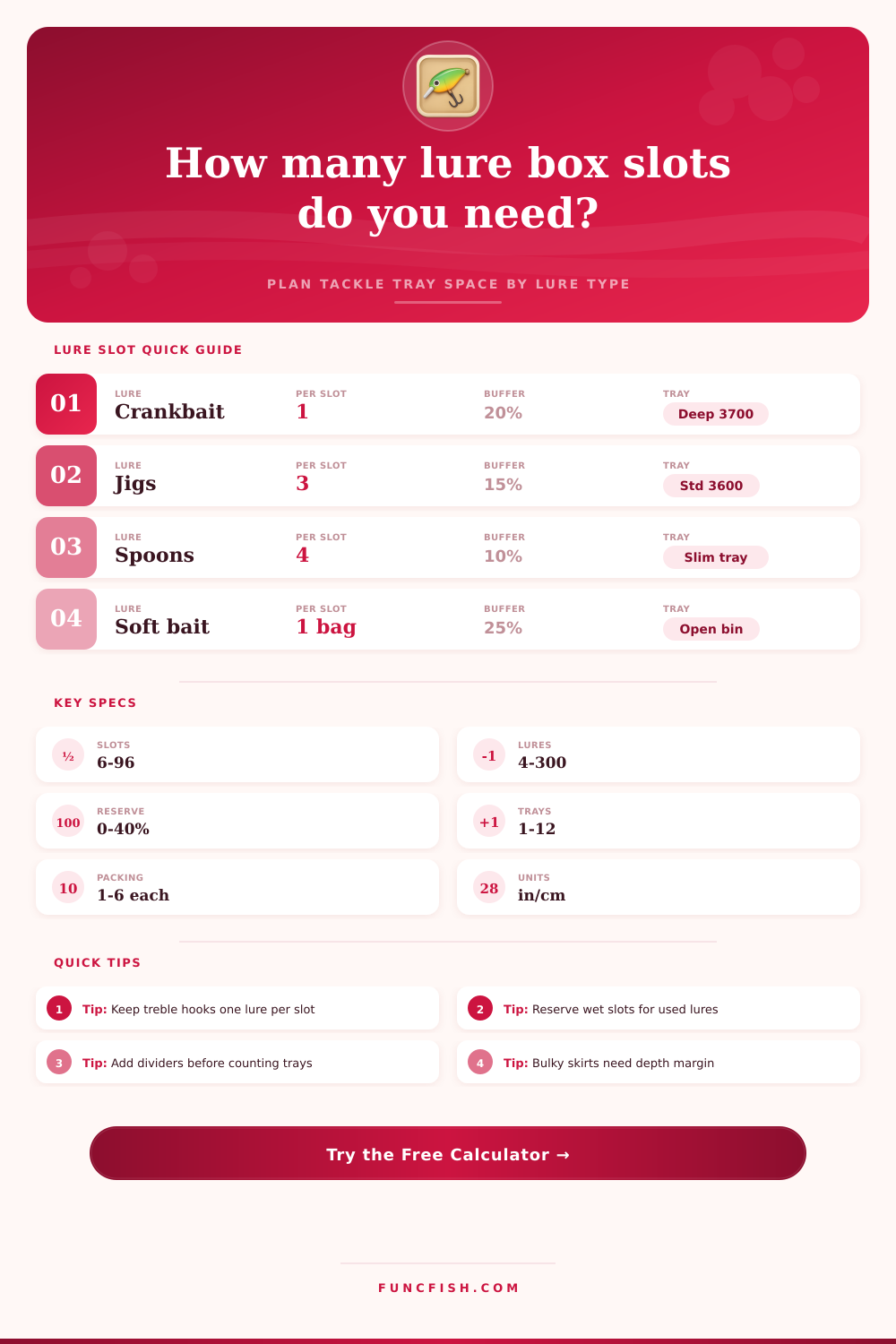
Use one treble bait per slot in a deep or standard 3700 tray for fast color changes.
Small spoons and spinners can stack when finishes are separated by sleeves or foam.
Round-head jigs group well by weight and color if hooks are aligned point-down.
Oversize glides, bucktails, and big topwaters often consume two standard slots each.
📊Reference tables
| Lure profile | Base packing | Length sensitivity | Slot planning note |
|---|---|---|---|
| Crankbait or jerkbait with trebles | 1 lure per slot | High above 4 in / 10 cm | Bills and trebles snag dividers, so spare room is more useful than stacking. |
| Jigs, chatterbaits, or bladed jigs | 2 to 4 per slot | Medium with skirt bulk | Group by head weight, then reserve extra depth for skirts and blades. |
| Spoons and inline spinners | 3 to 6 per slot | Low to medium | Thin metal lures pack tightly when finishes are protected from rubbing. |
| Soft plastic bags or rigged packs | 1 bag per slot | Medium above 5 in / 13 cm | Count original bags as packs; avoid mixing soft plastics with bare hard baits. |
| Spinnerbait or buzzbait | 1 to 2 per slot | High with wire arms | Wire frames waste rectangular tray volume, especially in shallow boxes. |
| Streamers, flies, or small jigs | 4 to 8 per slot | Low | Foam, sleeves, and wallet pages often beat hard dividers for tiny profiles. |
| Box layout | Usable slots | Longest practical slot | Best fit |
|---|---|---|---|
| Thin 3500 utility tray | 12 after divider loss | 3.8 in / 9.7 cm | Micro cranks, panfish jigs, small spoons, compact bank kits. |
| Standard 3600 utility tray | 18 after divider loss | 5.4 in / 13.7 cm | Kayak bass, trout, walleye, and mixed small hard-bait boxes. |
| Standard 3700 utility tray | 24 after divider loss | 7.0 in / 17.8 cm | Boat day boxes, large crankbait runs, jig and spoon sorting. |
| Deep 3700 lure tray | 16 after divider loss | 7.5 in / 19.1 cm | Deep crankbaits, topwaters, dressed trebles, and bulky spinnerbaits. |
| Binder sleeve or fly wallet | 30 pockets or rows | 4.5 in / 11.4 cm | Flies, trout spoons, thin plastics, feathered jigs, and backup colors. |
| Surf plug roll or tube insert | 10 tubes | 8.5 in / 21.6 cm | Metal lips, pencils, darters, tins, bucktails, and wet plug staging. |
| Species group | Typical lure mix | Suggested reserve | Access priority |
|---|---|---|---|
| Bass | Crankbaits, jigs, topwaters, spinnerbaits, soft plastics | 18% to 25% | Fast color and depth changes matter more than maximum density. |
| Trout | Spoons, inline spinners, micro jigs, streamers | 10% to 18% | Small lures pack well, but finishes need scratch separation. |
| Walleye | Jigs, blade baits, shallow cranks, crawler harnesses | 15% to 22% | Weight sorting and hook alignment make the box faster to scan. |
| Pike and musky | Glide baits, big spoons, bucktails, large topwaters | 25% to 35% | Oversize hooks and bodies demand length and depth more than slot count. |
| Inshore saltwater | Paddletails, jig heads, plugs, spoons, shrimp imitations | 20% to 30% | Rinse spacing prevents wet lures from contaminating dry compartments. |
| Surf species | Plugs, tins, bucktails, teaser rigs, soft bait packs | 20% to 35% | Wet plug staging and tube length often control the final count. |
| Adjustment | Slot multiplier | When to use | Calculator effect |
|---|---|---|---|
| No covers, hooks can touch | 1.00 | Single hooks, practice boxes, or low-value bulk lures | Keeps the base packing rate unchanged. |
| Light covers or single hooks | 1.08 | Jig boxes, spoons with sleeves, or protected hook points | Adds a small amount of spacing for faster removal. |
| Standard treble covers | 1.18 | Most crankbait, jerkbait, and topwater tray layouts | Increases required slots before reserve is applied. |
| Strict no-tangle separation | 1.35 | Tournament boxes and expensive hard-bait storage | Prioritizes retrieval speed over dense packing. |
| Saltwater rinse spacing | 1.28 | Inshore, surf, kayak, or wet-return lure trays | Leaves more air gap and wet parking capacity. |
💡Slot planning tips
Treble-hook hard baits should usually be counted as one lure per slot, even if two physically fit, because tangled hooks slow lure changes and damage finishes.
A lure box that is filled to the last compartment has no room for wet returns, broken hooks, color swaps, or the lure you cut off between spots.
Remember that point in the day where your tackle system start to get in the way? For most people it’s roughly forty minutes after the start of their morning bite. You can’t find your favorite crankbait because there is three treble hooks tangled together on one side of box like a ball of twisted metal. You waste five minutes trying to untangle the mess while fish relocate to new cover.
Why did this frustration occur? This happened because you didn’t consider physical space required before leaving dock. Most anglers count lures, not slots. Most anglers assume that if they own twenty jigs, they needs twenty slots. You didn’t consider how thick a box divider is, the fact that some baits won’t fit well with others, or inevitable wet return from each cast.
How to Organize Your Tackle Box
Once you know the type of box style and lure profile, the calculator do all the work for you (above). You don’t have to guess how many compartment can hold which lures. Knowing what it’s asking for in real terms is where most people get tripped up, though. Like if you’re storing crankbaits and pick a deep tray, it’s because you need vertical space for those crankbait bills, too, not just length in the shallow tray. Long jerkbaits won’t fit well in shallow trays, either; they’ll be crooked, or you’ll try to use dividers that snap off when you try to store them.
Slow = No Bites. That’s why the tool uses an effective packing rate. This rate take into account whether you want a true no-tangle divide or just standard covers. Hooks are deceptively bulky A jig may seem tiny, yet it has a hook point sticking way past the width of its body. Stacking three jigs in one slot, if not aligned correctly, will result in snags slowing each following swap.
On the page, there’s a reference table listing these stacking ratios based off lure shapes so it’s easy to see why a rigid and flat spoon can stack very closely together whereas a spinnerbait with wire arms wastes volume inside a rectangular tray. Like me, you probably want to get as many lures in your trays as possible while still keeping them accessible because that makes all the difference.
The second place intuition lets us down is in reserving space. Having more slots can’t hurt, right? When we actualy fish from a loaded box, we find having fewer slots make for fewer compromises. For instance, where do you put the wet lure? Where does the color change go? Or what about the lure with the busted hook that you need to replace quick while running and gunning?
Fifteen to twenty percent spare sounds like overkill until you’re hunkered in the rain and you have an open slot to stick your rinsed-off plug. Empty space isn’t wasted potential. It’s security from the mess real fishing gets you into. The calculator include reserve space for last few trays. This ensures you don’t end up with a box that works on paper but fails in person.
It all depends on the species targeted. A trout angler may have a box full of tiny spoons that pack tightly but require careful finish protection. A bass angler will rotate colors rapidly. They want many options within the same category of hard baits, which requires rapid access to many lures that look very similar. This is where the calculator come into play. It adjusts the demand for slots by considering both the species group and the lure profile.
For example, a panfish jig will take up less space then a pike bait. It knows this so it won’t suggest you should of buy too much of one size and not enough of another. So, the final verdict? Organizing tackle is all about flow. How can I get from thought to hand in the shortest distance possible? If my box layout reflect how I throw lures, then I look less and cast more.
It’s worth a little up front planning because it pays off in terms of the opportunities we catch versus the ones that get away. That’s what makes the entire system tick… The moment when you reach into the box and effortlessly extract the correct lure with no struggle at all.