Casting Lure Weight to Rod Rating Matcher
Compare total lure load, trailer weight, wind buffer, casting force, and line class against a rod lure rating window before you cast.
📌Scenario presets
⚙Rod and lure settings
Lure-to-rod match forecast
Full breakdown
📋Rod power reference grid
Ultralight
Light
Medium Light
Medium
Medium Heavy
Heavy
Extra Heavy
Surf Heavy
📏Rating and lure reference tables
| Rod rating band | Lure window | Metric equivalent | Typical line | Best casting load |
|---|---|---|---|---|
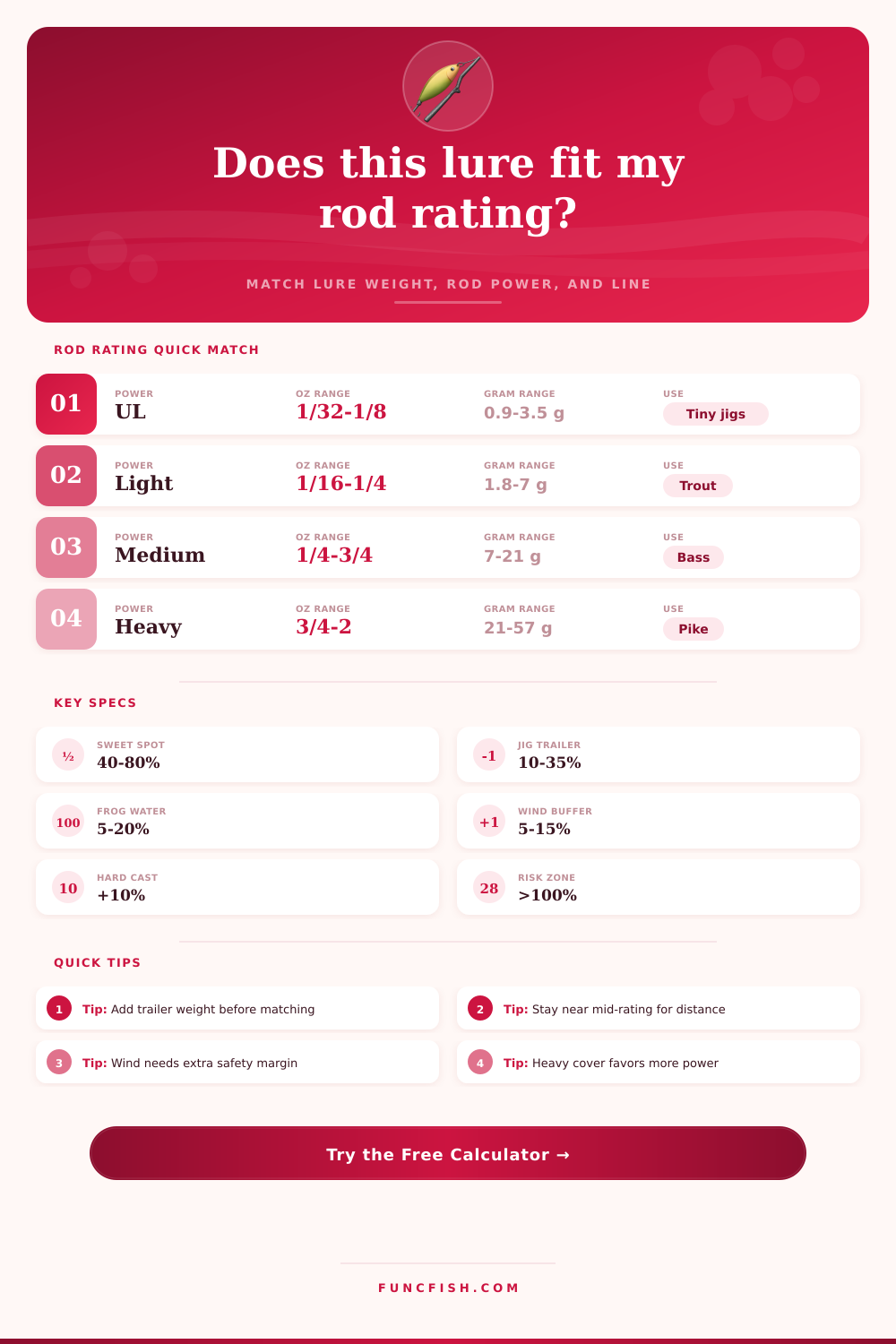
| Ultralight | 1/32-1/8 oz | 0.9-3.5 g | 2-6 lb | 1.6-3.0 g |
| Light | 1/16-1/4 oz | 1.8-7.1 g | 4-8 lb | 3.2-5.9 g |
| Medium light | 1/8-3/8 oz | 3.5-10.6 g | 6-10 lb | 5.7-9.2 g |
| Medium | 1/4-3/4 oz | 7.1-21.3 g | 8-14 lb | 12-18 g |
| Medium heavy | 3/8-1 oz | 10.6-28.3 g | 10-20 lb | 17-25 g |
| Heavy | 3/4-2 oz | 21.3-56.7 g | 15-30 lb | 34-50 g |
| Extra heavy | 1-4 oz | 28.3-113 g | 25-65 lb | 54-96 g |
| Surf heavy | 3-8 oz | 85-227 g | 20-50 lb | 130-205 g |
| Lure type | Added load factor | Air resistance | Hookset demand | Matching note |
|---|---|---|---|---|
| Ned rig / small jig | +6% | Low | Light | Often fishes best near lower mid-range |
| Jig with trailer | +18% | Medium | Firm | Trailer weight matters more than the head label |
| Spinnerbait | +12% | High | Medium | Blades pull harder than scale weight suggests |
| Crankbait / plug | +8% | Medium | Moderate | Treble hooks prefer some rod bend |
| Hollow frog | +20% | High | Heavy | Water in the body can overload light rods |
| Soft swimbait | +15% | Medium | Heavy | Use the rigged weight, not just package weight |
| Casting spoon | +3% | Low | Medium | Dense weight casts well near high mid-range |
| Weighted bait rig | +25% | Medium | Heavy | Include sinker, bait, swivel, and water load |
🎣Species and technique matching
| Species / target | Common casting weight | Rod class | Line window | Practical match |
|---|---|---|---|---|
| Panfish / crappie | 1/64-1/8 oz | UL-Light | 2-6 lb | Keep load light for small mouths |
| Trout streams | 1/32-1/4 oz | UL-Light | 2-8 lb | Spoons and spinners cast well at mid-rating |
| Walleye jigging | 1/8-1/2 oz | ML-Medium | 6-12 lb | Vertical work can use lower cast margin |
| Smallmouth bass | 1/8-5/8 oz | ML-Medium | 6-12 lb | Finesse rods dislike overloaded trailers |
| Largemouth bass | 1/4-1 oz | Medium-MH | 10-20 lb | Cover and hook gauge push the rod stronger |
| Inshore redfish | 1/4-1 oz | Medium-MH | 10-20 lb | Wind often requires a buffer above label weight |
| Striped bass | 3/4-3 oz | Heavy-Surf | 15-40 lb | Dense metals cast near upper mid-rating |
| Pike / muskie | 3/4-4 oz | Heavy-XH | 30-80 lb | Big hooks and leaders need more backbone |
| Rating use | Meaning | Casting feel | Risk |
|---|---|---|---|
| Below 0% | Under printed low rating | Rod may not load | Short casts and poor accuracy |
| 0-40% | Lower rating zone | Soft, low power loading | Good only for finesse control |
| 40-80% | Sweet spot | Clean load and release | Best balance for most casting |
| 80-100% | Upper rating zone | Deep rod loading | Smooth casts only, watch wind |
| Over 100% | Above printed high rating | Overloaded | Back off or use a stronger rod |
💡Practical checks
Tip: A printed lure rating usually assumes a smooth cast with a dry lure. Add trailer, bait, skirt, water, and hardware weight before judging the rod.
Tip: If the calculator shows upper-zone loading, use a smoother casting stroke or step up one rod power for wind, surf, or heavy cover.
Anglers as often experience a situation where a fishing lure feel too light or too heavy for the fishing rod that is being used. When fishing lures are too light, the cast will tend to land short on the desired target. Conversely, if the fishing lures are too heavy for the fishing rod, the tip of the fishing rod may bend too much during the cast.
The weight of fishing lures is more than just the number printed on the fishing lure package; the fishing lure trailer, the weight of the water contain within the skirt of the fishing lure, the force that is used to cast the fishing lure, and the weight range printed on the fishing rod all plays a role in the total load of the fishing lure. The rating for a fishing rod is the total amount of mass that the fishing rod will bend and release. However, beyond the fishing lure alone, additional component can increase the total weight of the fishing lure being used.
How to Match Lure Weight to Your Fishing Rod
For instance, adding a jig trailer to the fishing lure will increase its total weight. Additionally, using fishing lures with water within their skirts (like frog bodies) will also increase the total weight of the fishing lure being used. Thus, the total weight of the fishing lure is not as same as the weight printed on the fishing lure package.
The difference between the two is where many anglers makes errors in their fishing rod and fishing lure matching efforts. Wind will have an impact on the load that the fishing rod will experience with the fishing lure. On calm days, the fishing lure will travel according to it’s total weight.
However, if there is a crosswind, the fishing lure will experience increased air resistance that the fishing rod must overcome during the cast. The length of the fishing rod will also impact the total load on the fishing rod blank; the longer the fishing rod, the more stress the fishing lure will place upon the blank of the fishing rod. The type of fishing line that is used will also impact the load on the fishing rod.
For example, braided fishing lines will directly transmit the force of the fishing lure to the fishing rod; however, monofilament fishing lines will stretch and soften the load that the fishing rod experience. Additionally, if a heavy fishing leader is used (or if a wire fishing setup is used), the leader will add to the total weight that the fishing rod feel. Thus, these variable impact the total load that the fishing rod experiences, even though they are not accounted for on the fishing lure package.
The type of fish that is being targeted, as well as the type of cover in which the fish are located, may also impact the total ideal weight range for that fishing rod. Fishing rods that is constructed for finesse fishing will be lighter than fishing rods that are used in heavy cover, for example. If using a single-hook jig in areas with heavy cover, the load needs to be moved higher within the rating of the fishing rod; the fishing rod must be able to drive the hook into the caught fish.
Many anglers make mistakes with fishing rods and fishing lures when they dont consider the weight of the trailer for the fishing lure. For instance, many anglers do not consider that the high end of the fishing rod weight range is a limit that should of not been approached during windy condition. Additionally, many anglers do not consider that the wet fishing lures will add to the total weight of the fishing lure package.
These extra weight will increase the total load upon the fishing rod that must be accelerated to cast the fishing lure. It is recommended that anglers consider the fishing rod weight range as a working range for the fishing lures. For instance, the middle of the weight range will work best for most angler for most fishing scenarios.
The lower end of the range may be used for more delicate fishing scenarios, while the upper end of the range will be used for situations that require more power from the fishing rod. However, it is important to avoid using a fishing lure whose weight is above the high number printed for the fishing rod; using weights above the fishing rod rating will result in short cast with the fishing rod. The fishing rod will perform best within a specific zone for the total load of the fishing lure.
If the fishing rod loads smoothly with the fishing lure, and if the fishing lure begin to move smoothly without a kick from the fishing rod tip, the load of the fishing lure is within the proper range for that fishing rod. If the fishing rod tip remains flat, or if the angler finds it difficult to easily cast the fishing lure with the rod, the total load is too high for that rod. In such instances, the angler can change the weight of the fishing lure, or the angler can utilize a fishing rod with more power.
By ensuring that the load of the fishing lure is correct, the fishing rod will last more long when the angler utilizes it.