
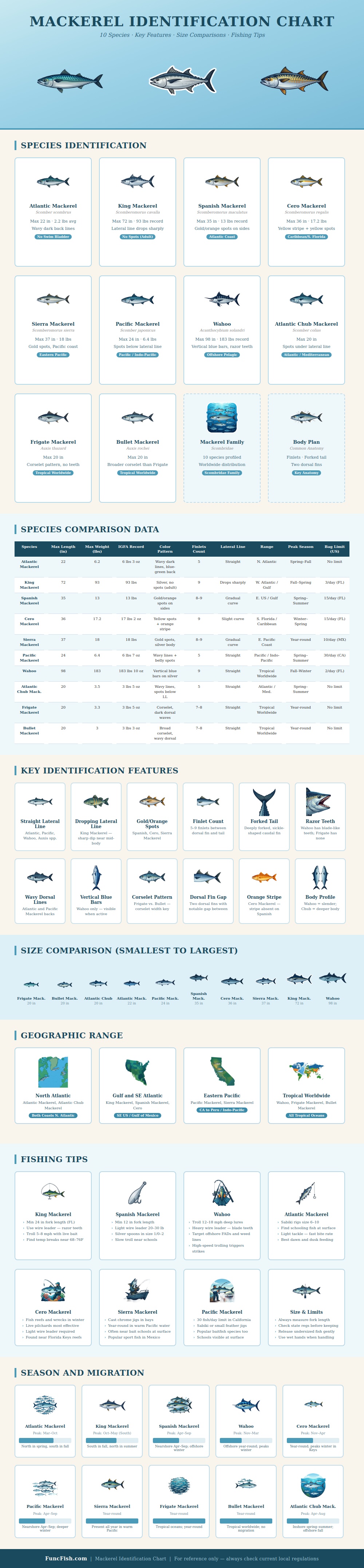
Mackerels are one of those families of fish which are recognizable to most anglers but hard to distinguish between different species. There’s a wide variety of them all over the place, running the gamut from small schooling fish to massive offshore beast. It can be easy to mistake a Wahoo for a barracuda because they have a similar shape, or a Spanish mackerel for a King if you’re fishing in Florida. You need to know what kind of fish you’ve caught because the species determines your tackle, bait, target depth, and even whether you can legally keep it.
These traits break down the species based on their best-known distinguishing features. Don’t fret about learning how many fins they have or what number and colors is on their scales; that won’t make you a better identifier. Just learn those useful features visible as fish comes to the surface.
How to Tell Different Mackerels Apart
First clue: look at that lateral line running along the fish’s side. Is it perfectly straight from head to tail? Chances are it’s either a Wahoo, a Pacific mackerel, or maybe an Atlantic. That sharp downward turn just past the pectoral fin followed by a rise towards the tail is a sure sign. It’s a King mackerel if that drop’s present.
Additional proof comes from the color pattern which can be deceptive based off lighting conditions and water clarity. When struck just right in the sun, the Atlantic mackerel’s back is covered with shiny wavy stripes like snakeskin, a beautiful sight. Because these fish aren’t very large, they make for good light-tackle fare; and they tend to be aggressive. Since they don’t have a swim bladder, an incorrectly iced or bled specimen will sink to the bottom after it dies. This characteristic makes speed crucial with Atlantic mackerel.
Opposite the Atlantic mackerel, the Spanish mackerel displays a metallic-silver belly with highly contrasting, bright orange and gold spotting along the sides and back. These fish is notorious for their toothy mouths and frantic runs. If your normal mono leader isn’t up to snuff, you’ll need to upgrade to wire because they’ll chew through it within seconds.
Before we head out on the water it’s good to know what to expect size wise. As you can see by the size comparison chart above, these fish come in many sizes. They range from a humble twenty-inch Frigate mackerel, common to tropical waters, to an almost eight-foot-long Wahoo that rules the offshore waters.
Sleek and elongated bodies is designed for speed with razor sharp teeth. A hit is both hard and fast. A lure must be pulled along at speeds that would seem overkill on most other species. Your rod should have plenty of backbone to handle sudden bursts of power without snapping under pressure.
Identifying Mackerel Species The geographic range determines what species you are likely to find. Northern waters is dominated by Atlantic mackerel in the spring and summertime. They migrate back out in the fall, followed by kings. As water cools down, those same macks head back south again.
In the Pacific, sierra mackerel hang around year round in the warm current up and down the coast of Mexico. On warmer days, they move a bit farther north to provide steady fishing action for boats working out of those areas. Understanding their preferred locations can save boatloads of time spent running down empty water.
Your fishing technique changes drastically different than your target species. Feeding along the surface in early morning or late evening hours, Atlantic mackerel fall to feather jigs or small Sabiki rigs. King mackerel demand a big live bait trolled around temperature breaks that form natural feeding highways. Wahoo seek out floating debris fields or weed lines to find something interesting, so they need deep divers pulled swiftly by them. The right setup, rod action, reel speed, and tackle; must align with the type of prey each predator hunts.
Lastly, there is seasonal timing. Even though many species follow water temperature changes more closely than calendar dates, they still occur at certain times of year. Nearshore Spanish mackerel will be present from the spring through fall as the water warms and then pull offshore again as the cool temps of autumn set in. On the opposite end of the spectrum, cero mackerel love those cooler winter months on reef structure. They ambush passing baitfish with surprising accuracy for their small stature. Knowing their movements lets you plan your trips for productive days instead of guessing at spots and hoping you find fish.
Even with effective ID work there’s more to it than just handling rules. Each jurisdiction and species has different bag limits, with some based on conservation concerns rather than what you want to do. Be sure to accurately measure (fork length) your fish before determining if it will meet a limit for keeping. By carefully returning any undersized fish, you help ensure healthy fish stocks so we can all continue to enjoy fishing well into the future. Beyond best practices regarding catch-and-release methods, proper care also means adhering to the resource management rules intended to keep marine environments healthy for generations to come.
Finally understanding mackerel is more about learning by seeing than knowing all the facts by heart. Pay close attention to their colors. Look for the shape of that lateral line. Think about how big or small they might be in your region. Match your tackle selection to these details. This will help you better identify which species just broke the surface once you get one to the boat.
Being able to see very slight variations between otherwise similar looking predatory fish is something the ocean repays if you are paying attention close enough to notice.