
So there you are hauling the fish aboard and it is big and swimming fast across the deck. Before the rules come into play or too much time have passed, you should of had an idea of what’s in your hands. Knowing the real size prevent guesswork. Having a good picture of how big a mahi mahi is in your head will help you know if it’s naturaly as big as you think.
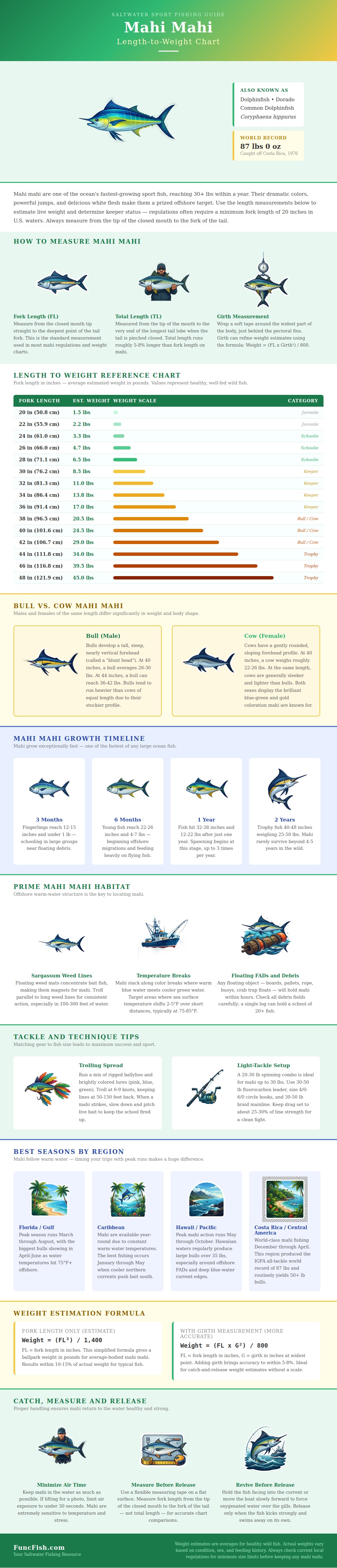
Most anglers overestimate weight because they mistake length for mass. They mistake length for mass. If you look at chart, you’ll find a 30″ fish isn’t what it seems and weigh closer to eight pounds rather than twenty. That change what you do in the moment and how you talk about it later.
How Big Are Mahi Mahi Fish?
Because mahi mahi grow rapidly, their size categories shifts very rapidly. A twenty inch juvenile will weigh a pound or two and it’s hardly worth filleting such small fish. Within six months, the same fish can double its length and quadruple its weight. At thirty two inches, those fish averages eleven pounds and make great keepers. They grow fast and don’t depend on memory from last year. The biology of these fish are to grow as fast as possible and die soon after; most do not live past four or five years. So when you catch one big one, it does feel special. Biology drives them to grow up quick so they can dies.
Weight is related to sex: Many casual fishermen don’t think about it, but weight is also related to sex. As males grows older, they become known as bulls due to their high forehead. Because they are generally stouter bodied, they’ll put on weight quicker then the females. For instance, a forty inch bull could easily be weighing almost thirty pounds while a cow of equal size would maybe be twenty five. That make a big impact when landing and fighting them. The added midsection mass allow the bulls to use more brute force. Knowing physical characteristic will change your tackle approach.
Finding them can be more about reading the sea surface than targeting depth range. Weedlines, floating debris and FADs create a magnet for both baitfish and aggressive predators. Sargassum mats; one of the main target areas identified in the graphic; offer structure for predator and cover for prey. Temperature breaks, the edges between warmer blue water and cooler green current, are key. Here’s where mahi stack up to ambush on drift by tides. Presentation means half of the battle is finding the place, and the other half is showing the bait.
Bright lures and rigged ballyhoo trolling at six to nine knots set off natural instincts to strike. Speed is important; mahi is visual hunters that react to flash and motion in open water.
If you intend on releasing your fish, then handling is equally important to catching. Mahi are unique among all saltwater fish in that their bodies cannot tolerate either stress hormones or sudden changes in temperature; air kills them quickly. Keep it wet, no more than 30 seconds of airtime, and hold it horizontally with its body supported so it can’t injure itself inside. Then revive and return to the water when the fish swims off under its own power. By doing this you will have a healthier population next time you go out.
When you know how big a mahi should be and how long they should stay heavy, fishing turn from a lottery ticket to an activity of observation. You begin to see the patterns, not just the fish. And that knowledge makes each hook set feel like an accomplishment, not luck.